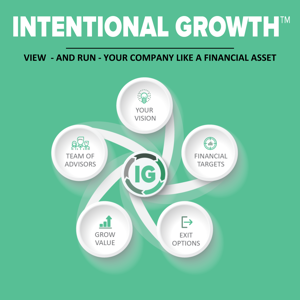
Intentional Growth

Intentional Growth

By Arkona - Intentional GrowthBusinessEntrepreneurshipInvestingManagement
Download on the App Store

Intentional Growth episodes

  • Leveraging the Digital World to Grow Business Value
    After selling his online publication with over 220,000 subscribers, Mark Daoust was approached by a friend also wanting to sell his business. This was the start of what would become Mark’s next adventure, Quiet Light Brokerage, has currently sold over $100M in online companies.
    If you listen, you will learn:
    What it means to be an online company
    The different types of online businesses
    How online businesses are valued
    How to increase the transferable value of your company
    The power of analytics online
    How a traditional business can leverage the internet
    Where It All Began
    Mark Daoust didn’t start out in the online business brokerage world. He first worked for an internet company in Maryland and made it through an extreme downsizing where he was then tasked with taking care of hundreds of clients.
    Through this experience, he learned a lot about working with online businesses and eventually started an online publication called Site Reference. Site Reference generated revenue through sponsorships of the newsletter as well as direct mailings to their list of contacts.
    [clickToTweet tweet=”“In the online world, if you have eyeballs..if you have an audience, you can make money.” ” quote=”“In the online world, if you have eyeballs..if you have an audience, you can make money.” ” theme=”style2″]
    Mark was admittedly a little naïve and sold Site Reference for less than what the company should have been worth if he would have made slight changes. It is hard to put a price on a company where he was the sole contributor to the business and all he had was a list of followers. Admittedly, his business lacked transferability.
    Making Your Business More Transferable & Valuable
    Mark now owns Quiet Light Brokerage which is in the emerging niche of selling and buying websites. He helps his clients with what he lacked in his previous business – how to make a business more transferable.
    In this podcast, Mark discusses four main things that will impact the value of a company.
    Risk
    Growth
    Transferability
    Documentation.
    Check out Mark’s Ultimate Guide to Website Value here: https://www.quietlightbrokerage.com/resource/website-value
    Marriage of Traditional and Online Business
    Quiet Light Brokerage works with different types of online companies including eCommerce, service based businesses, software as a service companies, content sites, subscriptions sites, and lead generation sites.
    Online companies are not just websites. Traditional brick and mortar businesses that have a company website are not online companies. According to Mark, traditional companies have the opportunity to grow their business in a way they haven’t before with leveraging the internet.
    “No one wants to talk to a salesperson. People don’t want to be sold. They want to make up their mind on their own.”
    The marriage of online and offline worlds is happening. Mark gives examples and elaborates on this point in the podcast. Business owners do not have to get rid of what they have developed offline but they will need to apply it to the online world to continue to be successful. There is only a ton of upside for their business.
    Contact Information and Bio for Mark:
    LinkedIn: https://www.linkedin.com/in/markdaoust/
    Twitter: @markdaoust
    Company Website: https://www.quietl
    55 min
  • Hunting the Next Best Venture
    When approached by an inventor with 7 patents for a new giant fake tree hunting blind, Clint Fiore went out on limb (a very lifelike tree limb) and quit his current job to raise capital, build a prototype, find an angel investor, manufacture, market, and sell what would eventually become Nature Blinds.
    If you listen, you will learn:
    The process of getting a start-up company going
    What it is like working with angel investors
    Opportunities and downfalls that may come with angel investments
    The trouble with valuing a start-up company
    How Clint sold ownership interest and exited his business
    How he leveraged his skills and migrated into buying and selling businesses in the middle market
    Nature Blinds Comes to Life
    Clint Fiore was an aviation specialist, pilot, and insurance salesman from Texas. He was a self-proclaimed business junkie but at this point in his life, was not a business owner and definitely not a hunter.
    “So here I am, this salesman for an insurance company who is reading business books and all of a sudden I get connected with this dreamer, inventor, artist guy who has patents and knows how to make cool looking stuff but doesn’t know how to do a business. I guess I read enough books by that point where I was like, you know what, I can do that.”
    Clint raised money for a prototype of the new age hunting blind which was basically a hyper realistic looking tree that hunters could hide in. He found an angel investor who saw opportunity in the Texas exotic hunting ranch market.
    Within a year, the company went from 6 to 50 employees, hit over 2 million dollars, and despite some bumps along the way, continued to grow.
    Valuing and Exiting Nature Blinds
    Being a minority owner of the company, Clint didn’t have control of the vision or direction of the company.
    The company started to succeed in more than just hunting blinds. They started selling smaller consumer products that had mass market appeal. Cash was thin because of earlier manufacturing issues so the angel investor, who had ownership in the company, was willing to invest millions more in the company. Great! The catch was that he wanted to be in the driving seat.
    “He who makes the gold, makes the rules.”
    Clint was given a buyout offer. This was personally rough for Clint as he helped to start the company and get it to where it was.
    Clint describes his buyout offer as “fair” but has a hard time putting a value on the start-up. They had millions of fans, were in 25+ states, had intellectual property, etc. How can you put a price on that?
    Texas Business Buyers
    After a forced exit from Nature Blinds, Clint searched for what he was going to do next. He owned, operated, and sold a technology start-up before looking to buy another business.
    Looking online was easy but getting a business broker to call you back was the hard part. He realized how disjointed the business brokerage industry was and wanted to change it. Texas Business Buyers emerged and put a new spin on the process.
    Listen and learn more about Clint’s journey and exit of his first company and the start of his newest venture, Texas Business Buyers.
    Contact Information and Bio for Clint:
    LinkedIn: https://www.linkedin.com/in/clintfiore/
    Twitter: @clintfiore
    Texas Business Buyers Website: https://texasbusi
    55 min
  • How to Sell an Online business
    Chris Yates owned and operated a digital marketing agency, chained to his desk day after day managing employees and client demands. After a call came in from an old employer looking to partner with Chris for his “next thing” after selling his own company, Chris’s life changed and the one he envisioned for himself started to emerge.
    If you listen, you will learn:
    The process of buying an online company
    The risks and opportunities of buying an online company
    How online companies are valued
    How online businesses are different from traditional business
    The 8 different types of online businesses
    Criteria (sniff-tests) to decide to buy or not to buy an online business
    Where to turn for analysis and advice on this process
    The Perfect Partnership
    Chris and his old employer, David, had differing skill sets that made for a perfect partnership. They had an idea to find online companies, acquire them, and take over their operations. These companies had to be the perfect balance of risk and opportunity to make the deal worth it. Within the first year of their partnership, Chris and David bought 10+ businesses and had triple digit annualized return on their money overall. This “work” and life was way more fun.
    Tips and Tricks
    From Chris’s perspective, the biggest myth or misconception that most people have is that “websites are different than real businesses.” You must treat an online business the same way you would treat a traditional business.
    Chris talks to us about the process of buying an online business, the due diligence that goes into the process, his personal recommended “sniff tests,” and other tips and tricks on how to figure out what to buy or where to even start looking.
    Entrepreneur Life Can Be Lonely
    Even though Chris started doing something he really enjoyed and was extremely good at, he was used to being around a company of people. He was not working in an office setting anymore where he could build relationships and friendships or even just have someone to bounce ideas off daily. He started to feel lonely and wanted to share his ideas, successes, and failures with people that would understand.
    Chris created a now annual event that brings together people who share experiences and knowledge on investing and buying online companies. His online businesses pay the bills but his passion is now this event that grows every year.
    Don’t Be Overwhelmed
    Chris leaves us with the comment that even if someone is looking to get into the business of buying online businesses, you don’t have to do it alone. Not only can you attend events such as the one Chris describes in our interview, but there are also lots of people that can help you with the technical aspects of the deal.
    Online business can be intimidating. He encourages entrepreneurs of all ages to explore this type of industry and don’t be afraid to bring in some help.
    There may be some (or a lot) of risk but also an extreme amount of opportunity online. Anyone can make it their passion just like Chris has done and there are communities of people to share in the experience.
    Contact Information and Bio for Chris:
    Website: https://www.chrisyates.org/
    Online Entrepreneurs Event Website : https://rhodiumweekend.com/
    Chris Yates is an entrepreneur who actively acquires and manages websites. In addition to buying and selling internet businesses, he also educates and coaches others to safely make money buying and selling websites. He is considered a website monetization expert and can ta
    1 hr 2 min
  • From Bankrupt to $270 Million Dollars

    From zero to $120+ Million in 6 years to bankruptcy, then to the cover of Inc. Magazine and the eventual sale for hundreds of millions of dollars, Norm Brodksy deserves every ounce of praise and money he received when he sold! The battle wounds of his first tragic business venture turned him into one of the wisest entrepreneurs I have ever encountered.

    The stories Norm shares with us are incredible! It was fascinating hearing him recount how he used his articles in Inc. Magazine to showcase his selling process with his potential buyers and then rejecting the offer at the last minute despite having appeared on the front page with the headline “Norm Says Yes”.

    Norm also shared with us some great real-life examples of how he made his companies so successful. Always to the point, it’s impossible not to be inspired by what Norm has to say.

    What are the lessons we can learn from Norm’s first business?

    Norm was crystal clear that even though there was a change in the marketplace and a variety of external factors, it was up to him to take responsibility and not to slip into the “Groundhog Day Syndrome” as he called it. His first piece of advice was:

    [clickToTweet tweet=”“If we blame others or outside forces for what happened, we’re destined to make the same mistakes over & over again.” ” quote=”“If we blame others or outside forces for what happened, we’re destined to make the same mistakes over and over again.”” theme=”style2″]

    3 key takeaways:
    1. If you want to expand your own empire, don’t pledge the assets from your cash cow to the new risky venture.
    2. Don’t get hung up on a sales revenue target. You want to build a profitable business, not just a high volume business.
    3. Build your business as if you’re going to keep it forever, but at the same time, build the business as if you need to sell it tomorrow. This looks like a contradiction but as you will see in the case of Norm’s second business, the culture you create with the “keep it forever” mentality is what actually makes the business more sellable.
    4. What was the main thing he did differently with his second business?

      The first (and most important) thing Norm did was take a look at who he is, what he wanted from his business, and why. At this point in his life as an entrepreneur, he decided the culture, vendors, and clients he worked with were the most valuable parts of a healthy and sustainable business.

      Bo Burlingham, the Editor at Large from Inc. Magazine, partnered with Norm on the column when he was selling CitiStorage. He also featured him in his book “Small Giants: Companies That Decide to Be Great Instead of Big“ because there were multiple times Norm had to decide whether he wanted to chase the revenue number again or maintain a profitable and healthy business.

      How does Norm define “company culture”?

      In short, it’s the way the employees are treated within the company. He viewed his employees more like being part of his family than just merely his workers. The best part is, by putting in effort and energy into his culture he was able to enjoy what he did and see the

      0 min
    5. From Bankrupt to $270 Million Dollars
      From zero to $120+ Million in 6 years to bankruptcy, then to the cover of Inc. Magazine and the eventual sale for hundreds of millions of dollars, Norm Brodksy deserves every ounce of praise and money he received when he sold! The battle wounds of his first tragic business venture turned him into one of the wisest entrepreneurs I have ever encountered.
      The stories Norm shares with us are incredible! It was fascinating hearing him recount how he used his articles in Inc. Magazine to showcase his selling process with his potential buyers and then rejecting the offer at the last minute despite having appeared on the front page with the headline “Norm Says Yes”.
      Norm also shared with us some great real-life examples of how he made his companies so successful. Always to the point, it’s impossible not to be inspired by what Norm has to say.
      What are the lessons we can learn from Norm’s first business?
      Norm was crystal clear that even though there was a change in the marketplace and a variety of external factors, it was up to him to take responsibility and not to slip into the “Groundhog Day Syndrome” as he called it. His first piece of advice was:
      [clickToTweet tweet=”“If we blame others or outside forces for what happened, we’re destined to make the same mistakes over & over again.” ” quote=”“If we blame others or outside forces for what happened, we’re destined to make the same mistakes over and over again.”” theme=”style2″]
      3 key takeaways:
      If you want to expand your own empire, don’t pledge the assets from your cash cow to the new risky venture.
      Don’t get hung up on a sales revenue target. You want to build a profitable business, not just a high volume business.
      Build your business as if you’re going to keep it forever, but at the same time, build the business as if you need to sell it tomorrow. This looks like a contradiction but as you will see in the case of Norm’s second business, the culture you create with the “keep it forever” mentality is what actually makes the business more sellable.
      What was the main thing he did differently with his second business?
      The first (and most important) thing Norm did was take a look at who he is, what he wanted from his business, and why. At this point in his life as an entrepreneur, he decided the culture, vendors, and clients he worked with were the most valuable parts of a healthy and sustainable business.
      Bo Burlingham, the Editor at Large from Inc. Magazine, partnered with Norm on the column when he was selling CitiStorage. He also featured him in his book “Small Giants: Companies That Decide to Be Great Instead of Big“ because there were multiple times Norm had to decide whether he wanted to chase the revenue number again or maintain a profitable and healthy business.
      How does Norm define “company culture”?
      In short, it’s the way the employees are treated within the company. He viewed his employees more like being part of his family than just merely his workers. The best part is, by putting in effort and energy into his culture he was able to enjoy what he did and see the
      1 hr 5 min
    6. Use Your Business to Change Lives

      This week we have a great story of someone that worked really hard to figure out who she was, what she wanted from her business and life, and why. Tana Green has done some exceptional things along her journey into her second half. She decided to use her current business as a platform to accomplish her life’s aspiration to change people’s lives.

      If you listen, you will learn…
      • How one person used her business to empower her and answer her calling in life
      • How Tana used her business as a platform to raise $10M for charity
      • The power of having access to a large workforce and contact base
      • How real change can happen on a large scale
      • Lloyd Reeb’s low-risk probes in action: the concept of trying meaningful and fulfilling pursuits until something sticks
      • The benefits of taking time out to evaluate your own mind
      • How to create a humane culture in your firm from the top down
      • The value of the Strength Finder system
      • The negative connotations of the term ‘CEO’ and how a ‘CLO’ could be the future of corporate governance
      • (more…)

        0 min
      • Use Your Business to Change Lives
        [et_pb_section bb_built=”1″][et_pb_row][et_pb_column type=”4_4″][et_pb_text]
        This week we have a great story of someone that worked really hard to figure out who she was, what she wanted from her business and life, and why. Tana Green has done some exceptional things along her journey into her second half. She decided to use her current business as a platform to accomplish her life’s aspiration to change people’s lives.
        If you listen, you will learn…
        How one person used her business to empower her and answer her calling in life
        How Tana used her business as a platform to raise $10M for charity
        The power of having access to a large workforce and contact base
        How real change can happen on a large scale
        Lloyd Reeb’s low-risk probes in action: the concept of trying meaningful and fulfilling pursuits until something sticks
        The benefits of taking time out to evaluate your own mind
        How to create a humane culture in your firm from the top down
        The value of the Strength Finder system
        The negative connotations of the term ‘CEO’ and how a ‘CLO’ could be the future of corporate governance
        Before figuring out what she wanted from her business and life, Tana would find herself breaking down in tears on Sunday night watching Extreme Makeover on TV. The stories were striking a chord deep inside and even though she was very successful in business, she couldn’t help but feel there was something missing… Tana originally thought she could only find fulfillment outside of the world of business but once she understood the massive platform her business offered her, the sky was the limit.
        Where was the turning point?
        Tana attended an event put on by her CPA firm. It just so happened that the keynote speaker was one of our friends, Lloyd Reeb, from the Halftime Institute.  After the event she met Lloyd for coffee and decided it was time for her and her husband/business partner, Mike, to get some next level coaching to help them figure out what was next.
        What did Tana do next?
        She determined that her passion was helping women stuck in domestic violence. Her personal experience pulled her to help people in need of an escape from abusive relationships.  But what did that mean? After some internal reflection and help from close friends and the Halftime Institute, Tana realized that her company could be used as a platform to magnify the impact she could make. She didn’t need to completely cut ties and sell the company to do what she wanted to do. Owning a company with thousands of employees and having influence in the community gave Tana amazing resources to serve the cause WHILE still keeping her company.
        How did she do it?
        Tana DID NOT DO the typical thing that entrepreneurs do after they come back from a conference. She did not walk back into the business and immediately bark orders on the new direction she was taking with her role. Tana wanted to help change people’s lives and that first started with mentoring and guiding her executive team. Getting her executives on board with the new vision was a slow but effective process. She gave them the resources they needed to become the next level team that would allow her to move into a different and more distant role. Everyone on her team first took their Strength Finders 2.0 to help guide the process. After the Strength Finders, Tana set up a monthly meeting to touch base with her team. She also wrote a book called Creating a World of Difference that she gives to eve
        50 min
      • Scale Your Company and Sell It

        We have a serious high achiever on the podcast this week – a man who managed to buy 11 companies (one in just three days) and sell his own $42 million company in just six weeks.

        After moving back home, Terry Lammers bought the family wholesale fuel and lubricants business. He became prolific in the marketplace by then buying up more and more of the competition. You will not find a man more experienced in the game of M & A…

        If you listen, you will learn…
        • Tricks to avoid nasty taxes in a sale
        • What you need in place to be able to sell a company in just six weeks
        • The benefits of recurring income
        • How Terry used the power of the Value Builder System without knowing it
        • How best to tell employees you’re selling up
        • How to use non-compete clauses
        • The importance of advisors
        • Where did Terry find the 11 competitors he bought along the way?

          Terry knew that in the limited area he did business, there was only a finite amount of competition and business to be had. He was always on the lookout for people that were trying to find a way out. Terry knew that once the competition was actually ready to sell, he had to jump on the opportunity.

          Some of the acquisitions were a bit more cumbersome and hairy (like the deal Terry explains went bad after the kind-hearted man went back on his word). However, most of the businesses that Terry bought had returns that the best of us could only dream of!

          How were most of the deals structured?

          Terry had a knack for knowing exactly what a business was worth to the seller and how to make it a great deal for both sides. He didn’t just let the professionals dictate the terms and conditions for the deal…he made a huge effort to make it a no-brainer for everyone.

          Some of the deals were bonus structures (earnouts), some were cash offers, some were stock purchases, and others were a combination. The only thing on Terry’s mind was to find a way to make a deal fair for everyone involved and get it done!

          What did Terry do differently because of his experience buying companies?

          After buying 11 other companies over the course of owning Tri-County Petroleum, Terry realized that things really needed to be buttoned up if a good deal was to be made. Following are some of the top things he did with intention before the sale of his company:

          • Signed agreements with all of his customers
          • Put in place non-compete clauses with key employees
          • Built out a high-caliber executive team that allowed him to focus on the business and not the day-to-day
          • Reviewed financials every year
          • Updated equipment
          • Leased equipment to clients to make them more sticky
          • Created a private label lubricant
          • What about the employees?

            Terry called everyone into a normal monthly meeting when he decided it was time to tell all of his employees about the sale of the company. There was no guarantee that a job was lined up for each employee under the new ownership…but the good news was that everyone was offered a job but one employee!

            The reason the one employee was not hired was they had an entitled attitude during the interview process with their new boss (weird how that didn’t go well!). All the employees were treated very fairly because the buyer decided who they wanted

            0 min
          • Scale Your Company and Sell It
            We have a serious high achiever on the podcast this week – a man who managed to buy 11 companies (one in just three days) and sell his own $42 million company in just six weeks.
            After moving back home, Terry Lammers bought the family wholesale fuel and lubricants business. He became prolific in the marketplace by then buying up more and more of the competition. You will not find a man more experienced in the game of M & A…
            If you listen, you will learn…
            Tricks to avoid nasty taxes in a sale
            What you need in place to be able to sell a company in just six weeks
            The benefits of recurring income
            How Terry used the power of the Value Builder System without knowing it
            How best to tell employees you’re selling up
            How to use non-compete clauses
            The importance of advisors
            Where did Terry find the 11 competitors he bought along the way?
            Terry knew that in the limited area he did business, there was only a finite amount of competition and business to be had. He was always on the lookout for people that were trying to find a way out. Terry knew that once the competition was actually ready to sell, he had to jump on the opportunity.
            Some of the acquisitions were a bit more cumbersome and hairy (like the deal Terry explains went bad after the kind-hearted man went back on his word). However, most of the businesses that Terry bought had returns that the best of us could only dream of!
            How were most of the deals structured?
            Terry had a knack for knowing exactly what a business was worth to the seller and how to make it a great deal for both sides. He didn’t just let the professionals dictate the terms and conditions for the deal…he made a huge effort to make it a no-brainer for everyone.
            Some of the deals were bonus structures (earnouts), some were cash offers, some were stock purchases, and others were a combination. The only thing on Terry’s mind was to find a way to make a deal fair for everyone involved and get it done!
            What did Terry do differently because of his experience buying companies?
            After buying 11 other companies over the course of owning Tri-County Petroleum, Terry realized that things really needed to be buttoned up if a good deal was to be made. Following are some of the top things he did with intention before the sale of his company:
            Signed agreements with all of his customers
            Put in place non-compete clauses with key employees
            Built out a high-caliber executive team that allowed him to focus on the business and not the day-to-day
            Reviewed financials every year
            Updated equipment
            Leased equipment to clients to make them more sticky
            Created a private label lubricant
            What about the employees?
            Terry called everyone into a normal monthly meeting when he decided it was time to tell all of his employees about the sale of the company. There was no guarantee that a job was lined up for each employee under the new ownership…but the good news was that everyone was offered a job but one employee!
            The reason the one employee was not hired was they had an entitled attitude during the interview process with their new boss (weird how that didn’t go well!). All the employees were treated very fairly because the buyer decided who they wanted to keep on the payroll. The fact that they hired all but one person showed that Terry had an amazing group of people working for him.
            What did Terry do after he sold?
            After selling the company, Terry sat at home for a few months watching The Mornin
            50 min
          • STOP and Reflect on What You Want

            He’s worked in sports management with the likes of Brett Favre, he bought and sold four businesses by the time he was 35, he’s done multiple M & As in his time as an investment banker, and now he’s a bestselling author (Networking is a Contact Sport, Moving the Needle), speaker and coach. He also loves the work of our recent guests Dean Niewolny and Lloyd Reeb over at the Halftime Institute.

            With that kind of background and experience you can probably guess, we were not exactly short of conversation! Listen to the show for some absolute gold advice about how to set yourself up for a fulfilling life after business, or read on for some of the highlights…

             How did Joe get started?

            The 8th in line of 8 older brothers, a negative net worth of $50,000 and a love for manufacturing, Joe had no doubts he was destined to be an entrepreneur. He went to the library and built his own database of manufacturing companies, pre internet, with the goal of calling all the owners to see where they were at. Joe’s main goal was to find someone that would be willing to take on a hard working, ambitious young man that would be willing to sell their company over time.

            After finding his perfect situation Joe did just that… and then acquired 3 more manufacturing companies before selling!

            What happened when he first sold his companies?

            He sold his companies at a relatively young age because he had 4 little kids at home and was starting to realize that he should reprioritize some things in his life.

            After Joe sold he got to work on his bucket list, i.e. single-digit golf handicap, running the Boston marathon etc. But soon it just wasn’t cutting it. In his words: “I thought I’d either have to create a new list or go back to work, or I’m gonna die!” That’s how he ended up in sports management, specializing in acquiring companies on behalf of sports stars.

            What has he learnt from the people he’s worked with?

            Most people don’t have any idea how to pause, call the whistle, and look at the replay.  How can you go onto to a life afterwards of passion and purpose if you have not assessed how you have played the game so far?  Having intention in the second half is hardest part!

            What he noticed about people who succeeded in their second half:

            Anyone who has successfully transitioned into their second half has taken time to reflect and take a look at who they are and what they really want. In the first half, we are busy working to create a stable household and to provide for our family. Many people measure success on the things we can see, i.e. flash cars, big houses etc., and this is more the domain of the first half. In the second half it’s more about things we don’t see, like respect, dignity and serving others. In the second half it’s about finding a purpose and having a life vision.

            Joe’s advice on how to measure your life after business:

            If your life turned out really great, what metrics would you use? Not enough people really define what success means. They can easily assume they’re unsuccessful, or on the flip side, aim for something they assume will make them successful; but it could all end in tears if they haven’t focused on what success really means to them.

            The questions Joe asks himself at the end of each day:
            1. What’s the best thing that happened today?
            2. What did I do today to create my ideal day?
            3. What am I most grateful for?
            4. What’s one new thing I learned today?
            5. What did I do today to make X dollars for my family?
            6. What did I do today to allow God to work through me?
            7. What am I looking most forward to tomorrow?
            8. Wise words for the road:

              “We find things that burn inside of us, and I think we’v

              0 min

            About Intentional Growth

            From the publisher's feed

            Intentional Growth™ is a podcast is a podcast for entrepreneurs and business owners wanting to view - and run - their company like a financial asset so they can have fun, create wealth, and make an impact. Truly make the entire journey of owning and running a company "worth it".