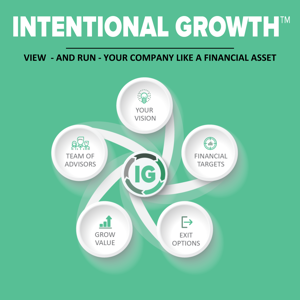
Intentional Growth

Intentional Growth

By Arkona - Intentional GrowthBusinessEntrepreneurshipInvestingManagement
Download on the App Store

Intentional Growth episodes

  • Getting Acquired by Google
    Mike Nunez founded AffiliateManager.com with his brother but always wanted to work for Channel Intelligence in Orlando. After a random encounter with the CEO of Channel Intelligence, he was called up to work for them. Six years later Channel Intelligence was acquired by Google for $125 million in an all-cash deal.
    Now Mike’s back growing AffilateManager.com into an industry leader by applying all the techniques he learned selling to Google.
    If you listen, you will learn:
    How a start-up company operates with the clear goal of acquisition
    The importance of taking advantage of networking opportunities
    What Google looks for when acquiring a company and how to align your business to be ready for an acquisition
    The importance of having a clear vision and initiatives in your business
    How Google handles acquisitions and the merging of employees
    Having a solid team of employees is everything
    Channel Intelligence
    Mike Nunez always wanted to work at Channel Intelligence in Orlando. They were a good company with a great reputation. Mark knew he couldn’t get hired there right out of college so built up his experience. He discovered affiliate marketing in college and ran a few different affiliate marketing programs at different companies as well as working on his own business.
    While networking at a conference, he met the CEO of the company he always wanted to pursue. Eight months later he was recruited to work for Channel Intelligence (CI). CI just received $15 million in funding so the company grew to around 150 employees in 2007, six years before they were acquired by the big guy, Google.
    Aligning with Google
    Channel Intelligence was a provider of technology to companies that enabled customers to buy their products online. They were active in over 30 countries working with over 850 retailers such as Best Buy and Target.
    Acquisition was always the goal at Channel Intelligence. The owners were very transparent about this. They never talked about going public or staying private. Every employee knew this and marched toward the same goal.
    In 2012, the CEO of Channel Intelligence left the company and the new CEO provided much needed focus. He helped align the company with Google and Google Shopping. They focused only on their “Where to Buy” feature on websites as well as feed syndication.
    Google soon came knocking after analyzing the company. Google had big goals for Google Shopping and wanted to acquire the company to be able to hit their goals quicker. It was a strategic acquisition and after some back and forth and due diligence, Google acquired CI for $125 million, 4X their gross revenue.
    “Everybody was very excited. We all felt like we were getting called home by the Mothership. We were all just super excited to be acquired by Google. Everybody gets to put Google on their resume,” says Mike.
    Life After Google
    Mike loved working for the Mothership but had more of entrepreneurial spirit. He wanted to change people’s lives and make more of a measurable impact. After 4 years with Google, he left to put more time into AfflilateManager.com.
    “The thing that us entrepreneurs want is that we want to feel like we are making an impact. In one year after the Google acquisition I sold more than Channel Intelligence had acquired in the 13 years prior. It was significant yet the impact on Google’s bottom line was the smallest of decimal points of percentages,” says Mike.
    Mike now works with medium sized businesses at AffiliateManager.com. Unlike Channel Intelligence and Google, he does not focus on the big fi
    52 min
  • The Perfect Exit
    Fresh out of college with the urging of his Dad, Tim Keran took over the daily operations and management of the family printing business, Western Graphics. He quickly grew the company from $3 million in revenue with 25 employees to $11 million with over 50 employees at its peak.
    If you listen, you will learn:
    How Tim used professional management techniques to run the family business
    Open-book management practices
    The benefits of a peer group
    Importance of improvement projects which hold all employees accountable
    The list of 6 key points Tim needed for the perfect sale of his company
    Importance of exit planning and a clear plan for your “second act”
    Family Business
    Tim watched his Dad start the family business from scratch and started working in it as a janitor in his teenage years. After a few more years and some more education, Tim started as a Controller out of college. Since his Dad was not the management type, he pushed Tim to take over as soon as he was ready.
    At 27-years-old he started to take over the operations of the company. With a background in accounting and obsession with learning different business practices, he brought in some professional managers to help run the company more like a business instead of like a family.
    “The journey there for me was the ability to take a small business kind of running ad hoc and putting it more in a professional model. I put some process behind some of the madness that happens in a small business,” says Tim.
    Tim bought the business from his Dad in 2001 and owned it for another 15 years. By the time he decided to sell, he had been in the business for 36 years.
    Deciding to Exit
    Tim built a great company culture as well as a profitable company. His management style was people and culture, then the numbers. He empowered his employees which motivated them to take ownership of improvement projects which helped the company run more effectively and efficiently.
    He loved being an entrepreneur but was more interested in business in general – growing a company and culture – versus the printing business. He wanted to work with business owners and help solve their business puzzles as he had done in his own company. Pushing 50-years-old he asked himself, “Am I ever going to do this?”
    It took him awhile to admit it but finally in a peer group setting he came to the conclusion, “I think I am going to sell Western.”
    Tim sat down with his Financial Advisor / CPA and drew up a list of friendly competitors to talk with about selling the company. They eventually realized their company with 8 million in sales was too small for a financial buyer to run it as a standalone business. They were going to be a “tuck in” to a larger company. Tim came to terms with this but had six main goals he wanted to accomplish with the sale which he talks about in the interview. These six things had to be met for him to feel good about the sale and where his employees were going.
    Second Act
    Knowing what he wanted to do in his “second act” helped get Tim through the emotional part of the exit. Some business owners do not plan for life after business which can leave them in a lonely spot after a sale. Tim had a passion to work with other business owners and knew this is what he wanted to do.
    “I knew what I wanted to do in my second act, I called it. Now I am helping other business owners build great businesses and hopefully a better life for them. My second act was really clear for me and I moved right
    52 min
  • Train Your Brain to Reach Peak Potential – Interview with Dr. Patrick Porter
    Dr. Patrick Porter is an entrepreneur, award-winning author, speaker, consultant, and the creator of BrainTap Technologies which uses technology to reformat how the mind works and thinks. Dr. Porter and his newest BrainTap technology helps people tap into their minds full potential through light, sound, and frequency.
    If you listen, you will learn:
    How to use technology for a meditation experience
    How technology can offset the stress overload that we encounter
    The four primary brain wave states
    How to retrain and refocus your entrepreneurial mind
    Not just what to think, but how to think
    How to train your brain to function at its highest peak potential
    Positive Changes
    At an early age, Dr. Porter had experience with meditation and relaxation techniques. His dad taught him the techniques using the Silva Relaxation Sound to work on his concentration and focus. Later in life Dr. Porter learned about Neuro-Linguistic Programming which was all about digitalization and relaxation. This lead to him creating his first business, Positive Changes.
    Positive Changes turned into one of the largest self-improvement franchises using mind-based technology. This made Dr. Porter a highly sought-after expert within the personal improvement industry. The company quickly grew when they implemented a training program of the brain technology. It continued to grow strongly until some bad hires were made and their decisions changed the course of the business.
    Dr. Porter decided to get out of the business and continued to receive a payout and royalties for the technology he created. The new management of Positive Changes eventually decided to stop paying him royalties and therefore ended up in a court battle with Dr. Porter. It ended in his favor and the company could not use his technology in any future sales so quickly fell apart.
    After his non-compete was over, Dr. Porter got back into the brain game with the urging of a friend travelling around and doing shows with the mind-based technology. This is where the idea of BrainTap Technologies was born.
    Training Your Brain
    “A lot of people think our brain is fixed. Our brain can change. You can literally retrain your brain. You can use technology, like the Brain Tap, to bring your brain back into balance and start getting the best life now instead of waiting for life to happen,” says Dr. Porter.
    There are four primary brain wave states and BrainTap helps you “tap into” these different states through light, sound, and vibration. It teaches you to go to these different brain wave frequencies, which depending on your goal and the program you choose, will help you relax or give you more energy.
    “We call it tai chi for the mind,” states Dr. Porter.
    Listen to the podcast to find out more on the different brain states and how BrainTap can change how you think.
    The Entrepreneurial Mind
    “The mindset of an entrepreneur is different than the mindset of an everyday worker. That’s why there are only so many people that are successful in business,” says Dr. Porter.
    Entrepreneurs tend to hit a burnout phase at some point. You work yourselves to the bone and cannot seem to shut it off at the end of the day. The brain gets stressed out and does not function at its highest peak at this point. When you can’t sleep because you are thinking too much about what to do or where to go next, you are missing a brain wave frequency called Theta which is the bridge between fears and frustrations and deep peaceful sleep. Again, BrainTap helps train your brain to move through these frequencies so you can learn how to relax or recharge your brain.
    “The greatest pharmacy on Earth is not on the corner, it is in between our ears. It
    55 min
  • Using an Exit to Fund Another Venture
    Dan Faggella founded a Brazilian Jiu-Jitsu Academy to pay for college and grad school which sparked the idea for his eCommerce business, Science of Skill. Science of Skill was created for the sole purpose of eventually selling it and using the exit money to fund an artificial intelligence market research company. He grew Science of Skill past $2 million in revenue, sold it in 2017, and TechEmergence was born completely funded by the exit.
    If you listen, you will learn:
    How recurring revenue helps the value of your business
    Importance of finding a marketing channel that ensures consistent profitability and growth
    Having key employees that can run the company without the owner can increase the value of the company and provide for a smoother transition/exit
    Importance of knowing how the processes of your company tie into growth and profit
    How to figure out and analyze the core metrics of your business
    Finding the right broker makes a ton of difference when selling a business
    Building Up Science of Skill
    Dan went from owning a physical Jiu-Jitsu gym to starting an eCommerce business. He started taping the Jiu-Jitsu seminars he was giving in person and putting them on the internet. He took the curriculum he used and studied himself and turned the videos, information, and skill development exercises into monthly subscription based lessons which would allow the company to have recurring revenue.
    “I had it impressed on me early on that recurring revenue is a good thing. Recurring revenue is going to help you sell for a higher margin. Recurring revenue is going to give you less nightmare than businesses that don’t have recurring revenue. The only reason I was able to sell that gym was because it was recurring so I think that lesson kind of traveled over. I transferred that to an online business model I could run from anywhere,” explains Dan.
    The Jiu-Jitsu videos and information quickly extended out into general self-defense and self-protection lessons which attracted a broader audience to Science of Skill making the company more diverse and valuable to a buyer.
    Starting With The End In Mind
    TechEmergence was always the goal at the end of the tunnel. Dan wanted to start a purpose led business in AI technology by growing and selling something highly profitable. He spent half his time giving Ted Talks, writing articles, and building a media business around artificial intelligence and spent the other half of his time selling self-defense materials on the internet.
    Dan wanted to sell Science of Skill quickly to fund his AI research company. He thought it would take a year or so and ultimately, it took over three years. He didn’t realize when founding the eCommerce business that it would be so difficult to sell.
    “I thought I am going to flip this bad boy and call it a day,” says Dan.
    Dan was under what he calls a “naïve belief” that he would be able to sell the company easily. In reality, he had to grow the company for four years before a bank would facilitate a seven-figure transaction. The banks required three years of tax returns and valuations.
    “Banks don’t like stuff that involve the internet,” says Dan.
    He did find a buyer who had previous experience in the eCommerce space with a bank that backed them. They purchased Science of Skill in early 2017. It was three years longer than what Dan originally planned and was anxious to get TechEmergence going on more of a full-time basis. 
    Lessons Learned
    Dan learned a lot throughout the process of starting and selling his eCommerce business. Not only shouldn’t you expect to sell a small
    53 min
  • Deciding to Sell and What Comes Next

    Mark Raderstorf is a Rehabilitation Psychologist by training and lifelong entrepreneur by choice. Mark was working at the University of Minnesota Medical School and decided to launch into private practice back in the 1980’s. He founded Behavioral Medical Interventions, Inc. (BMI), a disability management company and national provider of psychiatric and physical disability management services. For the next 15 years before selling the business, he helped people with injuries or disabilities in their emotional, psychological, or vocational adjustments.


    If you listen, you will learn:
    • How important referral relationships and reputation are to a service business
    • The impact key employees/shareholders have on the value of a company
    • The importance of having a coach/consultant during a company sale
    • How employees are the key asset in a service business sale
    • Having a plan for the sale of your company and your life after business can relieve stress and help with the adjustment
    • From Psychologist to Business Man

      Mark describes himself as a service-oriented individual. His passion for helping people was sparked by a traumatic event in his brother’s life. His older brother had a football related head injury and almost died from an aneurysm which dramatically changed the trajectory of his career. This experience was eye opening for Mark and he knew he wanted to help people in similar situations.

      Mark’s small private practice grew from Raderstorf and Associates to Behavioral Medical Interventions, Inc. when he was becoming too busy to handle the incoming business all on his own. He hired one person after another and the company continued to grow even through the financial downturn of 2009. The key to their success was a little bit of luck mixed with good relationships and reputation in the industry.


      Working on a Sale

      Mark took on more and more with the business which caused stress and worry. At the age of 50, he contemplated if he wanted to continue with the business for the rest of his life. He was spending more and more energy managing people and customers. He couldn’t “turn it off” at the end of the day and it was taking away from time with his wife and kids.

      “The business can just gobble you up if you let it. You gotta draw a line somewhere,” says Mark.

      Mark found himself spending less time impacting the daily lives of people which was why he went into psychology in the first place. He decided he wanted to do something different and figure out what his encore career was going to be.

      It took Mark two to three years to get his company ready to sell with the help of a CFO advisor. He brought in key employees to increase the value and marketability of the company. He tried to first sell to a private equity group but the deal went nowhere. He talks more about his experience in the podcast and what he learned throughout this process.

      Eventually Mark did sell to a partner, Crisis Care Network that later rebranded into R3 Continuum, whose services were a natural complement to BMI’s.


      What’s Next?

      Even though he could have stayed in the business and possible sold for more at a later stage, Mark does not regret the decision. It was his time to sell. The plan for Mark was to sell the business, take a sabbatical to Ecuador with his wife, and figure out what to do with the next stage of their lives.

      “The more time and energy you can spend on what’s next around the corner, the better the adjustment is going to be. It is really hard when you’re selling a business because all the focus is on getting business ready…It is important not to get too far down the road…It is impor

      0 min
    • Deciding to Sell and What Comes Next
      Mark Raderstorf is a Rehabilitation Psychologist by training and lifelong entrepreneur by choice. Mark was working at the University of Minnesota Medical School and decided to launch into private practice back in the 1980’s. He founded Behavioral Medical Interventions, Inc. (BMI), a disability management company and national provider of psychiatric and physical disability management services. For the next 15 years before selling the business, he helped people with injuries or disabilities in their emotional, psychological, or vocational adjustments.
      If you listen, you will learn:
      How important referral relationships and reputation are to a service business
      The impact key employees/shareholders have on the value of a company
      The importance of having a coach/consultant during a company sale
      How employees are the key asset in a service business sale
      Having a plan for the sale of your company and your life after business can relieve stress and help with the adjustment
      From Psychologist to Business Man
      Mark describes himself as a service-oriented individual. His passion for helping people was sparked by a traumatic event in his brother’s life. His older brother had a football related head injury and almost died from an aneurysm which dramatically changed the trajectory of his career. This experience was eye opening for Mark and he knew he wanted to help people in similar situations.
      Mark’s small private practice grew from Raderstorf and Associates to Behavioral Medical Interventions, Inc. when he was becoming too busy to handle the incoming business all on his own. He hired one person after another and the company continued to grow even through the financial downturn of 2009. The key to their success was a little bit of luck mixed with good relationships and reputation in the industry.
      Working on a Sale
      Mark took on more and more with the business which caused stress and worry. At the age of 50, he contemplated if he wanted to continue with the business for the rest of his life. He was spending more and more energy managing people and customers. He couldn’t “turn it off” at the end of the day and it was taking away from time with his wife and kids.
      “The business can just gobble you up if you let it. You gotta draw a line somewhere,” says Mark.
      Mark found himself spending less time impacting the daily lives of people which was why he went into psychology in the first place. He decided he wanted to do something different and figure out what his encore career was going to be.
      It took Mark two to three years to get his company ready to sell with the help of a CFO advisor. He brought in key employees to increase the value and marketability of the company. He tried to first sell to a private equity group but the deal went nowhere. He talks more about his experience in the podcast and what he learned throughout this process.
      Eventually Mark did sell to a partner, Crisis Care Network that later rebranded into R3 Continuum, whose services were a natural complement to BMI’s.
      What’s Next?
      Even though he could have stayed in the business and possible sold for more at a later stage, Mark does not regret the decision. It was his time to sell. The plan for Mark was to sell the business, take a sabbatical to Ecuador with his wife, and figure out what to do with the next stage of their lives.
      “The more time and energy you can spend on what’s next around the corner, the better the adjustment is going to be. It is really hard when you’re selling a business because all the focus is on getting business ready…It is important not to get too far down the road…It is impor
      44 min
    • 5 Bold Choices For You & Your Business
      Jay Coughlan, former CEO of Lawson Software, took the company public at $200 million and grew the revenue to $430 million. Besides CEO of Lawson Software, he is also known for other titles including former CEO of XRS Corporation, a father, a son, and a convicted felon. After a devastating accident, Jay spent time in jail and completely redefined his life.
      If you listen, you will learn: 
      The five bold choices to help you rise above your circumstances and redefine who you are
      How not to live “comfortably numb”
      How eliminating negative self-talk will make you more confident
      A quick three question debrief exercise to help turn failure into a learning opportunity
      The importance of knowing and performing activities that give you energy
      How to apply the five bold choices to your business and take some action
       
      The Accident
      Back in 1998, Jay and his father went out to a local hunt club and then a bar afterward. Jay drove drunk and ended up hitting at train at 60mph. Jay was devastated when he woke up in the hospital to find out that his father did not survive the accident. Before even leaving the hospital, Jay found faith. After receiving forgiveness from God and eventually from his entire family, he decided he wouldn’t let this low point in his life define who he was. He was a convicted felon and went on to serve a 6-month jail sentence but wasn’t going to be a victim of his circumstances.
      5 Bold Choices
      “Life is going to throw all of us a bunch of opportunities and a bunch of challenges. Those opportunities and challenges are going to demand a response,” says Jay.
      Jay’s response to his circumstance was to rise above and make choices that would help him be defined by something else, something better. He was being asked at speaking events how exactly he was able to do this which he describes in his book, “Five Bold Choices: Rise Above Your Circumstances and Redefine Your Life.” Jay created his current company, TruBalanced, and now consults business leaders and speaks at many events using these lessons he learned in his past and choices he made for his future.
      The five things, in addition to faith, that was driving Jay are listed below. He goes into these five things much more in depth in the podcast:
      Clarity: Keep the important things important
      Accountability: Take responsibility for your life journey
      Adaptability: Anticipating changes ensures growth
      Confidence: Keeping things in proper perspective
      Balance: Life is a marathon, not a sprint 
      Applying to Your Business
      You can apply the five bold choices to your business and be able to take action:
      Clarity: Business owners must have the clarity of knowing what is important, what is urgent, and what is not. Prioritizing is key. You can’t do everything.
      Accountability: There is a motivation in your accountability to do things with your family in addition to your business. The main thing about accountability is it’s about continuous learning. You have to learn from both your successes and failures.
      Adaptability: You must embrace change. “You need to embrace the ability to adapt versus fight it,” says Jay. If you are not thinking about where your company may go or even your “Life After Business,” you are not thinking through the realities of what is going to impact you and your family on an ongoing basis. If you don’t adapt, you
      50 min
    • Understanding Your Customer & Defining Progress

      Bob Moesta, current President and Cofounder of The ReWired Group, created the Jobs To Be Done Theory along with Harvard Business School Professor Clayton Christensen. The theory has successfully helped Moesta start, build, and sell several startups and launch over 3,500 products over the years. It is the main method used in his current occupation which helps business owners reevaluate their companies and drives them to really understand their customer to be a more profitable and valuable company.

      If you listen, you will learn:
      • What businesses are mistakenly doing that cost them customers and sales
      • How to use the Jobs To Be Done Theory to reevaluate your company
      • How to define progress and what that looks like to you
      • What causes people to make progress
      • How to frame your product or service as a solution to your customer
      • How context can create value
      • The Backstory and Theory

        From an early age, Bob Moesta always had a notion of questioning and wanting to know how things work. He always took apart things and put them back together. Because of his dyslexia, it made it hard for him to read and write but he learned by questioning and listening.

        He took this way of learning and his knack for product development and created the Jobs to Be Done Theory which is described in the book “Competing Against Luck” written by Clay Christiansen.

        “People don’t buy products or services, they hire them to do a job in their life,” Moesta explains in the podcast. When you ask people what they want out of a product or service, they usually have no clue. They know what their desired outcome is which is what a company must understand to be able to sell to them.

        Moesta goes into a business and intently interviews new, current, or previous customers about the company’s product or service. His goal is to find out what actually made them switch to or away from the product. What caused them to buy or choose a different product? What was their struggling moment that caused them to make progress? The Jobs to Be Done framework allows you to see the struggling moment leading to the customer’s purchase.


        Putting Theory into Practice

        After multiple customer interviews, business owners should be able to have an idea of what they should be focusing their business or messaging on. Some businesses need to completely reevaluate how they bring their products or services to market and may have to change their focus entirely.

        “You can sit in a conference room all day and guess what people will say,” says Moesta. Actually understanding why a customer purchases your product or service will help you position the product in a way that makes the consumer see you as a solution rather than just another product.

        “The moment that a customer or consumer struggles, they care about something and want something better. The more you find struggling moments and understand the progress they want to make, then you can design better products,” says Moesta. 

        You have to understand what causes people to value something over something else. This knowledge will not only make better products and drive revenue, but can help cut costs of marketing to the wrong people or in the wrong way.


        Value & Progress

        Bob’s main reason for doing what he does it to ultimately create value for companies. Bob and his team help businesses grow by understanding what their customers need in order to progress into a sale. The customer interviews conducted may result in a company having to change their offeri

        0 min
      • Understanding Your Customer & Defining Progress
        Bob Moesta, current President and Cofounder of The ReWired Group, created the Jobs To Be Done Theory along with Harvard Business School Professor Clayton Christensen. The theory has successfully helped Moesta start, build, and sell several startups and launch over 3,500 products over the years. It is the main method used in his current occupation which helps business owners reevaluate their companies and drives them to really understand their customer to be a more profitable and valuable company.
        If you listen, you will learn:
        What businesses are mistakenly doing that cost them customers and sales
        How to use the Jobs To Be Done Theory to reevaluate your company
        How to define progress and what that looks like to you
        What causes people to make progress
        How to frame your product or service as a solution to your customer
        How context can create value
        The Backstory and Theory
        From an early age, Bob Moesta always had a notion of questioning and wanting to know how things work. He always took apart things and put them back together. Because of his dyslexia, it made it hard for him to read and write but he learned by questioning and listening.
        He took this way of learning and his knack for product development and created the Jobs to Be Done Theory which is described in the book “Competing Against Luck” written by Clay Christiansen.
        “People don’t buy products or services, they hire them to do a job in their life,” Moesta explains in the podcast. When you ask people what they want out of a product or service, they usually have no clue. They know what their desired outcome is which is what a company must understand to be able to sell to them.
        Moesta goes into a business and intently interviews new, current, or previous customers about the company’s product or service. His goal is to find out what actually made them switch to or away from the product. What caused them to buy or choose a different product? What was their struggling moment that caused them to make progress? The Jobs to Be Done framework allows you to see the struggling moment leading to the customer’s purchase.
         
        Putting Theory into Practice
        After multiple customer interviews, business owners should be able to have an idea of what they should be focusing their business or messaging on. Some businesses need to completely reevaluate how they bring their products or services to market and may have to change their focus entirely.
        “You can sit in a conference room all day and guess what people will say,” says Moesta. Actually understanding why a customer purchases your product or service will help you position the product in a way that makes the consumer see you as a solution rather than just another product.
        “The moment that a customer or consumer struggles, they care about something and want something better. The more you find struggling moments and understand the progress they want to make, then you can design better products,” says Moesta. 
        You have to understand what causes people to value something over something else. This knowledge will not only make better products and drive revenue, but can help cut costs of marketing to the wrong people or in the wrong way.
         
        Value & Progress
        Bob’s main reason for doing what he does it to ultimately create value for companies. Bob and his team help businesses grow by understanding what their customers need in order to progress into a sale. The customer interviews conducted may result in a company having to change their offeri
        43 min
      • Pursuing Happiness in Life and Business

        Most people say that business isn’t personal, however if you’ve ever owned or currently run a private business, you know that statement is completely false… your business is a reflection of you and all your values. Your business and your life are inevitably intertwined.

        Marc Miller, Owner and Chief Happiness Officer at Imagine IT, has made happiness his life’s work after experiencing a tragic family event. Even though life threw him a very challenging curveball, he is on a mission to figure out “what it takes to be happy” even if it comes from an unlikely place.


        If you listen, you will learn:
        • How to keep running a business when you experience a family tragedy
        • Four principles of happiness
        • How to use your business to teach your values
        • How to make happiness actionable in the workplace

        • A Family Tragedy

          Over two years ago, Marc’s son, Gunnar, was in a fatal accident. Gunnar had issues with substance abuse and depression, but that is not what took his life. He was over 14 months sober and wiped out on a skateboard and died.

          After this tragic and devastating accident, Marc wanted to do something to honor his son. He started a non-profit, The Gunnar Project. He didn’t want to create another youth addiction non-profit so decided to go another route with it.

          “Gunnar had this unique ability to make people happy,” explains Marc. Marc decided to focus on the idea of happiness for the non-profit. The mission of the Gunnar Project is to inspire young adults and others to wake up every morning and pursue happiness. 


          What Makes Us Happy?

          Happiness is an intangible thing. It is a buzz word in our society today. Marc has read tons of books and research articles on happiness and outlines the four main principles of happiness in the podcast which can also be found on the Gunnar Project website:

          1. Healthy people find more happiness than those who are sick or unhealthy.
          2. People who learn, create, teach, grow are happier than those who are bored.
          3. People who are closely connected to others find happiness more than lonely people.
          4. People who are “good”, who have a relationship with a higher power are happier than those who are bad, who lie, cheat, and steal.
          5. Marc urges listeners to plan to intentionally do things every day that make you happy. Outline your day in the morning and avoid doing things throughout the day or talking to people that will make you crabby. Plan and choose to be happy.

            “The investment you have to make to be happy every day is a 3-minute investment. If you don’t have 3, 4, or 5 minutes in your day to pursue happiness, you are screwed.”

            People may think happiness is this big thing or event. It isn’t a milestone or pot at the end of the rainbow. In talking about happiness being more about the journey, not the goal, Marc says, “Happiness can be found in the little spaces in between the milestones, because that is where the action happens.” 


            Culture of Happiness

            Marc has created a culture of happiness at Imagine IT. After Gunnar died, Marc changed his title to Chief Happiness Officer to further his mission to drive happiness with everybody he meets day in and day out.

            Talking about happiness at work isn’t a “normal” thing in most companies. Imagine IT puts happiness at the forefront and therefore have a vocabulary around the subject which makes it easier for employees to talk about happiness.

            Happiness is actionable within Imagine IT’s culture. It is talked about in weekly

            0 min

          About Intentional Growth

          From the publisher's feed

          Intentional Growth™ is a podcast is a podcast for entrepreneurs and business owners wanting to view - and run - their company like a financial asset so they can have fun, create wealth, and make an impact. Truly make the entire journey of owning and running a company "worth it".