
Sign up to save your podcasts
Or

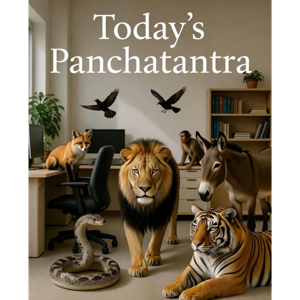


Wisdom Over Hastiness
Nearly 3,000 years later, the fable retains its relevance: solving one problem without considering long-term consequences may invite greater risks. Quick fixes, impulsive decisions, or unexamined interventions often generate new challenges.
For modern professionals and individuals alike:
Nearly 3,000 years later, this fable remains relevant. It teaches us that truth, coupled with intelligence, cannot be permanently defeated by deceit. While cunning may appear advantageous, morality aligned with clever strategy ensures justice and long-term success.
In modern life, both in offices and personal spheres:
When faced with life’s challenges, whether it’s office politics, personal betrayal, or moral dilemmas, remember: honesty, intelligence, and strategic action are your strongest allies. Just as Dharmabuddhi overcame Papabuddhi’s schemes, we too can navigate life’s complexities with courage, integrity, and wisdom.
A Timeless Lesson
The story from Panchatantra, an ancient wisdom collection of stories, of the Sun Bird/ needle-billed bird and the monkeys offers a timeless cautionary tale: good intentions alone do not ensure successful guidance. Wisdom must be coupled with discernment, patience, and respect for the autonomy of others. Whether in a corporate boardroom, a personal relationship, or a community setting, the principle holds:
In this podcast, though the story is simple, the narrative is profound in its teaching. It transcends age, culture, and circumstance, demonstrating that:
Ancient Wisdom teaches that even in leadership contexts, arrogance can be a blind spot. Leaders who overestimate their individual capability risk metaphorical “mud pits” of failure. Those who respect input, encourage collaboration, and remain adaptable cultivate environments where success is shared, sustainable, and resilient.
Intelligence can surpass raw power.
Unity amplifies effectiveness.
Humility and collaboration are strengths, not weaknesses.
One such story is that of The Three Fishes. On the surface, it looks like a small tale about survival in a lake. But when we expand it, the story is about leadership, planning, problem-solving, and the dangers of leaving everything to destiny. Let us dive into the detailed retelling of this story and uncover what it means for our modern lives—both in the corporate world and in our personal journeys.
The Panchatantra stories are not just simple tales for children; they are wisdom capsules wrapped in the form of engaging narratives. Written nearly 3000 years ago, these fables continue to be relevant because human behavior, challenges, and decision-making patterns remain unchanged across centuries. They show us how foresight, adaptability, and responsibility can save lives, careers, and relationships—while negligence, laziness, and blind reliance on fate can bring ruin.
One such story is that of the turtle and the two swans, where the turtle’s inability to control its tongue leads to a tragic downfall. Let us revisit this tale, unpack its meaning, and explore what it teaches us about the importance of restraint, discretion, and wisdom in both corporate and personal life.
Panchatantra stories, written nearly 3,000 years ago, repeatedly remind us of this timeless truth. These stories are not just bedtime tales for children. They are guidebooks for adults navigating the complex world of work, relationships, and leadership.
The story of the Tittibha birds and the mighty ocean is one such tale. Beyond its simple surface, it reveals deep truths about courage, arrogance, teamwork, and leadership. In this chapter, we will explore this story in detail, reflect on its relevance in the corporate world, and connect it with real-life experiences.
Panchatantra stories are often introduced to us as children’s fables. Parents, teachers, and grandparents use them to instill moral values, narrating tales where animals speak, act, and teach lessons. Yet, the richness of these stories is often missed in childhood. As adults, with the burden of responsibilities, office politics, and leadership dilemmas, we suddenly realize how profound these age-old stories are.
Today, we explore a story that teaches a vital lesson: associating with the wrong people and blindly trusting them can be dangerous. The forest in this story is not just a setting—it mirrors society, the workplace, and our social networks.
Panchatantra stories are far more than simple children’s tales. Written nearly 3,000 years ago, they offer timeless wisdom applicable to life, leadership, and human behavior. These fables, while entertaining, are deeply practical, showing us the consequences of choices, the perils of deception, and the value of prudence.
Panchatantra stories are more than simple children’s tales. Written nearly 3,000 years ago, they are timeless guides to human behavior, strategy, and morality. While entertaining, these stories offer profound lessons for both personal and professional life. Today, we explore a story that underscores a vital truth: disguising your true self, deceiving others, or relying on superficial appearances is ultimately dangerous.
Patience Over Haste: Lessons from the Leech and the Fly
Panchatantra stories are more than children’s tales; they are practical lessons for life. Written nearly 3,000 years ago, these fables remain relevant in both personal and professional spheres. They teach us about strategy, patience, foresight, and human behavior, often in ways that are far more nuanced than they appear at first glance.
Today, we explore a story that underscores the dangers of haste and the power of careful timing. It’s a lesson that applies equally to boardrooms, offices, and personal decision-making.
From the publisher's feed
Avadhanam is more than a podcast—it is an evolving space of mindful attention, inspired by the classical Indian art of Avadhanam, where the mind engages with multiple…
Staying true to its literal essence—focus, intellect, and multi-dimensional thinking—this channel brings together a wide spectrum of ideas, narratives, and reflections across life, society, and storytelling.
From the wisdom-driven narratives of “Today’s Panchatantra”, to thought-provoking explorations like “Directors Who Direct Us”, and many more upcoming series, Avadhanam is designed as a confluence of perspectives:
Each episode is an attempt to observe the world with attention, curiosity, and a touch of wit—staying rooted in tradition while engaging with modern realities.
Much like the art it draws inspiration from, Avadhanam invites you to listen, reflect, question, and connect the dots across diverse themes, because life, like Avadhanam, is not about one thread, but the harmony of many.