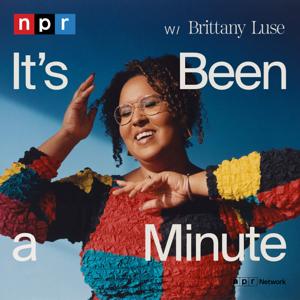
It's Been a Minute
Download on the App Store
  • Ranking

    13th

    on Spirituality

  • Favorites

    3,296

    Followers

  • Typical duration

    27 min

    per episode

  • If it hooks

    67%

    finish an episode

Based on Podcast App listening data

It's Been a Minute episodes

  • 'New Skin' and the botched quest for beauty
    What happens when you can't recognize your mom anymore?

    For Linli, the protagonist of the book New Skin, this is her reality: her mom Fanny has gone through so many back-alley plastic surgery procedures, Fanny’s face barely looks human anymore. When Fanny gets the opportunity to go on a reality TV show for the chance to fix her botched face, she jumps at it – and Linli tags along. But what happens when you can’t recognize your parent anymore? And what would achieving the perfect face really help?

    Brittany chats with author Sarah Wang about New Skin, immigration and intergenerational trauma, and our botched quests for beauty.

    For more episodes about parent relationships or beauty culture, check out:
    Why some families stop speaking
    The morbid lifelessness of modern beauty
    The beauty industry has an Epstein problem

    Support Public Media. Join NPR Plus.

    Follow Brittany on Instagram: @bmluse

    For handpicked podcast recommendations every week, subscribe to NPR’s Pod Club newsletter at npr.org/podclub.

    See pcm.adswizz.com for information about our collection and use of personal data for sponsorship and to manage your podcast sponsorship preferences.

    NPR Privacy Policy

    19 min
  • Why are tech bros embracing Psychedelics?
    Are psychedelics the next big thing?

    Psychedelics include the drugs LSD, magic mushrooms, peyote, and often ketamine and MDMA too, among others. And some of these drugs have a history of spiritual practice spanning millennia. Then many of these drugs became synonymous with hippies and 60s and 70s counterculture.  But now, psychedelics have new cheerleaders: tech bros and CEOs. So why the rebrand?

    To get into it all, Brittany is joined by Maxim Tvorun-Dunn, PhD candidate at the University of Tokyo, and Emma Goldberg, business reporter at the New York Times, to discuss what it means that these drugs are getting championed – and sometimes financially backed – by the tech elite, and how might that affect our culture’s relationship with psychedelics.

    This episode originally aired on March 24, 2025.

    Interested in hearing more of Brittany's series "Losing My Religion?" Check out these episodes:

    Goodbye, church... Hello, Wellness Industrial Complex!
    Am I a god?! Why "manifesting" your reality is easier than ever 

    Support Public Media. Join NPR Plus.

    Follow Brittany on Instagram: @bmluse
    For handpicked podcast recommendations every week, subscribe to NPR’s Pod Club newsletter at npr.org/podclub.


    See pcm.adswizz.com for information about our collection and use of personal data for sponsorship and to manage your podcast sponsorship preferences.

    NPR Privacy Policy
    20 min
  • The women leaving the 'New Right'
    Defectors from the ‘New Right’ say that sexism is a feature, not a bug of modern-day conservatism.

    New York Magazine’s Sam Adler-Bell published The Young Women Leaving the New Right, detailing the experiences of conservative women who say that rampant misogyny within the space is pushing them out of a community they helped build. From demanding that women stay home and out of public life to advocating for the repeal of civil rights law - some conservative women have reached their limit. But host Brittany Luse wonders: will this change of heart stick in the voting booths? Or is this just more of the same?

    To answer that question, Brittany is joined by Editor at Large of the 19th and NABJ President, Errin Haines. Errin helps unpack the link between the ‘new’ and ‘old’ right, white women checkered political history, and how searching for community can sometimes lead people down dark paths.

    Want more about women and politics? Check out these episodes:
    Progressive women have 'had it!' And they're fighting back.
    The political power of Gen Z women
    Enough is enough. Is it time to leave America?

    Support Public Media. Join NPR Plus.

    Follow Brittany on Instagram: @bmluse

    For handpicked podcast recommendations every week, subscribe to NPR’s Pod Club newsletter at npr.org/podclub.


    See pcm.adswizz.com for information about our collection and use of personal data for sponsorship and to manage your podcast sponsorship preferences.

    NPR Privacy Policy
    33 min
  • Are you a "high agency" person?
    Are you a “high agency” person?

    The tech world has been buzzing about the benefits of being a “high agency” person: someone who doesn’t wait for permission to pursue their own agendas. And that idea has been trickling out into the wider culture - for instance, posts that say things like “you can just do things,” or “when you remember you have free will.” High agency's wider appeal speaks to some of our biggest anxieties and existential questions, like: do we have control over our lives? And what do we risk to achieve the things we want?

    Brittany is joined by Sophie Haigney, a journalist and critic who wrote about high agency for The New York Times, and Max Read, a journalist and editor of the Read Max newsletter, where he covers trends, tech, politics and culture.

    (00:00) Are you a "high agency" person?
    (03:09) High agency's appeal in Silicon Valley
    (06:33) High agency people vs. agentic AI
    (11:27) Do we really have control over our own lives?
    (14:11) High agency and the gambler's mindset
    (19:01) When high agency means logging off

    For more episodes about agency in our modern world, check out:
    The joy of breaking up with dating apps
    The high cost of getting food delivered.
    Make life harder (and better): Learn another language.

    Support Public Media. Join NPR Plus.

    Follow Brittany on Instagram: @bmluse

    For handpicked podcast recommendations every week, subscribe to NPR’s Pod Club newsletter at npr.org/podclub.

    See pcm.adswizz.com for information about our collection and use of personal data for sponsorship and to manage your podcast sponsorship preferences.

    NPR Privacy Policy

    22 min
  • Is the 'biological clock' just one big scam?
    How does it feel to be called hostile?

    What about barren? Inhospitable? Geriatric? These are all words women over the age of 35 have heard in doctor's offices for decades to describe their reproductive health as they explore options for childbirth. The terminology has been changing, but for some, not quickly enough.  When the culture is pushing for more humane ways to talk about women's bodies, how long will it take modern medicine to catch up? Brittany talks with Rachel E. Gross, author of Vagina Obscura: An Anatomical Voyage to understand what the use of these words reveal about our cultural expectations of pregnant people.

    Want more on the culture of women’s health? Check out these episodes:

    Sex is pleasurable. It should feel safe too.
    The key to thriving later in life: menopause

    Support Public Media. Join NPR Plus.

    Follow Brittany on Instagram: @bmluse

    For handpicked podcast recommendations every week, subscribe to NPR’s Pod Club newsletter at npr.org/podclub.

    See pcm.adswizz.com for information about our collection and use of personal data for sponsorship and to manage your podcast sponsorship preferences.

    NPR Privacy Policy

    22 min
  • You can break the cycle of overthinking
    Is social media giving you analysis paralysis? You’re not alone.

    In his new book, ‘Minor Black Figures,’ novelist Brandon Taylor explores this vicious cycle and what it does to our self-worth. His characters are artists hyperaware of how social media can make or break their careers - and how it affects the art they make too.

    In this episode, Brandon joins Brittany to talk through what it means to make art in a world of critics - online and off - and the beauty of giving yourself grace.

    This episode originally aired on October 15, 2025.


    Support Public Media. Join NPR Plus.

    Follow Brittany on Instagram: @bmluse
    For handpicked podcast recommendations every week, subscribe to NPR’s Pod Club newsletter at npr.org/podclub.

    See pcm.adswizz.com for information about our collection and use of personal data for sponsorship and to manage your podcast sponsorship preferences.

    NPR Privacy Policy

    19 min
  • Progressive women are fed up & fighting back (feat. IHIP News)
    Political podcasting is said to be a men's game (and predominantly conservative). But two women stood up and said "I've had it!" Now they are revolutionizing political commentary in America.

    The hosts of the ‘I’ve Had It’ podcast: Jennifer Welch, a lifelong atheist, and Angie “Pumps” Sullivan, a former evangelical conservative, started their podcast to air petty grievances. But, as American politics got heated so did their podcast. Wine jokes became unfiltered takedowns of both Democrats and Republicans. In the process, they gained millions of followers and changed how the progressive media system works. And there's no slowing them down. 

    Host Brittany Luse sits down with Jennifer and Angie to talk about the power women have for shaping politics, why women just can't let go of Trump, and how Democrats can actually listen to progressive women.

    (00:00) IHIP's success as an indictment of the Democratic party
    (03:16) Jennifer and Angie's personal political journey
    (10:30) White women leaving the right
    (15:11) Jennifer's journey to progressivism
    (20:45) Why IHIP's unfiltered approach resonates
    (25:00) Why Democrats like Jack Schlossberg seek out IHIP's platform
    (30:28) The importance of women's voices ahead of the midterms
    (35:03) Why we should pay attention to how women do their politics

    Support Public Media. Join NPR Plus.

    Follow Brittany on Instagram: @bmluse

    For handpicked podcast recommendations every week, subscribe to NPR’s Pod Club newsletter at npr.org/podclub.

    See pcm.adswizz.com for information about our collection and use of personal data for sponsorship and to manage your podcast sponsorship preferences.

    NPR Privacy Policy

    38 min
  • Is your data getting colonized?
    Can AI really do everything by itself?

    AI has impressed a lot of people with its output. But even though it’s sold as an autonomous, inhuman tool, there’s a lot of human work that goes into it. While that work does happen in the US, many AI laborers also live overseas – and get paid less to do it. Everything that goes into making AI function – from the data it feeds on to the labor that trains it – smacks of colonialism, according to some scholars and researchers. This has led to the emergence of the term "data colonialism." Is this comparison a fitting one, and what are the broader implications of data colonialism for society at large?

    First, Brittany chats with Sam Mallari, Network Content Strategy Manager on the NPR Member Partnership Team, about when she first noticed the human hands behind AI's work. Then, Brittany gets deeper into it with Regine Cabato, a freelance journalist based in the Philippines who’s written about AI laborers there for The Washington Post, and Ulises Mejias, professor at SUNY Oswego and co-author of the book Data Grab the New Colonialism of Big Tech and How to Fight Back.

    (00:00) Does AI really do everything by itself?
    (04:20) The human labor behind AI
    (06:46) The work conditions of overseas AI laborers
    (09:43) Why AI companies recruit some workers from the Global South
    (14:56) The narrative of AI's magic
    (18:04) Is AI shaped by colonialism?
    (24:53) Is an ethical generative AI possible?

    For more episodes about AI and modern life, check out:
    You might be suffering from AI brain fry
    Me and my partner don't see eye-to-eye about AI. Now what?
    The hard work of having "good taste"

    Support Public Media. Join NPR Plus.

    Follow Brittany on Instagram: @bmluse

    For handpicked podcast recommendations every week, subscribe to NPR’s Pod Club newsletter at npr.org/podclub.

    See pcm.adswizz.com for information about our collection and use of personal data for sponsorship and to manage your podcast sponsorship preferences.

    NPR Privacy Policy

    29 min
  • People say America doesn't have a monarchy. They're wrong.
    The Kennedys are the first family that comes to mind when Americans consider homegrown, pseudo-royal dynasties. From Joe to John and Jackie, they have been elevated to a mythical cultural status. But is it possible that they share more in common with another prominent American family, the Kardashians? Today, Brittany is joined by MJ Corey, author of Dekonstructing the Kardashians: A New Media Manifesto, to find out how these two American 'royal' families share a cultural Krown.

    Want more about famous families and the narratives they spin? Check out these episodes:

    Inside the Michael Jackson legacy industrial complex
    Melania Trump’s multi-million dollar “infomercial”

    Support Public Media. Join NPR Plus.

    Follow Brittany on Instagram: @bmluse

    For handpicked podcast recommendations every week, subscribe to NPR’s Pod Club newsletter at npr.org/podclub.

    See pcm.adswizz.com for information about our collection and use of personal data for sponsorship and to manage your podcast sponsorship preferences.

    NPR Privacy Policy

    24 min
  • How to survive a millennial midlife crisis
    Many millennials either are already in their 40s or are staring them down. Are they having a midlife crisis?

    As this generation enters midlife, their lives look really different from their parents' lives: Millennials are more educated and have a higher median net worth, but the generation is also more unequal than previous generations, has higher debt and has lower rates of homeownership and marriage. How does that all shape what millennial midlife crises are starting to look like?

    Brittany finds out with Vox senior correspondent Alex Abad-Santos, who recently wrote an article about the millennial midlife crisis, and Sara Srygley, research associate at the Population Reference Bureau.

    This episode originally aired on June 20, 2025.

    For more episodes about the forces shaping Millennials’ lives, check out:

    You're not broken - the job market is.

    Enough is enough. Is it time to leave America?

    The ugly truth of America's expensive homes

    Support Public Media. Join NPR Plus.

    Follow Brittany on Instagram: @bmluse
    For handpicked podcast recommendations every week, subscribe to NPR’s Pod Club newsletter at npr.org/podclub.

    See pcm.adswizz.com for information about our collection and use of personal data for sponsorship and to manage your podcast sponsorship preferences.

    NPR Privacy Policy

    18 min

About It's Been a Minute

From the publisher's feed

Want in on a secret? Your likes and dislikes didn't develop by accident. There are subtle and not-so-subtle forces around you, shaping what you think, how you act, and even who you think you are.…

Best of It's Been a Minute

Ranked by our users in the last 21 days

More shows like It's Been a Minute

This American Life by This American Life

This American Life

90,457 Listeners

Fresh Air by NPR

Fresh Air

37,770 Listeners

The NPR Politics Podcast by NPR

The NPR Politics Podcast

25,958 Listeners

Pop Culture Happy Hour by NPR

Pop Culture Happy Hour

11,538 Listeners

Code Switch by NPR

Code Switch

14,640 Listeners

1A by NPR

1A

4,689 Listeners

The Daily by The New York Times

The Daily

112,298 Listeners

Up First from NPR by NPR

Up First from NPR

56,572 Listeners

Throughline by NPR

Throughline

16,333 Listeners

Life Kit by NPR

Life Kit

4,735 Listeners

Short Wave by NPR

Short Wave

6,570 Listeners

Consider This from NPR by NPR

Consider This from NPR

6,335 Listeners

Vibe Check by Zach Stafford, Saeed Jones

Vibe Check

1,775 Listeners

Wild Card with Rachel Martin by NPR

Wild Card with Rachel Martin

1,001 Listeners

The Sam Sanders Show by KCRW & Sam Sanders

The Sam Sanders Show

652 Listeners