
Sign up to save your podcasts
Or



Senior Account Executive Curvature Japan Markets
Direct selling of products and maintenance service to the Japan market since 2007, successfully developed and acquired new customer who are the INCUMBENT Telco players and ISP, Major Financial (Banking) institutional customers, Fortune 500 Japanese Manufacturers in Automotive, Pharmaceutical field as well as Multinationals operating in Japan.
Akihiko Kubo: Japan Representative Director of Williams Lea Tag, leading providers of marketing and communications supply chain services
Prior to joining Williams Lea Tag, Aki Kubo held the position of President and then Chairman of Ogilvy & Mather Group Japan. As the first local president, he managed six operating companies across advertising, digital planning, PR, activations, social media and digital media planning and buying.
Previously, Aki Kubo spent two and a half years as CEO, President of Weber Shandwick, where he helped blue chip global and local clients to retain and enhance their corporate reputations.
During more than 27 years at McCann Erickson, Aki Kubo worked his way up from Account Executive to Managing Director of McCann Erickson International, where he handled a wide variety of high profile clients across both the B2B and B2C space. In 2007, he moved with McCann Erickson to London to take on the role of Global Business Director.
Luke Verwey
While every country has its nuances, it is about finding the calibration point between the goals of the multinational company you work for and what resonates / can be adapted to the local market and workforce. Its about leveraging global strengths while respecting the local culture.
Language is obviously a big challenge when it comes to communication. So even if I conduct a town hall meeting with representatives from every area of my business, and they appear to be listening and nodding does not mean that people are receiving the message in the way I intend it to be delivered. You have to communicate over and over, but also find platforms that allow for conversations with differing levels of the organization.
I have to be cognizant that I am not a millennial and I do not think the way the core of my organization thinks so bottom up approaches are vital to engagement and innovation.
In Japan, the `why` is extremely important. In some of the other Asian markets, you can get away with just saying that something needs to be done, but in Japan, the `why` in detail, of the matter is very necessary.
While in Japan, hierarchy is respected, decision making is very collective, so it is a tricky thing to manage. You have to try and balance the different needs and different objectives of speed vs the in-depth consultation to really drive engagement in your organization.
Broad sweeping statements like Japanese don`t like change are not helpful. Most people in most countries don`t like change. Its about how you communicate that change without actually talking about change. Japan loves innovation, so talk less about change and more about the positive impacts of innovation.
We talk about what people do and how they do it. We want a high performing culture but not via driving bad behavior and individual agendas. Continuous two-way dialogue is necessary, it allows us to drive impact down the organization but also allows the employees to drive their voices up.
Listening is vital. Feedback in Japan is given indirectly and subtly so you have to be very clued-into the high contextual element of what is being said, because you are unlikely to get more than two chances to pick up on it before the person stops saying what needs to be said. And as an international leader, you need to hear what is being said.
There is no single Japanese playbook. Take the time to really understand people, that is much more useful than talking about doing things the `Japanese` way.
Take every opportunity to learn. Get out on the weekends into the country so you see new things and learn new things. Try to understand what the local topics are and what people think about them. It helps you correlate more data points about the market, the country and where your organization fits.
When you lead people, you have to lead them in a way they are going to follow. In Japan, when you teach a class, you line people up in order of seniority and you stand in front of the class. It seems very regimented but everyone is perfectly comfortable because they know their role and where they are supposed to be so that allows for performance to be maximized. In the USA, that kind of a set up would make everyone very uncomfortable and inclined to rebel. To make people feel comfortable and improve performance in the USA, its better to put everyone in a circle so there is no feeling of unnecessary hierarchy. Now, sometimes its useful to put people in uncomfortable situations as a way to challenge them but you need to do it with a specific purpose in mind and that is a call you need as a leader need to make.
A good culture is one where there is a shared sense of purpose and values, and being very upfront about tying that purpose to the actions you/your team are taking. You have to be consistent about that, because especially in Japan, that is the difference between creating a winning culture and a chaotic culture. A shared sense of purpose, professionalism and empowerment create sustainability, where your team can deal with the highs and lows.
In the Shop Japan Business, I looked at our call centre staff as extensions of the customer. They understood the customer because they spent so long speaking to them every day so they took on characteristics of the customer.VOC stands for voice of the customer but really it was at least 50% the voice of the communicator (our call centre staff). It helped us turn morale around because we actively listened and heard. Especially in Japan, if you show that the least empowered voice is going to be listened to, you create a tremendous amount of morale. It also creates innovation – if every new idea has to come from the top, then you are in big trouble.
I always caution Western leaders unfamiliar with Japan is to not fill up empty space. Ask a question and hold yourself back as the silence drags and wait for an opinion. Also try to never have the first word. Let someone else conduct the meeting and then at the end bring things together.
While the easiest way to teach in Japan is to line everyone up, the easiest way to run a meeting is to be overly attentive and give everyone the opportunity to voice their opinion.Getting buy-in from your Japanese team is really hard but when you get that buy-in, you absolutely over-perform.
Japanese employees are looking to make a long-term emotional commitment to where they work so they look for the same level of commitment from their leaders. For foreign leaders on 3 – 5 year postings, I recommend not just speaking with your inner circle. Everyone is meaningful, so have different events where you can show that you are caring about the voice of your employees and avoid being too focused on one group over others, gives you a balanced view of what is going on in the organization.
My acronym for leadership is VICES, which stands for vision, integrity, competency, efficiency and sustained success.
Poor performance and good performance are easy to deal with. It is mediocre performance that is more difficult to deal with.
Trust your people, let them know they are trusted but that it is an open process where people are also accountable.
New leaders need to be patient. The leader that will make the biggest changes is the one that listens and truly gains insight
Identify who are the biggest obstacles in your organization and remove them immediately and publicly. This is the only way that engagement, empathy and trust principles work.
Yasuaki Mori Ex-CEO Of Infineon Technologies Japan: EPISODE #1 Japan's Top Business Interviews
Yasuaki Mori is a European, Asia and North American technology growth executive in the disruptive mobility, automotive, IIoT and cyber security markets.
He has grown businesses from $200 to $700M and scaled organization from 100 to 200+ people, developed go-to market strategies and rebuilt, converted, strengthened organizations in sales, marketing, channel, system/application engineering, product quality, HR, finance. marcom, logistics and government affairs.
He is a multi-lingual & multi-cultural executive (French, Japanese, English) with professional networks in Europe, US and Asia.
Summary Points
Engaged employees are self-motivated. The self-motivated are inspired. Inspired staff grow your business but are you inspiring them? We teach leaders and organisations how to inspire their people. Want to know how we do that? Contact me at [email protected]
If you enjoy these articles, then head over to www.enjapan.dalecarnegie.com and check out our whitepapers, guidebooks, training videos, podcasts, blogs. Take a look at our Japanese and English seminars, workshops, course information and schedules.
About The Author
Dr. Greg Story
Your Corporate Coaching And Training Guy
President, Dale Carnegie Training Japan
Author of "Japan Sales Mastery", the Amazon #1 Bestseller on selling in Japan and the first book on the subject in the last thirty years. He is also the author of the new book "Japan Business Mastery" aimed at business people who are new to Japan and want to know more about how things work here.
In the course of his career Dr. Greg Story has moved from the academic world, to consulting, investments, trade representation, international diplomacy, retail banking and people development. Growing up in Brisbane, Australia he never imagined he would have a Ph.D. in Japanese decision-making and become a 30 year plus veteran of Japan.
A committed lifelong learner, he publishes articles in the American, British and European Chamber journals, and daily releases his videos and podcasts.
For podcasts and videos:
Mondays THE Cutting Edge Japan Business Show podcast &
THE Cutting Edge Japan Business Show video
Tuesday THE Leadership Japan Series
Wednesday THE Sales Japan series
Thursday THE Presentations Japan Series"
Friday THE Japan Business Mastery Show &
THE Japan Business Mastery Show video.
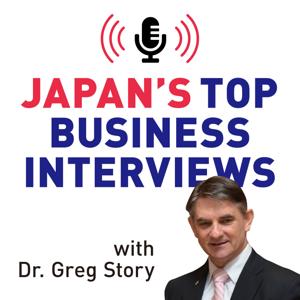
Saturday Japan's Top Business Interviews Show podcast and Japan's Top Business Interviews Show video
He is a thought leader in the four critical areas for business people: leadership, communication, sales and presentations. Dr. Story is a popular keynote speaker, executive coach and trainer.
Since 1971, he has been a disciple of traditional Shitoryu Karate and is currently a 6th Dan. Bunbu Ryodo (文武両道-both pen & sword) is his mantra and he applies martial art philosophies and strategies to business.
#DCTakeCommand
From the publisher's feed

43,814 Listeners

4,102 Listeners

1,916 Listeners