
Sign up to save your podcasts
Or



Send us Fan Mail
In the second of two parts, Lou talks with Jim Silvia, the vice president of the nonprofit Harpers Ferry Park Association and a 13-year veteran certified park guide at Harpers Ferry National Historical Park. Jim's newly published work, The Raid Minute By Minute, is a milestone in John Brown studies, being a comprehensive look, not only at the raid, but also the four years leading up to the raid.
To support the HF Park Association, please follow this link to purchase The Raid Minute by Minute (https://www.harpersferryhistory.org/product/raid-minute-minute)
Listeners are welcomed to join Jim and many other friends in the John Brown community for monthly programs sponsored by John Brown America 250, hosted by yours truly. (https://www.johnbrown250.org/)
Support the show
Send us Fan Mail
In the first of two parts, Lou talks with Jim Silvia, the vice president of the nonprofit Harpers Ferry Park Association and a 13-year veteran certified park guide at Harpers Ferry National Historical Park. Jim's newly published work, The Raid Minute By Minute, is a milestone in John Brown studies, being a comprehensive look, not only at the raid, but also the four years leading up to the raid.
To support the HF Park Association, please follow this link to purchase The Raid Minute by Minute (https://www.harpersferryhistory.org/product/raid-minute-minute)
Listeners are welcomed to join Jim and many other friends in the John Brown community for monthly programs sponsored by John Brown America 250, hosted by yours truly. (https://www.johnbrown250.org/)
Support the show
Send us Fan Mail
In this episode, Lou examines how Theodore Roosevelt appropriated—and ultimately undermined—the historical legacy of John Brown. Focus centers on Roosevelt’s August 1910 "New Nationalism" address at the dedication of the John Brown Memorial Park in Osawatomie, Kansas, followed by his September 1910 essay in The Outlook, "The Progressives of the Past and the Present."
Key topics explored include:
Outro music: "Gray," by Infraction
Support the show
Send us Fan Mail
In Part 2 of this gripping exploration into John Brown and his Jewish associates in Kansas, Lou revisits the infamous Pottawatomie Creek killings. Grounding the narrative in the vital testimony of August Bondi alongside other primary and secondary sources, the episode reframes the violence not as random slaughter but as a preemptive strike. Lou demonstrates how Theodore Wiener became a crucial actor in this lethal counter-offensive, as Brown, his sons, and his son-in-law moved to thwart a hostile, pro-slavery plot by executing five local pro-slavery collaborators: the Doyles, William Wilkinson, and William Sherman.
Following the bloodshed, the episode captures a striking vignette of Bondi and Wiener fighting shoulder-to-shoulder with Brown at the Battle of Black Jack in June 1856. Finally, Lou traces the fascinating post-Kansas "afterlives" of Bondi, Benjamin, and Wiener, bringing this remarkable historical alliance to a close.
Featured Music: "Judge Roy Bean's Theme" and "Miss Lily Langtry" from The Life and Times of Judge Roy Bean (Composed by Maurice Jarre, 1972).
Support the show
Send us Fan Mail
In this episode, Lou introduces us to the fascinating and unlikely alliance between John Brown’s family and local Jewish immigrants in the violent, war-torn landscape of Territorial Kansas. To set the stage, Lou explores how Brown—a self-conscious heir to the rigid Puritan Protestant tradition—deeply conceptualized and viewed the Jewish people.
We are then introduced to three of Brown’s Jewish associates: August Bondi, Jacob Benjamin, and Theodore Wiener. Drawing from the richest available historical records, the episode focuses primarily on Bondi and Wiener, charting their paths as they converge with Brown's militant mission. This deep dive sets the stage for the infamous Pottawatomie Creek uprising, where both men would play vital, radically different roles: Bondi as the enduring witness and historian and Wiener as a willing executioner.
Additional Music: "Mr. Aurante" (via Pixabay)
Support the show
Send us Fan Mail
In this episode, Lou uploads the transcript of the extended introduction of his book, John Brown Speaks (Rowman & Littlefield, 2015) to one of Google's AI programs, Notebook LM. Notebook LM "reads" the introduction and then produces a faux podcast featuring two human-like voices discussing the content of the article. As this experiment shows, AI is a very useful and interesting tool, but it is not without its flaws and biases based on the source and content of its knowledge. Overall, despite some problematic points, this AI podcast episode does a fairly good job of discussing the introduction and at points is quite interesting.
Additional music: "Ginormous Robots" by Nathan Moore
Support the show
Send us Fan Mail
In this episode, Lou introduces the question of whether John Brown should be posthumously pardoned. The theme begins with biographer David S. Reynold's Op-Ed in the New York Times on December 1, 2009 entitled, "Freedom's Martyr," in which he suggested the symbolic value of a posthumous pardon for Brown, either by the State of Virginia or even by then President Barack Obama. Two years later, this question was revisited by a John Brown birthday meeting, "Five Nine 2011" (commemorating the 211th birthday of Brown), held at the Brecht Forum in New York City. Among the other guests, both Reynolds and yours truly were invited to present the case for--and against--a posthumous pardon. Here's an opportunity to revisit that discussion and perhaps draw your own conclusions: Should John Brown today be pardoned?
If you'd like to view a video of the entire "Five Nine 2011" program on YouTube, click on this link: https://youtu.be/TT4hvNgmtxY?si=BrNRafHG6ilf9E__
Support the show
Send us Fan Mail
In this episode, Lou revisits the story of James and Maehala Doyle of Tennessee, who devoted themselves and their family to supporting slavery and opposing antislavery and abolitionist settlers in the Kansas Territory. In the Pottawatomie incident of May 1856, Doyle and his two oldest sons, William and Drury, were killed by John Brown's men, under the leadership of the old man, because of their role in spreading and supporting proslavery terrorism in the territory, and for posing a direct threat to the lives and well-being of the Browns. The Doyles are dumbasses--ignorant people caught up in advancing injustice and bigotry--and represent an element in the history of the United States that are always the most dangerous because they are the most useful tools to the machinations of powerful but wicked elites, from the slaveholders of the antebellum era to the fascist rightwingers of today.
Support the show
Send us Fan Mail
In this episode, Lou speaks with Dan Morrison, the founder of the John Brown Project and a documentary filmmaker from Torrington, Connecticut, John Brown’s birthplace. Morrison details his work, including a community arts project that produced a 21st-century remix of the Civil War era song, "John Brown's Body" and his current musical documentary, "Pushing the Rock," which examines systemic racism in America and features interviews with historical figures’ descendants and scholars. The conversation heavily focuses on rehabilitating the historical reputation of abolitionist John Brown, countering common misconceptions that portray him as a terrorist, a failure, or insane, and advocating for white people to actively combat white supremacy as Brown did. They also discuss the recent conservative media backlash against Dr. Stacey Patton, a Howard University journalism professor who cited Brown as an example of a good white ally, further prompting their discussion about the ongoing struggle against misinformation and historical bias, especially relating to John Brown.
Support the show
Send us Fan Mail
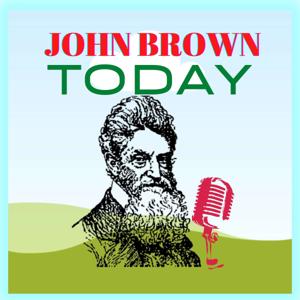
In this episode, Lou breaks with the regular approach of this podcast to put a John Brown lens on pressing contemporary issues. He specifically addresses three main topics, arguing why John Brown would be an anti-Zionist due to the movement's oppressive colonial practices and its perceived anti-biblical, racialized nature; critiquing the notion that the recently murdered Charlie Kirk was a Christian martyr because of his white nationalist views and opposition to the Black civil rights tradition; and finally, condemning the Trump administration's attempts to revise history and minimize the violence and injustice of slavery. John Brown Today, Lou concludes, is a podcast devoted to the meaning of John Brown and therefore must serve as a platform to advocate for justice, truth-telling, and keeping his legacy alive in the face of modern political struggles.
To see an explainer video for this episode, check out the JOHN BROWN TODAY YouTube platform, and look for the short video entitled, "The John Brown Lens."
Support the show
From the publisher's feed

90,880 Listeners

14,507 Listeners

9,192 Listeners

8,832 Listeners

12,507 Listeners
16,838 Listeners

15,577 Listeners

15,893 Listeners
1,444 Listeners
1,087 Listeners