After the last meeting when the WGN Radio Book Club discussed their favorite books of 2025, our book lovers – John Williams, Steve Alexander, Bob Kessler, Steve Bertrand and Sara Tieman – have returned to discuss the books they’ve been reading during the first couple of months of 2026.
https://serve.castfire.com/audio/7999043/2-26-26_WGN_Radio_Book_Club_January_February_2026-02-26-183143.128.mp3
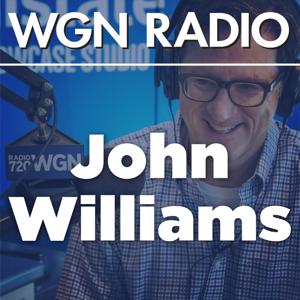
John Williams (weekdays 10am-2pm, including The Noon Business Lunch, plus the Mincing Rascals podcast)
A Marriage at Sea, Sophie Elmhirst (Riverhead Books).
Okay, I’m finally aboard. What a swift, marvelous weekend read. Maurice and Maralyn Bailey set sail from London for New Zealand. A whale sinks their boat and they survive for 118 days before finally, randomly, maddeningly getting rescued. I understood the book to be a telling of how she took charge and pulled the moping Maurcie through. True, her disposition was positive, survive-at-all-costs. And they did. But he pulled his weight too. Surprisingly, the story doesn’t end with the rescue. I was struck by details of the second, post-rescue act.
The History of Science in Bite-Sized Chunks, Nicola Chalton and Meredith MacArdle (Michael O’Mara Books).
Where did I find this one? A museum bookshop? It’s great fun. Perfect for that budding scientist who’s STEM curious and able. In short 2–4-page entries, they tell you all the people and principles you should know more about. Aristotle’s view of the universe, Copernicus and modern astronomy, Galileo’s improvements to the telescope, Newton, Einstein, Super Novas, how a black hole works (in two pages, no less, with a diagram!), Pi, Pythagoras, and Fermat! Who’s having fun now? The three-point problem and poor Marie Curie. Max Plank and Bunsen burners. Okay, I’ll stop. Love this book!
The Best American Science and Nature Writing, edited by Susan Orlean (Mariner).
If Orlean is writing it or editing it, I’m reading it. This collection of longish essays from last year are a treasure trove of beauty and wonder. Says Orlean, “ Science writing won’t save us but it’s part of the fight…” So we read about the powers of a super smeller. Gene therapy and how birds talk and much more. Indulge yourself!
The Man Who Mistook His Wife for a Hat, Oliver Sacks, (Vintage).
I read this one when it came out in 1985 and interviewed Sacks after. The AI summary: A 1985 book by neurologist Oliver Sacks, a collection of case studies about patients with neurological disorders, exploring the mysteries of the mind through their unique experiences, such as visual agnosia (the title case), memory loss, and other perceptual and intellectual challenges, all told with compassion and insight. The book is divided into four sections: “Losses,” “Excesses,” “Transports,” and “The World of the Simple,” and became a bestseller, inspiring an opera and influencing the fields of neurology and psychology. The JW summary: Inspiring. As much about surviving and thriving as suffering and loss. That title story: an artist suffers an injury and now sees (even dreams) in black and white. Now art, food and flesh (and sex) are ever changed for him. And yet he goes on and flowers in a new way. And that’s just the first chapter.
Steve Alexander (agribusiness reporter)
Fever Beach by Carl Hiaasen
A novel
I hope Mr. Hiaasen donates his brain to science. Not now, but certainly after he passes because what pours out of that noggin is comedy genius. As is his M.O., he creates wackadoodle scenarios in which he skewers Floridians who don’t have a solid grip on reality or facts. (If you’re a fan of the Proud Boys, militias, or J-6ers, you’ll want to pass on this one.) I found it hilarious, entertaining and an easy read.
Unplugged by Tom Freston
A memoir
You may not know his name, but Tom Freston was one of the founding fathers of MTV. He later became CEO of MTV Networks and then of Viacom. As fun and interesting as those stories are, his pre-corporate wanderlust is fascinating. After graduating from college, he avoided going to Vietnam by studying for his MBA, not a commonly attained degree back then. He landed a job in a Madison Avenue ad agency to work on prestigious brands like Charmin tissue (he knew Mr. Whipple). But his itch to travel caused him to quit and hitchhike through Europe, Africa, India, and Afghanistan–for eight years! That he survived, much less thrived and made it back to run MTV and satisfy the whims of a very creepy Sumner Redstone at Viacom, makes for a great read.
Yellowface by R.F. Kuang
A novel
Here’s one of those novels that presents a moral dilemma for the main character and, of course, to service the plot, she chooses the immoral option. Struggling author June Hayward, after watching her best-selling author and frenemy choke and die, is faced with the opportunity of stealing the deceased’s unpublished manuscript about Asian history and publishing it as her own. She does, of course, assumes an Asian pen name (Juniper Song) to provide cred to the story she stole, and becomes famous and rich (by struggling author standards). But, she lives in constant fear her scam will be discovered, with social media playing a significant role.
It’s a quick, satisfying read that includes an examination of cultural appropriation and who has the right to tell certain stories. There’s also some dirt (maybe true maybe not… still interesting) about the publishing industry.
Currently, I’m finishing Culpability by Bruce Holsinger, and am beginning 1929 by Andrew Ross Sorkin.
WGN Radio Book Club
Theo of Golden (2025) Allen Levi
Tremendous. A warm-hearted and sincere work that reads at first like a series of vignettes about individuals living in a small town in Georgia and the mysterious, kindly outsider who gets to know them. But the story takes a turn that knits everything together in a brilliant way, examining what it means to be an artist and a human being. I might just turn right around and read it again.
The Final Score (2026) Don Winslow
He’s considered today’s premiere crime fiction writer, and this collection of short stories/mini-novels ensures he’s still earning that distinction. I don’t usually connect with short stories because the characterizations aren’t deep enough. This doesn’t suffer from that ailment; it’s quite the opposite and is a collection of page-turners that feel complete and whole despite their less-than-novel page counts.
When Caesar Was King: How Sid Caesar Reinvented American Comedy (2025) David Margolick
A thorough account of the life of this important entertainment figure. I was born years after his TV dominance, and this book is good at really driving home just how massive he and his programs were in the 50s. The sad part is that even though many in Caesar’s orbit went on to have lengthy, storied careers (Mel Brooks, Carl Reiner), the man himself didn’t have that same sustained success, although he remained wealthy. The book does a good job of diving into the demons that held him back, along with his triumphs.
The Land in Winter (2025) Andrew Miller
Not a bad read and my experience of it wasn’t nearly in line with the laudatory reviews. Even though it reads fairly quickly, it felt like a slow setup leading to a flourish of actions. I’m considering a re-read later this year to see how it fares.
The Writing on the Water (2025) John Ajvide Lindqvist
I am a huge fan of his earlier works, especially ‘Let the Right One In,’ ‘Handling the Undead,’ and ‘Little Star’ which are three favorite novels of the 2000s. This one is an above average mystery thriller with clever, sympathetic likable characters but not much more. Next to those other works I mentioned, it pales in comparison. Bring back the weird/scary stuff!
Steve Bertrand (host of Steve Bertrand on Books podcast, recently retired after over 40 years as a WGN Radio news anchor and reporter)
99 Ways to Die: and How Avoid Them by Ashely Alker
Uplifting, right? Actually, this is a very funny account of how we perish and things we can do to put it off. For example, a door frame is no longer considered the go to spot during an earthquake. Lightning strikes kill only about 30 people a year. Don’t ride a hippo! The book comes from a very personal story. Ashely’s mom was diagnosed with a serious illness and the family couldn’t keep up with the medical jargon. She went into medicine to help translate what doctors were telling her. Sadly, her mother died before she became a full-on doctor.
The Dark Time A Peter Ash novel by Nick Petrie
Ash is a vet dealing with PTSD and saving the word at the same time. In this story, he battles the threat that AI will create an world wide meltdown. This is a page turner for sure but, get this, 70% of Petrie’s readers are women. That speaks to his emphasis on character development over explosions. Oh, and Karl Marx makes an appearance.
Night Night Fawn by Jordy Rosenberg
Ellen Rosenberg describes her self as a Brooklyn yenta, who’s dying in her NYC apartment. She narrates on two levels: one, sort of as a detached memoir, while the other is her present moment hallucinatory rambles fueled by disease and pain killers. The book takes on the Jewish Diaspora, homophobia and (he’s back) Karl Marx. Ellen rejects her child as the biggest disappointment of her life (notice Jordy gives her his last name) but it’s hilarious at the same time.
Sara Tieman (promotions & public relations manager emeritus and station book club international correspondent)
Buckeye (2025) – Patrick Ryan
Set in mid-America in a fictional Ohio small town, the word that comes to mind when thinking about Patrick Ryan’s novel is “Americana.” Yet behind those picket fences we encounter infidelity, prejudice, homsexuality, loss, forgiveness, love, secrets, and choices through four main characters – Cal, Becky, Margaret, and Felix – along with their offspring, Skip and Tom. It’s a character-driven sweeping saga from the 1930s to the 1970s and the connection between two families and those four characters, all stemming from a kiss in a hardware store. The novel’s first six chapters introduce you to even-tempered Cal Jenkins, his father Everett, a World War I vet most likely suffering from PTSD, Cal’s wife Becky, a medium who hosts sessions in her home much to Cal’s displeasure, and Becky’s parents. The subsequent six chapters switch to Margaret, a red-haired, green-eyed orphan bounced between foster homes who finally moves to Columbus where she meets and marries Felix whose job promotion moves the couple to the small town. A short time later, World War II prompts Felix to enlist in the Navy while Cal is prevented from service due to a physical deformity.
The switch of the backstory of Cal to Margaret was a bit abrupt for me at the start and it’s where I nearly set the book aside. I would have preferred some sort of layout with defined section headings. That aside, I was curious enough about the characters that I kept with the story and I’m glad for it because it was well-paced and I breezed through its pages. Ryan’s novel is poignant, moving and devastating in parts and I found it a worthwhile, satisfying read.
The Stolen Life of Colette Marceau (2025) – Kristin Harmel
If you’re a fan of historical fiction like I am, this is a book for you. The story alternates between present-day (well, 2018) and 1940s Occupied Paris and features Colette Marceau, a nearly 90-year-old jewel thief who is the descendant of Robin Hood. Colette’s mother Annabel teaches her how to steal and who to steal from as set by the codes of their ancestor, redistributing wealth to the French Resistance and for Colette later, modern charities. When Colette recognizes a bracelet displayed in a Boston gallery that was last seen on the night of her mother’s arrest in 1942 with her sister who was believed drowned in the Seine, she sets upon a search for answers. One or two of the characters felt a bit underdeveloped, but the story kept me engaged with a blend of mystery, history, reckoning, and moral dilemma.
Best Offer Wins (2025) – Marisa Kashino
Early on, I thought I might give up on this one, but the brisk pacing and my curiosity kept me turning the pages. The best way I’d describe the narrator and main character Margo is unhinged. Margo and her husband Ian are living in a small apartment, trying for a baby, and looking for a larger family home in the DC metro area. But in this competitive market, they continue to lose out to other buyers and can’t stretch much beyond their $1.2 million budget. When Margo gets early word from her realtor that a home is soon to be listed in her dream neighborhood, she goes to extreme (and yes, I mean extreme) lengths to make it hers, from stalking the property to befriending the owners and a whole lot more. This was a wild ride that I sped through in two days. Fans of darker twisty mystery thrillers should like this selection.
The Eternal Forest: A Memoir of the Cuban Diaspora (2025) – Elena Sheppard
I was captivated by this beautiful, poetically and lovingly-written generational memoir of the author’s family history and family stories interwoven with the history and story of Cuba. Elena is the first of her family to be born in America and wrestles with not feeling “Cuban enough” but she writes the stories her grandmother Rosita shared, talking about the women in the family and describing an idyllic life in Cuba before being forced to flee with her daughters Margarita (Elena’s mom) and Mariana (Elena’s aunt) and join her husband in Florida in 1960. Rosita always thought her exile would be temporary and that someday soon (next year?) she’d return to Cuba. A family tragedy is handled delicately, but there is no doubt that it is a shadow impacting all three generations of these women, most especially Rosita and Margarita.
Weeks on from my reading of this, I’ve continued to contemplate the complicated emotions of the exiled and their relationships to the ones that remained, how belonging and connections to heritage changes across generations, and the preservation of family stories.
Nobody’s Girl: A Memoir of Surviving Abuse and Fighting for Justice (2025) – Virginia Roberts Giuffre
I started my 2026 reading year with Giuffre’s memoir published posthumously and, I’ll echo what Bob Kessler wrote in his December 2025 review of the book (https://wgnradio.com/john-williams/wgn-radios-december-book-club-choices/) – it’s not easy to read about the abuse Virginia Robert Giuffre suffered from family and the circle of Jeffrey Epstein and Ghislaine Maxwell. It’s horrifying and uncomfortable knowing what she and other young girls in that circle endured. When she found a way to escape after she’d been sent to Thailand, Giuffre became a tireless advocate, fighting to be believed and for justice to hold her abusers accountable. And that fight took a toll on Giuffre who had several health setbacks prior to her death. This line in particular speaks to the devastating aftermath of what she and fellow victims suffer, “…a loss of the capacity to enjoy life. Those injuries are permanent in nature.”
More book recommendations from Sara Tieman
Recent Posts
John Williams
Author Sophie Elmhirst talks ‘A Marriage at Sea’
.cls-7{fill:#fff;fill-rule:evenodd}
Would you pay extra for premium movie seats?
.cls-4{fill:#000;}
Connell McShane: The future of tariffs is uncertain
.cls-7{fill:#fff;fill-rule:evenodd}
John Williams Best of Speed Jokes 2-27-26
.cls-7{fill:#fff;fill-rule:evenodd}
Should FCC review shift of live sports to pay TV?
.cls-4{fill:#000;}
Click for more