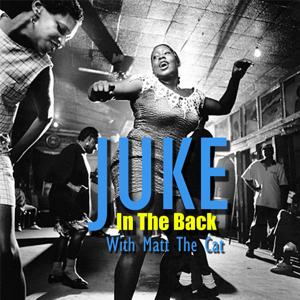
Juke In The Back

Juke In The Back

Download on the App Store

All Juke In The Back episodes

  • Episode #417 – Jimmy Preston
    Air Week: April 30-May 6, 2018
    Jimmy Preston
    Jimmy Preston made a major contribution to early Rock n’ Roll by ushering in the era of the screamin’ sax. “Messin’ With Preston,” “Hucklebuck Daddy,” “Hay Ride” and his other early sides for Gotham Records were highly influential in the new genre of Rhythm & Blues, but it’s his original version of “Rock The Joint” that he will always be remembered for. “Rock The Joint” from 1949 is a definite contender for the first Rock n’ Roll song, but since you can’t pin an entire musical movement down to just one tune, let’s just say that it was one of the first. It jumps, it wails, it swings and tells the story of how this music is really going to make them rock the joint. It was immediately covered by Chris Powell & The Five Blue Flames for Columbia, then Jimmy Cavallo, but most importantly, Bill Haley laid down a ground-breaking rockabilly version of “Rock The Joint” in 1952. So even though Jimmy Preston is mostly remembered for one major contribution, Matt The Cat has dug up many more noteworthy jump tunes to open your ears and tap your toe to. This week’s “Juke In The Back” is jumpin’ with some pristine shellac from the great and highly unappreciated Jimmy Preston. DIG! 
    LISTEN BELOW
    59 min
  • Episode #416 – Little Esther
    Air Week: April 23-29, 2018
    Little Esther 
    Esther Mae Jones is one of the First Ladies of R&B, yet her 1950s output under the name Little Esther is sadly overlooked. Little Esther was discovered by bandleader Johnny Otis in 1949, when she was only 14 years old. Otis immediately added her to his musical ensemble. He had scored a few hits before, but nothing could have prepared Otis for his HUGE 1950 breakthrough record, “Double Crossing Blues,” featuring Little Esther and The Robins. Otis and his group dominated the R&B lists in 1950, scoring three #1 hit records and six R&B top tens, all featuring Little Esther. This week, Matt The Cat examines Little Esther’s records with Otis as well as her duets with The Dominoes, Bobby Nunn, Little Willie Littlefield and her many solo sides for the Federal and Savoy labels. Esther Jones would gain much recognition as Esther Phillips in the 1960s and ’70s, but as a teen in the 1950s, Little Esther laid the groundwork for musical genius. The spotlight shines bright on Little Esther, this week on the “Juke In The Back.” This is the “soul that came BEFORE rock n’ roll.”
    LISTEN BELOW
    59 min
  • Episode #415 – Motown Artists BEFORE Motown
    Air Week: April 16-22, 2018
    Motown Artists BEFORE Motown
    The entire “Juke In The Back” this week features Motown’s biggest acts,BEFORE there even was a Motown Records and before those acts were household names. Matt The Cat spins the earliest records by The Miracles (1958), The Four Tops (1956), The Supremes (as The Primettes) and many more. Marvin Gaye’s first recordings with The Marquees are discussed with fellow group member, Reese Palmer. You’ll get the real story behind the story as to how DC’s Marquees became the “new” Moonglows as well as hear the original Bo Diddley produced version of the Marquees’ “Wyatt Earp,” which Okeh Records wouldn’t release. All this and more on this week’s, “Juke In The Back.”
    LISTEN BELOW
    59 min
  • Episode #414 – John Lee Hooker: 1948-51
    Air Week: April 9-15, 2018
    John Lee Hooker: 1948-51
    John Lee Hooker was one of the most influential and important musicians of the 20th Century. He single-handedly invented his own electric guitar boogie sound, which he let loose on the world with his first single, “Boogie Chillen'” in 1948. By early 1949, it was a number one R&B hit and Hooker was on his way to infamy. He took the Delta Blues he had learned growing up from his step-father, William Moore and his sister’s boyfriend, Tony Hollins and turned it upside down, creating his own distinct style. A style that was often copied, but never fully coped. Hooker knew that he wasn’t going to make any money getting stuck in record company contracts, so he would record for any company that would pay him up front. He waxed for numerous labels during the late 1940s and early ’50s and recorded under several pseudonyms, in order to protect himself from lawsuits. This week, Matt The Cat digs deep into John Lee Hooker’s early work for the Modern, Sensation, King, Staff and Chess labels as we feature his most important records from 1948-51. This is where it all began for the consummate “boogie man.” It’s in ’em and it’s got to come out, this week on the “Juke In The Back.”
    LISTEN BELOW
    59 min
  • Episode #413 – Early Billy Stewart & R&B Jail Songs
    Air Week: April 2-8, 2018
    Early Billy Stewart & R&B Jail Songs
    Many 1960s soul legends had their start in 1950s R&B and this week, the “JukeIn The Back” takes a listen to Billy Stewart’s early records for the Chess and Okeh labels. You can really hear Stewart’s distinctive singing style develop on his early recordings with Bo Diddley’s band providing the musical backing and the DC vocal group The Marquees (Marvin Gaye was a member) singing behind him. We’ll also spend a few days in jail as Matt The Cat spins a few “prison song” 78s. There are other surprises as well, so don’t miss this week’s “Juke In The Back.”
    LISTEN BELOW
    59 min
  • Episode #412 – The Cadillacs
    Air Week: March 26-April 1, 2018
    The Cadillacs 
    The Cadillacs began their journey in 1953 as The Carnations and when they changed their name they helped usher in a new era of automobile names for R&B vocal groups. Lead tenor Earl “Speedo” Carroll and bass singer Bobby Phillips forged a friendship that would carry on from their days growing up in Harlem until the day each of them passed on. While together, The Cadillacs produced some of the coolest jump tunes from the classic “Speedo” to the jazzy “Down The Road” and the killer “No Chance.” As a ballad group, Speedo and the boys recorded the version of the immortal “Gloria” that all other vocal groups are measured against as well as other gorgeous tunes like “You Are” and “The Girl I Love.” Matt The Cat features an interview with Earl Carroll himself, so that he can tell The Cadillacs story in his own words. We lost Earl Carroll and a little piece of early rock n’ roll on November 25, 2012, but Speedo will never be forgotten in the hearts of those who dig REAL vocal group harmony.
    LISTEN BELOW
    59 min
  • Episode #411 – Jimmy Coe
    Air Week: March 19-25, 2018
    Jimmy Coe
    The “Juke In The Back” is proud to feature Jimmy Coe, a great 1950s saxophonist, bandleader and session man that is often ignored today. Coe came up in the 1940s playing in renown bands including the Jay McShann (at the same time as Charlie Parker) and the Tiny Bradshaw bands. After the war, he settled in Indianapolis, playing clubs until hooking up with vocalist Flo Garvin. He cut a record with her and one on his own for King Records in 1952. Even though King insisted as listing Coe as Jimmy Cole, he still caught the ear of The States Record Company. His 3 singles for States are a shining example of great musicianship, a solid groove and comedic talking blues. Coe and his group then played on records by The Students, Ronnie Haig and The Five Stars. This week, Matt The Cat moves the Jimmy Coe 78s from the back of the Juke and spotlights a true unsung hero of Rhythm & Blues. 
    LISTEN BELOW
    59 min
  • Episode #410 – Spark Records
    Air Week: March 12-18, 2018
    Spark Records 
    The “Juke In The Back” is proud to present one of the premiere, short-lived R&B record labels of the 1950s. Started by songwriters Jerry Leiber & Mike Stoller after they were stiffed on royalty payments for Big Mama Thornton’s “Hound Dog,” Spark records only lasted for a year and a half. In that time they wrote and produced some of early rock’s most defining songs like “Riot In Cell Block #9” and “Smokey Joe’s Cafe” for The Robins, “Love Me” for Willie & Ruth (Elvis Presley would go on to cut it), “One Bad Stud” for San Francisco’s The Honey Bears and many more. Spark was cut short in 1955, when Atlantic Records offered Leiber & Stoller an offer they couldn’t refuse. Catch the Spark Records story this week on the “Juke In The Back” with Matt The Cat.
    LISTEN BELOW
    59 min
  • Episode #409 – Billy “The Kid” Emerson
    Air Week: March 5-11, 2018
    Billy “The Kid” Emerson 
    The “Juke In The Back” with Matt The Cat features Billy “The Kid” Emerson, a talented R&B singer and songwriter who never had a hit record, but his songs were covered by the likes of Elvis Presley and Billy Riley.  Originally from Tarpon Springs, FL, Billy Emerson burst on the scene in 1954, with the help of friend Ike Turner.  He released a string of stellar R&B records for Sun, before moving on to Vee-Jay, Chess and many others.  Elvis recorded Emerson’s very soulful, “When It Rains It Pours” and Billy Riley made Emerson’s “Red Hot” a rockabilly standard.  Billy “The Kid” Emerson’s story and music is the feature of this week’s “Juke In The Back.”
    LISTEN BELOW
    59 min
  • Episode #408 – Mambo / Vita Records
    Air Week: February 26-March 4, 2018
    Mambo / Vita Records
    The Juke In The Back is jumpin’ this week with records from the Vita Label and its direct predecessor, Mambo Records. In 1955, record producer Mike Gradney got together with Larry Mead, who owned a record pressing plant in Pasadena, CA to form Mambo Records. They picked that name, because the Mambo was all the rage in ’55. Mambo hit the ground running with a roster of fantastic R&B cats, like Willie Egan (who’s name always appeared on record as either Eggins or Egans), saxophonist Jackie Kelso and vocal groups the Squires and The Colts. Just as Mambo issued The Colts, “Adorable,” they decided that disc jockeys might get confused and think Mambo Records was a Latin label instead of an R&B label. They changed Mambo to Vita and reissued “Adorable” as Vita 112. “Adorable” was Vita’s first hit record and The Colts only hit record. More Vita releases from The Colts, The Squires, Harmonic Slim, Ike Turner and The Titans followed. In late 1956, Vita had a huge hit on their hands when “Confidential” by Sonny Knight took off nationally. Vita couldn’t handle the distribution of such a large seller, so they leased the record out to Dot Records. The tide started turning for Vita in 1957 and Gradney left Mead to form his own label, Spry Records. Unfortunately, he took some of Vita’s best artists with him and by 1959, Mead decided to shut Vita down for good. This week’s Juke In The Back is a look into the musical legacy of Vita Records, another small West Coast label that made a significant contribute to Rhythm & Blues and the formation of Rock n’ Roll. 
    LISTEN BELOW

    59 min