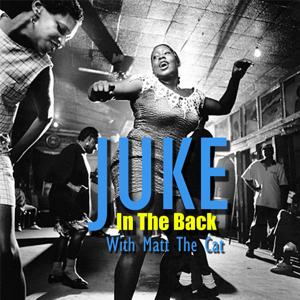
Juke In The Back

Juke In The Back

Download on the App Store

All Juke In The Back episodes

  • Episode #366 – The Harptones
    Air Week: May 8-14, 2017
    The Harptones
    The Harptones never had a national hit record, yet they are arguably the finest vocal group to come out of New York City during the 1950s. Willie Winfield’s soaring tenor matched with Raoul Cita’s songwriting and arrangements helped them hit the local charts and influence their peers. What set The Harptones apart from many of the successful vocal groups of the day was their perfectly matched harmonies. Whereas most vocal groups had only one signature song, The Harptones enjoyed many, from their first release, 1953’s “A Sunday Kind Of Love,” to “Life Is But A Dream” in ’55 and “The Shrine Of St. Cecilia” in ’57. This week, Matt The Cat digs out many of The Harptones’ wrongfully forgotten records and gives ’em a spin in our old Rockola “Juke In The Back.”
    LISTEN BELOW
    1 hr
  • Episode #365 – Johnny Otis
    Air Week: May 1-7, 2017
    Johnny Otis
    This week, the Juke In The Back is proud to honor the late, great Johnny Otis. He was a true renaissance man. Otis was a singer, songwriter, drummer, bandleader, talent scout, record label owner and radio / TV show host and that s not everything he did. He was the son of Greek immigrants, growing up in a mostly Black section of Vallejo, CA during the 1920s and 30s. He not only absorbed Black Culture, he became a part of it, changing his last name to Otis in order to sound more black. He went from playing drums at the Club Alabam on Central Ave. in LA to opening his own Barrelhouse Club in Watts in 1947, creating a scene of his own. His first records were made just as the big bands were dying off and the jump combos were rising. Johnny Otis did not interpret rhythm and blues, Johnny Otis WAS rhythm & blues. From his first recordings for Leon Rene’s Excelsior Label in 1945 to his commercial breakthrough in 1949-50 for Herman Lubinsky’s Savoy Label to his great rock n roll success with “Willie And The Hand Jive” for Capitol in 1958, Johnny Otis did more than almost anyone to push Black Music into the mainstream, creating rock ‘n roll. Juke In The Back highlights the early part of Otis amazing career from 1945-1958. It s not an overstatement to say that the music we enjoy today is here because of what Johnny Otis recorded, played and produced in the late 1940s and early 1950s. This Juke is truly The Johnny Otis Show.
    LISTEN BELOW
    59 min
  • Episode #364 – Aladdin Records, Pt. 3
    Air Week: April 24-30, 2017
    Aladdin Records Story, Pt. 3
    The “Juke In The Back” presents part 3 in our series on Aladdin Records, one of the most important independent labels of the pre-rock era. Part 3 focuses on 1953-55, just as Rock n’ Roll was beginning to enter the mainstream. Matt The Cat digs up a great variety of styles this week as vocal groups, raw Rhythm & Blues, jump instrumentals, drinking songs and ballads take center stage. We’ll dig on some hits and misses from Amos Milburn, The Five Keys, Chuck Higgins, Gene & Eunice and Shirley & Lee. We’ll also hear some great debut records from Bobby Marchan and Sonny Knight, who would go on to greater success on other labels. A few rare vocal group sides are also featured. Grab a handful of nickels, because this week the “Juke In The Back” is loaded with Aladdin Records sides out of Beverly Hills, CA. This is the final part in our 3 part series. 
    LISTEN BELOW
    59 min
  • Episode #363 – Aladdin Records, Pt. 2
    Air Week: April 17-23, 2017
    Aladdin Records Story, Part 2
    The “Juke In The Back” presents part 2 in our series on Aladdin Records, one of the most important independent labels of the pre-rock era. Part 2 will pick up the Aladdin Records Story in 1950 and carry it through til rock n’ roll began hitting the mainstream in 1954. This week, we’ll hear more hits from Aladdin’s early hit-makers, Amos Milburn and Charles Brown. We’ll also dig some of the newcomers, like Floyd Dixon, Peppermint Harris, Calvin Boze, Shirley & Lee, the Five Keys and more. Aladdin was a rare label in that almost everything they pressed was worth hearing. If you ever see a discarded Aladdin 45 by an artist you’ve never heard before, pick it up, because chances are it’ll make you very, very happy. Matt The Cat hosts the Aladdin Records Story, Part 2, this week on the “Juke In The Back.”
    LISTEN BELOW

    59 min
  • Episode #362 – Aladdin Records, Pt. 1
    Air Week: April 10-16, 2017
    The Aladdin Records Story: Part 1
    The “Juke In The Back” begins a two part special on one of the most important record labels of the pre-rock era, Aladdin Records. Eddie and Leo Mesner started Aladdin as Philo Records in 1945. It was one of the first independent labels on the West Coast and sought to fill in the R&B void left by major labels like Victor, Decca and Columbia. The Mesners hired Maxwell Davis to help with musical arrangements and back up their artists and got the label off to a jumpin’ start. In February of 1946, Philo became Aladdin and a record label icon was born. With artists like Johnny Moore’s Three Blazers featuring Charles Brown, Helen Humes, Illinois Jacquet, Wynonie Harris, Amos Milburn and some rare releases from a young Robins group, how could Aladdin possibly fail? They didn’t and in the process, they helped propel rhythm & blues into the mainstream, paving the way for the emergence of Rock n’ Roll. This week’s show focuses on the beginning of the label from 1945-49 and next week’s show will feature 1950 to the birth of Rock n’ Roll. Grab some nickels, because the party’s getting ready to start down at the Chicken Shack…with Matt The Cat and the “Juke In The Back.”
    LISTEN BELOW
    59 min
  • Episode #361 – Jimmy Liggins
    Air Week: April 3-9, 2017
    Jimmy Liggins
    Jimmy Liggins didn’t have the chart success or popularity of his older brother Joe Liggins, but he did have a killer band, a raw sound and quite possibly the “first rock n’ roll record.” Both brothers traveled to California from their native Oklahoma in order to make it in the music business. Jimmy started out as a professional boxer before hanging up the gloves in order to drive his older brother around after the success of Joe’s “The Honeydripper” in 1945. By the end of ’46, Jimmy told Joe that he was cuttin’ out on his own to form his own band and make his own records. He hit the charts with his 2nd single “Teardrop Blues” in 1948. Its flipside was “Cadillac Boogie,” which was Ike Turner and Jackie Brenston’s inspiration for “Rocket 88.” Jimmy Liggins only scored four R&B chart hits during his career, but he cut a trove of groovy plattahs worth hearing. He is definitely one of R&B’s unsung heroes. Get Jimmy Liggins’ story and all the great music that comes with it on this week’s “Juke In The Back” with Matt The Cat.
    LISTEN BELOW
    59 min
  • Episode #360 – Joe Liggins
    Air Week: March 27-April 2, 2017
    Joe Liggins
    There were so many important figures in post WWII Rhythm & Blues that helped build what would become Rock n’ Roll. Today’s popular culture has left so many musical pioneers behind and this week the “Juke In The Back” features Joe Liggins, one such pioneer who’s been largely forgotten. Liggins scored one of the biggest hits of all-time when his “The Honeydripper” hit #1 on the R&B Chart for 18 staggering weeks in 1945. Singer/songwriter and music historian, Billy Vera drops by the “Juke” to tell us how “The Honeydripper” became such an enormous hit. Liggins scored 10 solid hits for Leon Rene’s Exclusive Records before moving to Art Rupe’s Specialty Records in 1950. At Specialty, Liggins had the biggest R&B hit of 1950 when “Pink Champagne went to #1 for 13 weeks and ended up selling more copies than “The Honeydripper.” It looked like Joe Liggins’ career couldn’t be stopped, but soon Rock n’ Roll, the music he helped create, pushed him and his contemporaries aside to make way for the youth movement. The “Juke In The Back” is proud to honor one of the great musical pioneers of the last century as Matt The Cat plays every chart hit from the fantastic Joe Liggins.
    LISTEN BELOW
    59 min
  • Episode #359 – Influence of “Junker’s Blues” & R&B Telephone Songs
    Air Week: March 20-26, 2017
    The Influence Of “Junker’s Blues” & R&B Telephone Songs
    The “Juke In The Back” is jumpin’ this week as we take a look at the history and influence of the Champion Jack Dupree classic, “Junker’s Blues.”  He learned the tune from New Orleans boogie woogie pianist Drive ‘Em Down, but it was Dupree’s recording that influenced Fats Domino, Lloyd Price and Professor Longhair.  We’ll also make some long distance rhythm & blues phone calls from Floyd Dixon, Sonny Terry, Muddy Waters and Big Walter. Grab a nickel and dig on the “Juke In The Back.”
    LISTEN BELOW
    59 min
  • Episode #358 – Chuck Berry, Pt. 3 – 1958
    Air Week: March 13-19, 2017
    Chuck Berry, Part 3 – 1958
    Chuck Berry has been called the “Father of Rock n’ Roll” and with good reason. He took the blues of T-Bone Walker and B.B. King, the guitar riffs of Carl Hogan and mixed it with the fiddle and Western Swing music of Bob Wills & His Texas Playboys. Then he rolled it all into one big sonic blast. Rhythm & Blues become Rock n’ Roll when Chuck Berry began writing songs aimed at teenagers, finally granting them their own music. The “Juke In The Back” presents the final part of a 3 part feature on Chuck Berry’s early career. This week, Matt The Cat focuses on Berry’s recorded and released output during the pivotal year of 1958. He began the year with a bang and the #1 R&B tune “Sweet Little Sixteen.” 1958 was also the year that gave us “Reelin’ and Rockin’,” “Johnny B. Goode,” “Around and Around” and “Carol.” Just like in the first parts of this series, this week’s program is packed with some fantastic and seldom-heard instrumentals, showcasing Chuck Berry’s true guitar chops. So dig this final “Juke In The Back” treatment of the legendary “Shakespeare Of Rock n’ Roll,” Chuck Berry. 
    LISTEN BELOW
    59 min
  • Episode #357 – Chuck Berry, Pt. 2 – 1956-57
    Air Week: March 6-12, 2017
    Chuck Berry, Pt. 2 – 1956-57
    Chuck Berry has been called the “Father of Rock n’ Roll” and with good reason. He took the blues of T-Bone Walker and B.B. King, the guitar riffs of Carl Hogan and mixed it with the fiddle and Western Swing music of Bob Wills & His Texas Playboys. Then he rolled it all into one big sonic blast. Rhythm & Blues become Rock n’ Roll when Chuck Berry began writing songs aimed at teenagers, finally granting them their own music. The “Juke In The Back” presents part 2 of a 3 part feature on Chuck Berry’s early career. This week, Matt The Cat presents every studio recording made by Chuck Berry from the middle of 1956 to the end of 1957. We pick up where part 1 left off as the hits continue with “School Day (Ring! Ring! Goes The Bell)” topping the R&B chart during the spring of ’57. We’ll also dig the demo and hit versions of “Rock and Roll Music” as well as some great, but overlooked Berry instrumentals. We end this week’s program with the demo version of “Sweet Little Sixteen” and will pick it up next week on part 3 with the evolution of that important Chuck Berry tune. Don’t miss the “Shakespeare Of Rock n’ Roll” on this week’s “Juke In The Back.” 
    LISTEN BELOW
    59 min