LaGuardia and Wagner Archives at LaGuardia Community College/ CUNY

LaGuardia and Wagner Archives at LaGuardia Community College/ CUNY

By Marian ClarkeSociety & CultureHistory
Download on the App Store

LaGuardia and Wagner Archives at LaGuardia Community College/ CUNY episodes

  • John Lindsay's Re-election and Getting the Jewish Vote
    Mayor John Lindsay faced an uphill climb in his campaign for reelection in 1969 after losing the Republican primary to John Marchi, forcing him to run with the backing of only the Liberal Party. The Democratic Party nominee Comptroller Mario Procaccino failed to attract broad Democratic support because of his conservative views and verbal gaffes, but Lindsay desperately needed support from Jewish voters in the outer boroughs to win. Israeli Prime Minister Golda Meir's trip to the U.S. in September proved the right opportunity for Lindsay to regain his standing with the Jewish community in Brooklyn and Queens. In this audio, Jay Kriegal (Lindsay Chief of Staff) and Sid Davidoff (Mayoral Assistant) recount how the city came to build a sukkah, a structure of branches and leaves which Jews traditionally eat in during the harvest festival Sukkoth, in the Brooklyn Museum parking lot as the site for a formal dinner in Meir's honor. This event captured the city's attention and helped Lindsay win reelection.

    The sukkah and the Meir visit hlped Lindsay increase his support among liberal Jews who could not pull the lever for Procaccino. In the general election, Lindsay and Procaccino split the Jewish vote with Lindsay getting support from the more liberal, better-educated, and affluent Jews, and Procaccino doing better among working and lower middle class Jews in the outer boroughs.
    4 min
  • Rise of the Reformer: La Guardia Radio Programs
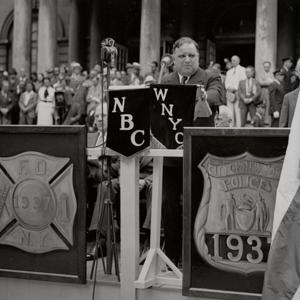
    Mayor Fiorello La Guardia was committed to excising corruption from New York City. He battled Tammany Hall (New York’s Democratic machine) with fierce idealism and relentlessly pursued racketeers and gamblers who often targeted poor immigrants.
    29 min
  • LA GUARDIA AND RELIEF: LA GUARDIA RADIO PROGRAMS
    In the 1920s, the United States enjoyed unprecedented prosperity, and many people assumed that poverty would be eliminated entirely. However, Mayor Fiorello La Guardia noticed that as the stock market boomed so did unemployment. After the 1929 stock market crash, La Guardia called for federal aid and made public assistance a reality in New York City.
    29 min
  • Health and Housing- La Guardia Radio Programs
    Tuberculosis claimed both Mayor Fiorello H. La Guardia’s wife and daughter in 1921. His devastation over this loss coupled with the grim conditions—poor sanitation and overcrowding—that afflicted most of the city’s impoverished citizens lead the mayor to expand public health efforts and to construct public housing projects.
    29 min
  • La Guardia and Aviation
    This recording explores Mayor Fiorello H. La Guardia’s lifelong enthusiasm for aviation—from his service as a bombardier in WWI to his support of the Kelly Bill as a congressman to his absolute dedication to getting New York an airport.
    14 min
  • La Guardia and The Physical City- La Guardia Radio Programs
    From the time he took office on January 1, 1934, until American entry into World War II, Fiorello H. La Guardia's public works brought about in New York the greatest government-sponsored municipal transformation in America since Washington, D.C. was created out of Potomac marshlands. The vast physical transformations under La Guardia began with the Triborough Bridge. Robert Moses, the parks commissioner, was instrumental in La Guardia’s massive physical changes to the city. As a result of their often-contentious partnership, gigantic swimming pools, parks, freeways, and other public works would characterize the La Guardia Administration.
    29 min
  • John Lindsay’s Re-election and Getting the Jewish Vote
    Mayor John Lindsay faced an uphill climb in his campaign for reelection in 1969 after losing the Republican primary to John Marchi, forcing him to run with the backing of only the Liberal Party. The Democratic Party nominee Comptroller Mario Procaccino failed to attract broad Democratic support because of his conservative views and verbal gaffes, but Lindsay desperately needed support from Jewish voters in the outer boroughs to win. Israeli Prime Minister Golda Meir's trip to the U.S. in September proved the right opportunity for Lindsay to regain his standing with the Jewish community in Brooklyn and Queens. In this audio, Jay Kriegal (Lindsay Chief of Staff) and Sid Davidoff (Mayoral Assistant) recount how the city came to build a sukkah, a structure of branches and leaves which Jews traditionally eat in during the harvest festival Sukkoth, in the Brooklyn Museum parking lot as the site for a formal dinner in Meir's honor. This event captured the city's attention and helped Lindsay win reelection.

    The sukkah and the Meir visit hlped Lindsay increase his support among liberal Jews who could not pull the lever for Procaccino. In the general election, Lindsay and Procaccino split the Jewish vote with Lindsay getting support from the more liberal, better-educated, and affluent Jews, and Procaccino doing better among working and lower middle class Jews in the outer boroughs. 
    4 min
  • Study with the Best: Steinway & Sons
    Professor Richard K. Lieberman, director of the LaGuardia and Wagner Archives, describes the rich history of the Steinway & Sons piano company from its origins in the mid-nineteenth century through its rise to becoming one of the foremost piano makers in the world. A CUNY-TV presentation for Admission Services (March, 2004).
    11 min
  • Public Education in America
    Dr. Richard K. Lieberman, Director of the LaGuardia and Wagner Archives, discusses public higher education's history-- the creation of the G.I. Bill after WWII, the resulting surge in college attendance, and the racial inequalities that veterans of color faced in education.  (New York Times building, November 11, 2009)
    7 min
  • Dr. John Hope Franklin
    Until his death in March 2009, Dr. John Hope Franklin was one of the most renowned historians of his time and the author of many books, including the landmark "From Slavery to Freedom: A History of African-Americans." An activist as well as scholar, he worked with Thurgood Marshall to strike down segregation in the Brown v. Board of Education case and marched with the Reverend Martin Luther King, Jr. from Selma to Montgomery in 1965. His writing helped to overturn earlier histories which rationalized Jim Crow, slavery, and white supremacy. He became the first African-American to chair a history department at Brooklyn College, and the first African-American president of the American Historical Association. President Bill Clinton awarded the Medal of Freddom to Franklin and appointed him to the Advisory Board to the President's Initiative on Race. His writing was a harbinger and agent of change in the continuing struggle for equality in the United States. 
    In this podcast, esteemed historian, Dr. John Hope Franklin discusses intercollegiate athletics, race, and higher education (December 5, 1989).

    7 min

About LaGuardia and Wagner Archives at LaGuardia Community College/ CUNY

From the publisher's feed

The LaGuardia and Wagner Archives podcast explores the social and political history of New York City based on oral histories and audio recordings from the La Guardia and Wagner Archives' collections.