LaGuardia and Wagner Archives at LaGuardia Community College/ CUNY

LaGuardia and Wagner Archives at LaGuardia Community College/ CUNY

By Marian ClarkeSociety & CultureHistory
Download on the App Store

LaGuardia and Wagner Archives at LaGuardia Community College/ CUNY episodes

  • AIDS Activism: Tom Kalin and Gran Fury
    Gran Fury was was an artists’ collective that emerged from ACT-UP (AIDS Coalition to Unleash Power) in 1988 and was devoted to AIDS activism through agitprop art. Gran Fury used public space and and advertising space to bring attention to the AIDS crisis and the lack of government support for people suffering from the disease. Most of their work borrowed the language and rhetoric of advertising as well as radical feminist artists. Tom Kalin was one of the 11 members of the collective. In this oral history, he discusses the origins of Gran Fury, their aesthetics, the collective's artistic process, the representation of people with AIDS, and his own feelings of urgency and fear.
    15 min
  • Sid Davidoff: the Lindsay Administration and the 1968 Columbia University Riots
    Sid Davidoff was administrative assistant to Mayor John V. Lindsay for seven years. He was widely considered one of the Mayor’s top personal aides. In this oral history, Davidoff tells the story of the 1968 Columbia University riots and the Lindsay Administration’s involvement in trying to resolve the crisis. Members of Students for a Democratic Society (SDS), a student activist group that helped define New Left politics in the 1960s, called for the university to sever ties from a think tank involved in weapons research for the Vietnam War. At the same time, SDS, black and Puerto Rican students, and community activists opposed Columbia’s construction of a university gym in Morningside Park, arguing the project appropriated public property for the elite students while offering only limited access to Harlem neighborhood residents. Students and Harlem community activists tore down some of the fencing surrounding the gym construction site, marched to campus and occupied Low Library, the university’s main administrative building. Davidoff explains how the administration attempted and failed to facilitate a peaceful solution, revealing the tensions between the different protest groups, the university administration, and the police.
    12 min
  • Hon. Bella Abzug
    Bella Abzug, a Hunter College alumna, discusses women's involvement in government, the contradictory nature of democracy, and feminism. She raises the issues of climate change, gender inequality, and women as agents of social change (CUNY Graduate Center, December 3, 1992). 
    Bella Abzug stands with Shirley Chisholm, Betty Friedan, and Gloria Steinem as one of the most important figures in the women's rights movement of the 1970s. Throughout her life, Abzug was known for her loud voice, flamboyant style, and large hats. She began her professional career as a lawyer in the 1940s and was a noted advocate for numerous leftist causes. These included civil rights cases in the South and cases related to the advancement of women's rights. By the late 1960s she had become a vocal critic of the Vietnam War. In 1971, she was elected to serve New York's 19th District in the House of Representatives where she served until 1977. Her tenure in Congress was notable for her unflinching support of women's rights, and she was one of the loudest and most visible supporters of reproductive rights and the Equal Rights Ammendment. In 1977, she competed in the contentious primary for the Democratic nomination for Mayor of New York City, eventually losing to future mayor Ed Koch. After several failed bids for various Congressional seats, Abzug retired from elected office. Though she never again held elected office after 1977, she remained an important figure in politics, women's rights, and social justice causes until her death in 1988.

    10 min
  • Roger Wilkins
    Roger Wilkins-- noted civil rights activist, lawyer, professor, and journalist-- discusses the legacy of the civil rights movement, the challenges facing African Americans in post-segregation America, and the lack of white leadership advocating for racial equality. (CUNY Graduate Center, November 13, 1993)
    Roger Wilkins began his career working for Supreme Court Justice Thurgood Marshall and the NAACP Legal Defense Fund. He later worked as a lawyer in Ohio. At age 33, he was appointed assistant attorney general during the Lyndon Johnson Administration. He left government in 1969 and joined the editorial page staff of the Washington Post. He won a Pulitzer Prize, along with Carl Bernstein, Herbert Block, and Bob Woodward for their work exposing the Watergate burglary. He left the Washington Post in 1974 but continued his journalisitic career working for several major news outlets around the country. He was also a Clarence J. Robinson Professor of History and American Culture at George Mason University until his retirement in 2007.
    10 min
  • LA GUARDIA AND ORGANIZED LABOR: LA GUARDIA RADIO PROGRAMS
    LA GUARDIA AND ORGANIZED LABOR: LA GUARDIA RADIO PROGRAMS: THE DREAMER AND THE DOER - THE LIFE AND WORK OF FIORELLO H. LA GUARDIA:  Organized labor leaders praised him as friend and inspiration. As a congressman, Fiorello H. La Guardia was one of labor's best friends, but as New York City mayor he opposed unionization of city workers both as a threat to the city budget and to his authority.
    29 min
  • THE LAST DAYS / WORLD WAR TWO: LA GUARDIA RADIO PROGRAMS
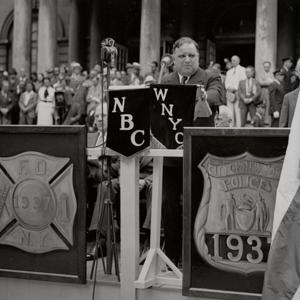
    THE LAST DAYS / WORLD WAR TWO: LA GUARDIA RADIO PROGRAMS: THE DREAMER AND THE DOER- THE LIFE AND WORK OF FIORELLO H. LA GUARDIA:  Fiorello H. La Guardia's third term as Mayor of the City of New York was not his finest hour, but to many it will be his best remembered. The reason? He achieves fame as a radio personality with a weekly program on WNYC. The freewheeling mayor runs a radio grab-bag featuring everything from recipes to the Sunday comics.
    29 min

About LaGuardia and Wagner Archives at LaGuardia Community College/ CUNY

From the publisher's feed

The LaGuardia and Wagner Archives podcast explores the social and political history of New York City based on oral histories and audio recordings from the La Guardia and Wagner Archives' collections.