
Sign up to save your podcasts
Or

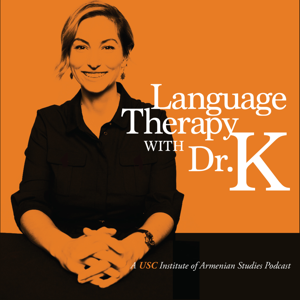


Why are some forms of Armenian dismissed as "incorrect" or "impure"? What can dialects preserve that standardized forms of a language may lose? And what do we lose when speakers are taught to distrust the Armenian they inherited?
In this episode, Dr. K continues her conversation with historical and comparative linguist Dr. Hrach Martirosyan, one of the world's leading specialists on the history of Armenian, to explore the extraordinary diversity of Armenian dialects. Drawing on historical and comparative linguistics, they examine how Armenian dialects emerged and evolved, how linguists have classified them, and how differences in sounds, words, and grammatical structures can reveal layers of the language's history.
From ancient features preserved in the dialects of Artsakh and other communities to words and forms absent from the written record, the conversation reveals how much of Armenian's past remains hidden in living speech. Along the way, Dr. K and Dr. Martirosyan challenge the hierarchies that have led generations of speakers to regard their own varieties as deficient or corrupted. They show instead how dialects carry histories of continuity, innovation, migration, and contact, and why recognizing their linguistic value can also restore something more personal: a sense of dignity in the Armenian one speaks.
What happens when the language you inherit is not the language of the place you have come to think of as home? And what does it mean to be told—implicitly or explicitly—that the Armenian you speak is somehow the wrong one?
Dr. K sits down with poet and creative producer Nyree Abrahamian to trace a linguistic life that moves from Western Armenian in Toronto to Eastern Armenian in Yerevan, with English, French, dialect, and plenty of mixing along the way. Their conversation explores what happens when heritage language meets homeland, why categories like "native speaker," "diasporan," and even "repatriate" can begin to break down, and how those tensions are passed on—and sometimes inverted—across generations.
But what if fluency is not the only thing a language can offer? From the intimacy of audio storytelling to an unexpected turn toward writing poetry in Armenian, Nyree reflects on what becomes possible when a language long associated with correction, anxiety, and getting it right becomes a place for experimentation instead.
Why do Armenians write the same language differently? Why do debates over spelling evoke such strong emotions? And what can linguistic scholarship reveal about one of Armenian's most enduring controversies?
In this episode, Dr. K continues her conversation with historical and comparative linguist Dr. Hrach Martirosyan, one of the world's leading specialists on the history of Armenian, to explore the evolution of Armenian orthography—the shared conventions that govern how a language is written. Drawing on historical linguistics and comparative examples from languages around the world, they examine why writing systems evolve, how orthographic reforms unfold, and where the Armenian experience fits within a broader global history.
From the principles underlying the fifth-century Armenian alphabet to debates that long predated the twentieth-century reforms, the conversation challenges misconceptions about Armenian orthography, distinguishes linguistic evidence from ideology, and places the Armenian example within broader historical and comparative context.
How can someone who speaks a dozen languages still struggle to speak the one that feels most personal? Why can a heritage language carry emotional burdens that no foreign language ever does? Dr. K is joined by literary critic, translator, poet, and curator Christopher Atamian—a Harvard graduate, Fulbright Fellow, and award-winning translator of Armenian and French literature into English—to explore the psychology of heritage language anxiety. Together they discuss multilingualism, family expectations, translation, and the pressure to be "Armenian enough," revealing why speaking a heritage language is often less about linguistic competence than about negotiating belonging. Along the way, they challenge long-held assumptions about what it means to be a "native speaker," examine how translation can make literature accessible across languages, and consider why multilingualism does not necessarily protect us from linguistic insecurity. More broadly, the conversation challenges what it means to be a heritage speaker, inviting listeners to rethink fluency, belonging, and what it truly means to claim a language as one's own.
Did the invention of the alphabet mark the beginning of Armenian? Was there writing in Armenia before Mashtots? And what can the Armenian alphabet reveal about the deeper history of the Armenian language?
In this episode, Dr. K continues her conversation with historical and comparative linguist Dr. Hrach Martirosyan, one of the world's leading specialists on the history of Armenian, to explore the origins and development of the Armenian alphabet. Drawing on linguistics, manuscript traditions, and the comparative study of writing systems, they examine the relationship between language and script, discuss the evidence for and against pre-Mashtotsian writing, and situate the Armenian alphabet within the broader context of early Christian literary cultures.
The conversation also explores the origins of letter names, the principles behind the ordering of the alphabet, the later addition of letters such as Օ and Ֆ, and the use of Armenian letters as numerals. Along the way, they reconsider a range of enduring claims about the alphabet's origins, symbolism, and structure, illustrating how linguistic evidence can illuminate questions that have long occupied both scholars and the public imagination.
Rather than treating the alphabet as the beginning of the Armenian language, this episode places it within a much longer linguistic history, reframing Mashtots' achievement not as the birth of Armenian, but as a transformative moment in its already ancient story.
Can a language carry the memory of thousands of years? What does it actually mean to ask how old a language is?
In this episode, Dr. K continues her conversation with historical-comparative linguist Dr. Hrach Martirosyan, whose work on the earliest stages of Armenian has helped reshape scholarly understanding of the language's development, as they explore one of the most frequently asked—and frequently misunderstood—questions about Armenian: how old it truly is. Drawing on the tools of historical and comparative linguistics, they unpack the concepts of Pre-Armenian and Proto-Armenian, explain how languages diverge, and reconsider what linguistic continuity looks like across vast stretches of time.
Grounded in examples from modern Armenian, the conversation reveals the historical strata embedded within everyday speech, illuminating a language shaped not by isolation but by movement, encounter, and transformation. Armenian emerges not as a relic of the past, but as a dynamic linguistic system whose longevity lies precisely in its capacity to evolve.
What does it mean to call Armenian an Indo-European language? And, what, exactly, is a "language family"?
In this episode, Dr. K sits down with historical comparative linguist Dr. Hrach Martirosyan to unpack the scientific foundations behind that claim. Together, they explain how scholars reconstruct linguistic relationships across thousands of years, why Indo-European became the most studied language family, and common misperceptions about linguistic ancestry. Moving from early discoveries about deep similarities between Sanskrit and European languages to Grimm's Law and beyond, the conversation illustrates how words like mother, father, and daughter preserve echoes of a shared linguistic past across millennia, and how linguists distinguish inheritance from contact.
This episode offers a clear and compelling introduction to how historical-comparative linguistics uncovers the deep history of Armenian, showing how scientific methods illuminate its place within one of the world's most widespread and extensively studied language families.
Why do we call it stand-up? What do mob violence and comedy have in common? In this episode of Language Therapy, Dr. K sits down with Judith Shelton—comedian, actor, and professor of stand-up comedy and improvisation at the USC School of Dramatic Arts—to unpack the language and culture behind making people laugh. Drawing on her decades-long career, from The Groundlings to a memorable turn as Kramer's girlfriend on Seinfeld, Judith reflects on how stand-up comedy is shaped by combative metaphors: punchlines, killing it, bombing on stage. Together, they explore whether comedy can truly be taught, and where craft ends and instinct begins. The conversation culminates in a powerful reflection on stand-up as a humanizing force—one that fosters empathy, connection, and self-knowledge, especially in the diverse classroom Judith has cultivated at USC. Join us for a sharp, thoughtful, and deeply entertaining exploration of language, laughter, and what comedy reveals about who we are.
What are the roots of the Armenian language and what does it mean to call it a living, evolving language? In this introductory episode of a special Armenian-language season, Dr. K sits down with Dr. Hrach Martirosyan, one of the world's leading historical-comparative linguists and foremost authorities on Armenian. Together, they unpack widespread misconceptions about Armenian—from what it means to call it Indo-European, to myths about its origins and age, to debates over the "right" form, borrowings, and language purism—setting the stage for a deep exploration of Armenian as a language shaped by history, contact, and its speakers. This conversation highlights what linguistic science, in all its branches and manifestations, can reveal about the millennia-long presence of Armenian speakers in the Armenian highland and across the globe.
From the publisher's feed

43,827 Listeners

37,575 Listeners

38,694 Listeners

28,903 Listeners

7,572 Listeners

111,831 Listeners
34 Listeners

24,526 Listeners
17 Listeners

18,895 Listeners

12,418 Listeners