
Sign up to save your podcasts
Or



There are many rabbit holes we could go down when looking at the subgenres or new areas spawned from Gothic literature. But, with the aim of keeping these episodes informational but not more than 30 minutes, we’re going to look at three key ones: the haunted house, Southern Gothic, and dark academia.
[4:46] “The Haunting of Hill House is considered a perfect example of this trope—Stephen King even said so!”
[11:42] “Much like the early English Gothic novels that placed their scary settings in hot climates, like Italy and Spain, Southern Gothic includes this ‘heat’ for the same reasons: believing that the oppressive heat made people hot tempered or unable to think clearly.”
[14:53] “In these old and shadowed places, there is the potential for a dark underbelly—usually taking the form of secret societies with often-unhealthy thirst for knowledge.”
Books mentioned in this episode:
Connect with Marisa:
Matthew "Monk" Lewis created his Gothic horror novel, The Monk, that shocked London society before his 20thbirthday. In this episode, we look at how taking the Gothic down the road to horror opened the genre to so many best-selling authors today!
[3:09] “In his work the mind and the body are assaulted by human and supernatural forces… With a twist of sexual urges.”
[9:51] “The truth is: The Monk and The Italian were published the same year—1796. Given the plot similarities, it is likely that they both knew what Gothic tropes they wanted to use, but presented them in two very different ways.”
[18:16] “His swerve towards horror in his Gothic novel would be the precursor to and inspiration for H. P. Lovecraft, Richard Matheson, Octavia E. Butler, Stephen King, Neil Gaiman, to name a few.”
Books mentioned in this episode:
Connect with Marisa:
Ann Radcliffe, the mother of the English Gothic novel, used her tales of terror to look at feminist themes like inheritance and the dangers of marriage. Unfortunately, her own biography demonstrates that she was confined by what was expected of women writers and is still missing form Gothic 101 syllabi.
[1:22] “As a fun fact to start us off: if you’re a Jane Austen fan, you may recognize the title The Mysteries of Udolpho.”
[5:52] “In fact, there is an argument to be made that even though female protagonists are threatened, scared, and locked away, they find a way to endure throughout the story.”
[13:48] “She was an incredibly popular novelist during her lifetime—some believing *the* most popular of the era."
Books mentioned in this episode:
More resources for you:
Horace Walpole lived and breathed the Gothic. His novel, The Castle of Otranto, is considered the first English Gothic novel, earning him the title of ‘father of Gothic’. In this episode, we’ll look at his biography, his inspiration for his “Gothic story”, and his legacy.
[1:15] “For the man who began the English Gothic novel era, he isn’t exactly what you’d expect.”
[12:48] “If you’ve read Shakespeare’s Hamlet, you’ll get a very similar vibe to Otranto.”
[15:59] “Let the critics have their say: I shall not be vexed: it was not written for their age which wants nothing but cold reason. I own to you, and you will think me madder than ever, that of all my works it is the only one in which I pleased myself.”
Books mentioned in this episode:
More resources for you:
Diving right into Spooky Season by tracing the history of the English Gothic novel. In this first episode of the series, we discuss where the term “Gothic” came from and how it moved from architecture to literature in England in the late eighteenth century. We then trace the evolution of the English Gothic novel from 1764 up until the beginning of the 20th century by looking at the tropes that define the genre and, of course, a mention of Freud.
[3:45] “For historical context, English Gothic literature emerged at a time of political, economic, and social upheaval.”
[10:26] “Gothic [found] itself relegated to the popular and trashy realm of cheap, formulaic fiction.”
[15:00] “But what Freud also provided was a springboard of sorts for the Gothic to travel across the Atlantic.”
Books mentioned in this episode:
More resources for you:
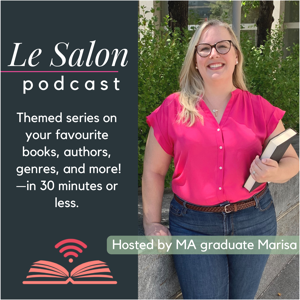
A little about what you can expect from the Le Salon Literary Discussion’s podcast.
Meet your host, Marisa, and learn about the French salon tradition this bookish business is based on. I am all about providing resources—from virtual discussions to breaking down literary theory—that enhance what it is you’re reading. It’s educational tidbits without the tuition!
Each podcast series will be on a specific theme and launched seasonally. This way we’ll dive into different writers, books, genres, and more—all in 30 minutes or less.
More resources for you:
From the publisher's feed