
Sign up to save your podcasts
Or



Why This Episode Matters
Healthcare organizations invest enormous effort in quality improvement projects, yet many struggle to achieve durable change. Too often, improvement is treated as something that happens at the frontline, while leadership behaviors, management systems, and organizational culture remain untouched.
In this episode, Dr. Lee Erickson reflects on decades of hands-on improvement work to explain why real progress depends less on tools and more on how leaders think, learn, and show up. The conversation challenges familiar assumptions about accountability, expertise, and authority and offers a grounded alternative rooted in scientific thinking, transparency, and coaching.
Key Ideas Explored
Takeaways for Quality Leaders
Continue the Conversation
Connect with Dr. Lee Erickson on LinkedIn or through her organization Adaptient to continue the dialogue.
This episode is especially useful for executives, physician leaders, and quality professionals trying to move beyond project-based improvement toward lasting cultural change.
If this conversation resonated, consider sharing it with a colleague or leaving a thoughtful review.
Resources & Frameworks Referenced
New episodes published every other Thursday at 7AM Eastern Time.
Leading Quality is a podcast for healthcare leaders committed to improving systems, culture, and outcomes.
If you found this episode valuable, follow the show, rate and review the podcast, or share it with a colleague working to improve care.
Connect with Jason Meadows on LinkedIn for more insights on healthcare quality and leadership.
New episodes published every other Thursday at 7AM Eastern Time.
Credits:
Host, Writer, and Executive Producer
Jason Meadows, MD
Produced by
Thrive Healthcare Improvement
Edited by
Milan Milosavljevic
Why This Episode Matters
Healthcare quality work often stalls not because of a lack of methods or data, but because organizations fail to build the leadership and culture needed to sustain improvement. In this episode, Dr. Todd Allen reflects on his journey from frontline emergency medicine to senior quality leadership at Intermountain Healthcare and The Queen’s Health Systems, and how his view of quality evolved from tools and measurement to leadership, trust, and psychological safety. The conversation explores the design and impact of physician leadership development as a core strategy for cultural change—offering a perspective on quality improvement that goes far beyond projects, dashboards, or checklists.
Key Ideas Explored
Takeaways for Quality Leaders
Continue the Conversation
Resources & Frameworks Referenced
New episodes published every other Thursday at 7AM Eastern Time.
Leading Quality is a podcast for healthcare leaders committed to improving systems, culture, and outcomes.
If you found this episode valuable, follow the show, rate and review the podcast, or share it with a colleague working to improve care.
Connect with Jason Meadows on LinkedIn for more insights on healthcare quality and leadership.
New episodes published every other Thursday at 7AM Eastern Time.
Credits:
Host, Writer, and Executive Producer
Jason Meadows, MD
Produced by
Thrive Healthcare Improvement
Edited by
Milan Milosavljevic
What if some of the biggest gains in patient safety aren’t inside hospitals at all—but at the kitchen table?
In this episode, Dr. Amy Billett and Dr. Chris Wong walk us through the groundbreaking, cross-disciplinary effort at Dana-Farber/Boston Children’s in collaboration with Ariadne Labs that cut ambulatory central-line–associated bloodstream infections (CLABSIs) for pediatric oncology patients by ~50%.
It’s a story of co-design, equity, humility, and design thinking—with families as full collaborators, not passive recipients.
Instead of pushing out top-down fixes, the team built the work with families, home-care nurses, and even a checklist engineer who transformed dense clinical instructions into clear, waterproof (yes, literally waterproof), one-page cognitive aids that could survive kitchens, bathrooms, and real homes. They aligned inpatient teaching with home supplies, created universal clean kits to eliminate equity gaps, rebuilt teach-backs to remove shame, and translated materials into Spanish and Arabic so safety didn’t depend on luck or language.
You’ll also hear how Amy’s three-decade career in pediatric quality and safety shaped the work—and how her mentorship of Chris helped fuel the next generation of system thinkers committed to closing the “know-do gap” in medicine.
At a time when more care is shifting homeward, this episode offers a playbook for making safety real beyond the hospital walls.
What We Cover
Key Takeaways
Connect with Today’s Guests
Dr. Amy Billett
Dr. Chris Wong
Leading Quality is a podcast for healthcare leaders committed to improving systems, culture, and outcomes.
If you found this episode valuable, follow the show, rate and review the podcast, or share it with a colleague working to improve care.
Connect with Jason Meadows on LinkedIn for more insights on healthcare quality and leadership.
New episodes published every other Thursday at 7AM Eastern Time.
Credits:
Host, Writer, and Executive Producer
Jason Meadows, MD
Produced by
Thrive Healthcare Improvement
Edited by
Milan Milosavljevic
What if the hardest part of quality isn’t finding the right answer, but making the right action unmistakable for the people who deliver care? That’s the thread we pull with Dr. Hilary Babcock—infectious disease physician, longtime infection prevention leader, and now chief quality officer helping steer a 12-hospital system of 33,000 people through transformation without losing its soul.
We talk about learning to lead beyond subject-matter expertise and how COVID pressure-tested every leadership instinct. Hilary shares how she and her team turned dashboards into decisions, building a centralized quality hub with deep resources and a one-page “top five” for each priority so busy managers could act today. She explains why outcome views must be paired with real-time process visibility—knowing not just that CLABSIs ticked up, but exactly who is overdue for a dressing change right now—so data becomes a map rather than a mirror.
We also go inside vaccine policy and trust. BJC implemented one of the nation’s earliest influenza mandates, treating it as a safety tool within a clear accommodation process. During the COVID rollout, transparency, values, and personal candor anchored tough choices about prioritization and access. The organization’s values—kindness, respect, excellence, safety, teamwork—moved from posters to practice, and a shift to centrally led, locally embedded quality teams helped spread best practices across hospitals while protecting local relationships.
If you care about healthcare quality, leadership, and culture, you’ll leave with practical tactics and renewed optimism. Hit play, then share this with a colleague who wants to turn analytics into action. If the conversation resonated, subscribe, leave a review, and tell us the one change you’ll try this week.
Leading Quality is a podcast for healthcare leaders committed to improving systems, culture, and outcomes.
If you found this episode valuable, follow the show, rate and review the podcast, or share it with a colleague working to improve care.
Connect with Jason Meadows on LinkedIn for more insights on healthcare quality and leadership.
New episodes published every other Thursday at 7AM Eastern Time.
Credits:
Host, Writer, and Executive Producer
Jason Meadows, MD
Produced by
Thrive Healthcare Improvement
Edited by
Milan Milosavljevic
A door swinging open in the OR. A tiny defect in IV tubing. Both seem trivial—until you realize they expose how fragile our systems really are.
In this episode, Allie Muniak, Executive Director of Health System Improvement at Health Quality BC, shows how human factors turns everyday frustration into lifesaving insight. We follow her path from psychology to system redesign, uncovering how design, teamwork, and curiosity prevent harm long before checklists or policies do.
Allie explains what human factors really means in healthcare—how people, technology, and environments interact under real-world pressure. She shares how normalizing observation as learning (not policing) helped surgical teams transform the safety checklist from a compliance tool into a culture of attention, anticipation, and role clarity.
Then, a gripping case study: ICU nurses reporting spontaneous over-infusions after a new pump rollout. Rather than defaulting to “retrain the user,” a multidisciplinary team dug deeper—partnering with engineers and vendors to discover a hidden tubing defect that led to a global recall of hundreds of millions of sets. It’s a powerful example of how listening to the front line and rejecting blame can reshape safety worldwide.
We close with lessons for every leader: slow down to see work as it’s really done, balance reactive review with proactive learning, and design systems that support clinicians instead of constraining them.
If you care about real root cause analysis and systems that make the right action the easy one, this episode is for you.
🔗 Additional Resources
📚 Mentioned in This Episode
Leading Quality is a podcast for healthcare leaders committed to improving systems, culture, and outcomes.
If you found this episode valuable, follow the show, rate and review the podcast, or share it with a colleague working to improve care.
Connect with Jason Meadows on LinkedIn for more insights on healthcare quality and leadership.
New episodes published every other Thursday at 7AM Eastern Time.
Credits:
Host, Writer, and Executive Producer
Jason Meadows, MD
Produced by
Thrive Healthcare Improvement
Edited by
Milan Milosavljevic
A small change at the bedside can ripple across an entire system. That’s the spark behind this conversation with Dr. Khalil Sivjee, Medical Director at Cleveland Clinic Canada and pulmonary–critical care physician, as we explore how data, design, and relentless measurement turn delays into decisions and anxiety into action.
We begin in the ICU, where a simple ventilator-liberation protocol challenged “that’s how we do it” and proved that even a junior clinician can drive measurable improvement. From there, Khalil zooms out to outpatient redesign—mapping the lung-cancer journey from first nodule to treatment and collapsing months-long waits by pre-ordering imaging, biopsies, and consults. Supported by EMR flags that signal when access drifts off target, this work redefines what it means to be data-driven.
We unpack “metrics that matter”—from reducing “scanxiety” through faster imaging turnaround to tracking safety events and service-line dashboards that keep teams focused on what patients actually feel. Then the conversation expands into the workplace, where Cleveland Clinic’s corporate advisory model helps companies build healthier environments through smarter design—air quality, ergonomics, mental-health screening, and on-site “pre-primary” checks that spot hypertension and diabetes early.
Finally, we look to the frontier of access: portable diagnostic kits and AI-enabled triage that bring care to students, remote workers, and underserved communities. The distance between a question and a clinical answer keeps shrinking.
The takeaway: the future of outpatient care is near-home, proactive, and measurable. Put the patient at the center, bring services to them, and measure everything that matters.
If this resonates, follow, share, and leave a review—and tell us the one metric you think every clinic should track.
🔗 Resources & Links
Guest Links
Specific References Mentioned in the Episode
Leading Quality is a podcast for healthcare leaders committed to improving systems, culture, and outcomes.
If you found this episode valuable, follow the show, rate and review the podcast, or share it with a colleague working to improve care.
Connect with Jason Meadows on LinkedIn for more insights on healthcare quality and leadership.
New episodes published every other Thursday at 7AM Eastern Time.
Credits:
Host, Writer, and Executive Producer
Jason Meadows, MD
Produced by
Thrive Healthcare Improvement
Edited by
Milan Milosavljevic
Safety isn’t a side project. It’s the operating system.
We sit down with Paul Lambrecht, a rare blend of front line paramedic sensibility and executive discipline, to unpack how high reliability organizing moves from idea to front line work. From standing up daily safety huddles to building a just culture where ARCC and SBAR actually get used, Paul explains how to turn near misses into gold, flatten authority gradients, and create a system where performance as intended becomes the norm.
We trace his journey through a post-merger health network that unified on a single EMR and chose safety as its identity, leading to dramatic reductions in preventable harm. Paul breaks down the five principles of high reliability—preoccupation with failure, sensitivity to operations, reluctance to simplify, deference to expertise, and commitment to resilience—and shows how to operationalize each with simple, durable tools. You’ll hear how a 20-minute, whole-house huddle can give real-time situational awareness, how a shared dashboard closes loops fast, and why top-down sponsorship paired with frontline ownership changes behavior at scale.
We also look forward. Human factors is reshaping patient safety by designing systems that make the right action the easy action—clear interfaces, standardized kits, cognitive offloading, and smarter workflows. Paul shares candid lessons on psychological safety and just culture, how to coach leaders who default to blame, and where to start if you’re resource-constrained: round for safety, mine near misses, train in ARCC and SBAR, and build reliability into daily routines.
If this conversation sparks ideas for your team, follow and share the show, leave a review to help others find it, and tell us: what’s the one safety ritual you’ll start this week?
Connect with Paul Lambrecht on LinkedIn
Additional Resources
Foundational Books
Peer-Reviewed / Authoritative Articles & HRO Background
Practical Tools & Frameworks
Leading Quality is a podcast for healthcare leaders committed to improving systems, culture, and outcomes.
If you found this episode valuable, follow the show, rate and review the podcast, or share it with a colleague working to improve care.
Connect with Jason Meadows on LinkedIn for more insights on healthcare quality and leadership.
New episodes published every other Thursday at 7AM Eastern Time.
Credits:
Host, Writer, and Executive Producer
Jason Meadows, MD
Produced by
Thrive Healthcare Improvement
Edited by
Milan Milosavljevic
As Stephen Covey once wrote, "Change happens at the speed of trust." This simple yet profound insight applied by this week's guest, Dr. Curt Smecher captures the essence of how British Columbia's Physician Quality Improvement program transformed healthcare from the ground up. Affectionately known as "Papa QI," Smecher shares the remarkable journey of creating a physician-led improvement movement that has trained over 1,600 clinicians across the province.
What makes this story exceptional isn't just the scale, but the approach. Rather than following the conventional wisdom of starting with executive buy-in, PQI began with frontline physicians and built upward. This counterintuitive strategy created a powerful foundation of clinical expertise while gradually earning administrative support through demonstrated results. The program's governance structure – with physicians, administrators, patients, and Doctors of BC as equal partners – represents a radical departure from healthcare's typical hierarchies.
Perhaps most revolutionary was the early decision to include patients as full participants in all aspects of the program. When questioned about involving patients in budgeting discussions, Smecher's response was telling: "Most of our patients know more about budgeting than our doctors do." This authentic partnership approach has been central to PQI's success and sustainability over its decade-long existence.
The program's impact extends beyond clinical improvements. Physicians trained through PQI demonstrate 40% higher engagement levels compared to their peers, suggesting that meaningful involvement in improvement work serves as a powerful antidote to burnout. Protected funding ensures resources remain dedicated to improvement rather than being diverted to immediate clinical pressures – a recognition that investing in system improvement requires dedicated space and time.
Looking ahead, Smecher describes PQI's evolution from building capacity to effectively utilizing that capacity, with the ultimate vision of "whole system quality" that addresses upstream factors rather than playing healthcare whack-a-mole. For anyone seeking to create lasting healthcare transformation, this conversation offers invaluable insights into building improvement capability that outlasts any single leader or initiative.
Leading Quality is a podcast for healthcare leaders committed to improving systems, culture, and outcomes.
If you found this episode valuable, follow the show, rate and review the podcast, or share it with a colleague working to improve care.
Connect with Jason Meadows on LinkedIn for more insights on healthcare quality and leadership.
New episodes published every other Thursday at 7AM Eastern Time.
Credits:
Host, Writer, and Executive Producer
Jason Meadows, MD
Produced by
Thrive Healthcare Improvement
Edited by
Milan Milosavljevic
What transforms a one-star hospital into a four-star institution in just four years? The answer lies not in fancy technology or complex solutions, but in approaching problems with genuine humility and data-driven focus.
Dr. Kimiyoshi Kobayashi brings a refreshing perspective to healthcare quality leadership in this illuminating conversation. As Chief Medical Officer at UMass Memorial Medical Center, he shares the critical mindset shift that helped him lead a remarkable quality transformation: "I always tried to remember when approaching somebody to approach each problem with humility." This approach—starting with curiosity rather than assumptions—has proven more valuable than any technological solution.
The discussion delves into common misconceptions about capacity command centers, revealing that despite their NASA-like appearance with monitors and co-located services, their effectiveness depends entirely on answering fundamental organizational questions. "It doesn't matter how shiny the room is," Dr. Kobayashi explains, "if you don't have difficult discussions around how decisions will be made when there are winners and losers."
For physicians transitioning into quality leadership, Dr. Kobayashi offers hard-earned wisdom from his own mistakes. He describes how his medical training conditioned him to be "answer-oriented," while leadership requires focusing on process and collaboration. This insight resonates deeply for clinical leaders who must unlearn the habit of individual problem-solving to embrace collaborative improvement.
Looking toward healthcare's future, Dr. Kobayashi envisions AI transforming quality measurement by enabling more comprehensive monitoring across all procedures and settings. Yet he maintains that human judgment will remain essential: "While data might get easier to extract, someone still has to tell the story and understand where workflows need to change."
Subscribe to Leading Quality for more conversations with healthcare leaders who are transforming patient care through innovative approaches to quality improvement.
Leading Quality is a podcast for healthcare leaders committed to improving systems, culture, and outcomes.
If you found this episode valuable, follow the show, rate and review the podcast, or share it with a colleague working to improve care.
Connect with Jason Meadows on LinkedIn for more insights on healthcare quality and leadership.
New episodes published every other Thursday at 7AM Eastern Time.
Credits:
Host, Writer, and Executive Producer
Jason Meadows, MD
Produced by
Thrive Healthcare Improvement
Edited by
Milan Milosavljevic
Dr. Lawrence Yang's powerful story begins with a stark confession: "My body had to say no for me because I didn't know how to do it myself." This candid admission sets the tone for a conversation that weaves together personal vulnerability, system transformation, and the science of hope.
As a family physician who once installed a bedroom and shower in his clinic to work longer hours, Dr. Yang's burnout journey will resonate with healthcare professionals everywhere. His turning point came through an unexpected avenue—quality improvement science—which provided both methodology and community when he needed it most. "I think quality improvement science is a science of hope," he explains, revealing how structured approaches to system problems can alleviate the moral distress that accompanies witnessing poor care experiences repeatedly.
The conversation explores British Columbia's innovative Physician Quality Improvement program, which has trained nearly 800 physicians through a unique collaboration between government and clinicians. This "silent army" represents tremendous potential for healthcare transformation, demonstrating what's possible when improvement capacity is intentionally built at scale. Dr. Yang artfully distinguishes between moral injury, moral distress, and burnout, while explaining how joy in work requires leaders to facilitate safety, purpose, autonomy, community, fairness, and recognition.
Looking toward 2030, Dr. Yang envisions primary care transformation through honest quality assessment, team-based models enabling everyone to work at top-of-scope, and transparent metrics aligned with the "sextuple aim." His advice to new clinicians cuts through professional martyrdom culture with refreshing clarity: "The system will not benefit from your martyrdom. What's in your job description is to model sustainability and wellness for your patients, colleagues, and family members."
This conversation isn't just about surviving in healthcare—it's about finding the courage to bring our full selves to the work we care about, and in doing so, creating the conditions for healthcare transformation. What might be possible if we approached system change with both vulnerability and courage? Dr. Yang's journey suggests the answer could be revolutionary.
Leading Quality is a podcast for healthcare leaders committed to improving systems, culture, and outcomes.
If you found this episode valuable, follow the show, rate and review the podcast, or share it with a colleague working to improve care.
Connect with Jason Meadows on LinkedIn for more insights on healthcare quality and leadership.
New episodes published every other Thursday at 7AM Eastern Time.
Credits:
Host, Writer, and Executive Producer
Jason Meadows, MD
Produced by
Thrive Healthcare Improvement
Edited by
Milan Milosavljevic
From the publisher's feed
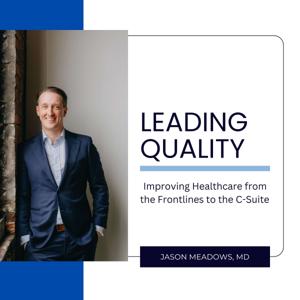
Welcome to Leading Quality, the show that dives into the real-world stories and strategies of healthcare quality improvement leaders at all levels, from Frontline Champions to C-Suite…