
Sign up to save your podcasts
Or

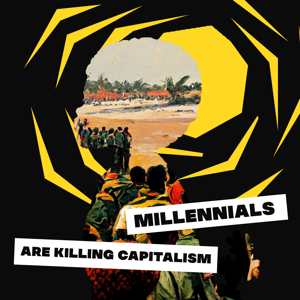

In this episode we are joined by Wassila Abboud to discuss her essay, "The Dining Table and the Drone." Our conversation begins with her meditations on grief in Lebanon. We explore how people often name today's grief through the language of past griefs — and what this transference between past and present reveals about the psyche under domination.
From there, we turn to Walter Benjamin's "angel of history" and why Abboud argues this analogy fails to capture Lebanon's relationship to catastrophe. We discuss why so many returns cluster around 1982, how that year fractured grief itself, reshaping collective memory, political imagination, and the vocabulary of resistance. We examine the paradoxical meaning of ceasefire, the choreography of repeated displacement, and the temporal logic of domination that ensures catastrophe is always waiting just beyond its declaration.
Our conversation also situates Lebanon's grief in relation to Gaza's present devastation, asking what it reveals about the impossibility of stability in a regional order sustained by capital accumulation and the extraction of life. We trace the sequence of events between 1978 and 1982 — from Operation Litani to the Camp David Accords and Israel's full-scale invasion of Beirut — not simply as military maneuvers but as the crystallization of a regional order that fractured Lebanon's political landscape and redefined resistance.
Wassila Abboud is a cultural worker and writer researching between Beirut and Amsterdam. Her work engages with critical theory, philosophy, and culture and takes on both a speculative and materialist approach, examining the conditions of past and present historical struggles. (Follow her on IG: @wassila_)
If you like what we do and want to support our ability to have more conversations like this. Please consider becoming a Patron. You can do so for as little as a 1 Dollar a month at patreon.com/millennialsarekillingcapitalism
 View all episodes
 By Millennials Are Killing Capitalism

4.7
419419 ratings
In this episode we are joined by Wassila Abboud to discuss her essay, "The Dining Table and the Drone." Our conversation begins with her meditations on grief in Lebanon. We explore how people often name today's grief through the language of past griefs — and what this transference between past and present reveals about the psyche under domination.
From there, we turn to Walter Benjamin's "angel of history" and why Abboud argues this analogy fails to capture Lebanon's relationship to catastrophe. We discuss why so many returns cluster around 1982, how that year fractured grief itself, reshaping collective memory, political imagination, and the vocabulary of resistance. We examine the paradoxical meaning of ceasefire, the choreography of repeated displacement, and the temporal logic of domination that ensures catastrophe is always waiting just beyond its declaration.
Our conversation also situates Lebanon's grief in relation to Gaza's present devastation, asking what it reveals about the impossibility of stability in a regional order sustained by capital accumulation and the extraction of life. We trace the sequence of events between 1978 and 1982 — from Operation Litani to the Camp David Accords and Israel's full-scale invasion of Beirut — not simply as military maneuvers but as the crystallization of a regional order that fractured Lebanon's political landscape and redefined resistance.
Wassila Abboud is a cultural worker and writer researching between Beirut and Amsterdam. Her work engages with critical theory, philosophy, and culture and takes on both a speculative and materialist approach, examining the conditions of past and present historical struggles. (Follow her on IG: @wassila_)
If you like what we do and want to support our ability to have more conversations like this. Please consider becoming a Patron. You can do so for as little as a 1 Dollar a month at patreon.com/millennialsarekillingcapitalism

1,858 Listeners

1,460 Listeners

1,590 Listeners

340 Listeners

3,330 Listeners

3,916 Listeners
937 Listeners
323 Listeners

550 Listeners

1,125 Listeners
1,012 Listeners

252 Listeners

605 Listeners

557 Listeners

492 Listeners