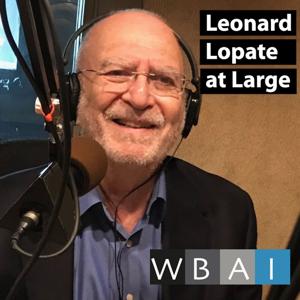
Leonard Lopate at Large on WBAI Radio in New York

Leonard Lopate at Large on WBAI Radio in New York

By Leonard Lopate at Large on WBAI Radio in New YorkArts
Download on the App Store

Leonard Lopate at Large on WBAI Radio in New York episodes

  • Edward L. Widmer discusses a new Walt Whitman exhibit he curated at the Morgan Museum. (6/18/19)
    “Comrades! I am the bard of Democracy,” iconic American poet Walt Whitman wrote in his notebook in 1859. Over his 73 years (1819–1892) he made good on that claim. As Whitman bore witness to the rise of New York City, the Civil War and other major transformations in American life, he attempted to reconcile the famous contradictions of this country through his inclusivity and his prolific body of work. The author of one of the most celebrated texts of American literature—1855’s “Leaves of Grass”—came from humble origins in Long Island and Brooklyn but eventually earned a global audience that has never stopped growing. In this installment of Leonard Lopate on WBAI, Edward L. Widmer talks about a new exhibition he curated at the Morgan Library and Museum celebrating the 200th anniversary of Walt Whitman’s birth.
    59 min
  • Kathryn and Ross Petras take your word usage and pronunciation questions. (6/14/19)
    Have you ever wondered about the correct pronunciation of a word you use all the time. Are there words that you think you’re hearing people mispronounce or misuse all the time? In this installment of “Leonard Lopate at Large” on WBAI, Kathryn and Ross Petras, authors of their New York Times bestseller “You're Saying It Wrong: A Pronunciation Guide to the 150 Most Commonly Mispronounced Words--and Their Tangled Histories of Misuse” and “That Doesn't Mean What You Think It Means: The 150 Most Commonly Misused Words and Their Tangled Histories” take your questions about this crazy thing we call the English language.
    59 min
  • Shane Bauer discusses his Mother Jones cover story Behind The Lines In Syria. (6/13/19)
    “I went to Syria to understand America’s role in one of the 21st century’s greatest tragedies,” writes Shane Bauer in his cover article for the current issue of Mother Jones. In “Behind The Lines In Syria: Special Forces, Jihadists, and ISIS Wives Went In. I Decided To Follow Them.” he puts the disturbing images and shocking headlines coming out of that country into perspective with his own first-hand experience. Join us for a discussion with Shane Bauer on the state of Syria today, in this edition of “Leonard Lopate at Large” on WBAI.
    59 min
  • Colin Davey on the history of the American Museum of Natural History (6/12/19)
    The American Museum of Natural History is one of New York City’s most beloved institutions, and one of the largest, most celebrated museums in the world. Located across from Central Park, the sprawling structure, spanning four city blocks, is a fascinating conglomeration of many buildings of diverse architectural styles built over a period of 150 years. The first book to tell the history of the museum from an architectural perspective, Colin Davey’s “The American Museum of Natural History and How It Got That Way” goes beyond the buildings themselves and explores the role the institution has played in the development of science in the past three centuries. In this installment of Leonard Lopate at Large on WBAI, Colin Davey tells you everything you ever wanted to know about the American Museum of Natural History.
    1 hr
  • Dr. Matt McCarthy discusses his book Superbugs: The Race to Stop an Epidemic. (6/11/19)
    In his new book “Superbugs: The Race to Stop an Epidemic,” Dr. Matt McCarthy explores the history of bacteria and antibiotics, from Alexander Fleming's discovery of penicillin, to obscure sources of innovative new medicines to the cutting-edge DNA manipulation known as CRISPR, bringing to light how we arrived at this juncture of both incredible breakthrough and extreme vulnerability. His professional life as a physician, researcher and ethics professor has put Dr. Matt McCarthy is on the front lines of a groundbreaking clinical trial testing a new antibiotic to fight lethal superbugs, bacteria that have built up resistance to the life-saving drugs in our rapidly dwindling arsenal. Join us for a conversation with Dr. Matt McCarthy about this critical issue in this installment of “Leonard Lopate at Large” on WBAI.
    57 min
  • Dr. Tia Powell talks about her book Dementia Reimagined. (6/10/19)
    Despite being a physician and a bioethicist, Tia Powell wasn't prepared to address the challenges she faced when her grandmother, and then her mother, were diagnosed with dementia. The statistical odds they were facing weren't great. In the US, 10,000 baby boomers turn 65 every day; by the time a person reaches 85, their chances of having dementia approach 50 percent. And with no cure and none coming soon (despite the perpetual promises from pharmaceutical companies), Dr. Powell's goal is to move the conversation away from an exclusive focus on cure to a genuine appreciation of care—what we can do for those who have dementia, and how to keep life meaningful and even joyful. Join us for a conversation with Dr. Tia Powell about her book "Dementia Reimagined: Building a Life of Joy and Dignity from Beginning to End" in this installment of “Leonard Lopate at Large” on WBAI.
    58 min
  • Josh Howard talks about his documentary The Lavender Scare. (6/7/19)
    With the United States gripped in the panic of the 1950s Cold War, President Dwight D. Eisenhower deemed homosexuals to be “security risks” and vowed to rid the federal government of all employees discovered to be gay or lesbian. Over the next four decades, tens of thousands of government workers would lose their jobs for no reason other than their sexual orientation. But the mass firings had an unintended effect—they stirred outrage in the gay community, helped ignite the gay rights movement and thrust an unlikely hero into the forefront of the LGBTQ fight for equality. Partly based on the award-winning book by historian David K. Johnson, Emmy Award-winning director Josh Howard’s documentary “The Lavender Scare” covers a little-known chapter of American history and is a timely reminder of the need for vigilance and social action when civil liberties are under attack. Join us for a discussion of “The Lavender Scare” and the events that inspired it, in this edition of “Leonard Lopate at Large” on WBAI.
    56 min
  • Pete Muroski takes your gardening questions as we head into summer. (6/6/19)
    In this installment of “Leonard Lopate at Large” on WBAI, we open the phones so that gardening expert Pete Muroski can take your questions on all things botanical. In this installment of “Leonard Lopate at Large” on WBAI, we open the phones so that gardening expert Pete Muroski can take your questions on all things botanical. If you’re the type of person who goes all out in the garden for the summer months or simply interested in possibly picking up a new hobby, you won’t want to miss this show.
    59 min
  • Catherine Whitlock on her book Ten Women Who Changed Science and the World (6/5/19)
    It’s only been a little over a century since the Nobel Prize in science was first awarded to a woman. However, after Marie Curie’s 1911 accolade, 17 other women―including two in 2018―have been so honored (Curie also won the award a second time). In her new book “Ten Women Who Changed Science and the World: Marie Curie, Rita Levi-Montalicini, Chien-Shiung Wu, Virginia Apgar, and More (Trailblazers, Pioneers, and Revolutionaries),” co-written with Rhodri Evans, Catherine Whitlock explores the lives of Curie, three other female Nobel Prize winners and six other women who broke through gender discrimination in a variety of fields to help shape our world with their extraordinary discoveries and inventions. Join us for a discussion with Catherine Whitlock about the 10 women who inspired her book in this installment of “Leonard Lopate at Large” on WBAI.

    1 hr
  • Phillip Lopate on the greatest essays the world has ever known (6/3/19)
    Novelist, critic, poet and essayist Phillip Lopate has received a John Simon Guggenheim Fellowship, a New York Public Library Center for Scholars and Writers Fellowship, two National Endowment for the Arts grants, and two New York Foundation for the Arts grants. He is currently a professor at Columbia University’s School of the Arts, where he teaches nonfiction writing. In this installment of “Leonard Lopate at Large” on WBAI, Phillip considers not only what makes an essay great, but what makes an essay an essay.
    58 min

About Leonard Lopate at Large on WBAI Radio in New York

From the publisher's feed

Leonard Lopate, the Peabody and James Beard Award-winning broadcaster, is back on WBAI where he began his radio career. Tune in weekdays from 1-2pm at 99.5fm New York or you can listen to the show…