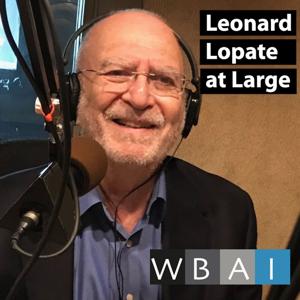
Leonard Lopate at Large on WBAI Radio in New York

Leonard Lopate at Large on WBAI Radio in New York

By Leonard Lopate at Large on WBAI Radio in New YorkArts
Download on the App Store

Leonard Lopate at Large on WBAI Radio in New York episodes

  • Rory Chase and Jonathan White give Leonard a masterclass in artisanal cheesemaking. (July 27, 2018)
    Chaseholm Farm Creamery is a grass-based dairy farm nestled in a 350-acre patchwork of pastures, crop land, woods and waterways located just outside of Pine Plains, NY. The Creamery was founded in 2007 when Rory Chase returned home to the farm and started making cheese, retrofitting a barn his grandfather built in the early 1930s to serve as a cheesemaking plant and aging cave. It is one of only a handful of Farmstead outfits producing cow’s milk cheese from their farm’s own herd in the state of New York. Bobolink Dairy was founded by Nina and Jonathan White in 2002, on leased farmland, before the pair eventually moved their operation to a 186-acre farmstead in Milford, NJ in March of 2010. Each season, the dairy milks approximately 50 cows with a bumper crop of young heifers and bulls of their own new breed, the Bobolink Blacks, which are the result of crossing several common "modern" dairy breeds (Ayrshire, Guernsey, Jersey and others) with the ancient Kerry cattle of Ireland. In this Friday edition of “Leonard Lopate at Large” Rory Chase and Jonathan White give Leonard a masterclass in artisanal cheesemaking.
    57 min
  • New York Times Bureau Chief Alissa Rubin talks European politics with Leonard. (July 26, 2018)
    Few journalists have a resume as formidable as Alissa Rubin. The Paris bureau chief for the New York Times initially joined the paper in January of 2007 as a correspondent in Baghdad. In the fall of 2008 she became the bureau chief there before moving to Kabul, Afghanistan the following year. Alissa served as the bureau chief in that city for almost four years, departing in the late summer of 2013 to take up the job her current post. But she has continued to work on projects in Afghanistan and joined the Times team covering the Islamic State’s takeover of northern and western Iraq in 2014. That August, she was seriously injured and nearly killed in a helicopter crash in Kurdistan, covering the beleaguered Yazidis. Alissa is a recipient of the 2016 Pulitzer Prize for international reporting, the 2015 John Chancellor Award for journalistic achievement and the 2010 Overseas Press Association award for her piece on women suicide bombers titled “How Baida Wanted to Die.” On Thursday’s show, Alissa gives Leonard an update on the state of Europe today.
    1 hr
  • Elizabeth Anderson and Leonard discuss the American workforce. (July 25, 2018)
    Are we under authoritarian rule at work?
    In her book “Private Government: How Employers Rule Our Lives (And Why We Don’t Talk About It),” Elizabeth Anderson explores the deplorable working conditions that persist right here in the US.
    “In ‘Private Government,’ Anderson explores a striking American contradiction,” wrote the New Yorker’s Joshua Rothman. “On the one hand, we are a freedom-obsessed society, wary of government intrusion into our private lives; on the other, we allow ourselves to be tyrannized by our bosses, who enjoy broad powers of micromanagement and coercion.”
    Join Leonard and Elizabeth for a conversation about the state of the American workplace.

    57 min
  • Elizabeth Anderson and Leonard discuss the American workforce. (July 25, 2018)
    Are we under authoritarian rule at work?
    In her book “Private Government: How Employers Rule Our Lives (And Why We Don’t Talk About It),” Elizabeth Anderson explores the deplorable working conditions that persist right here in the US.
    “In ‘Private Government,’ Anderson explores a striking American contradiction,” wrote the New Yorker’s Joshua Rothman. “On the one hand, we are a freedom-obsessed society, wary of government intrusion into our private lives; on the other, we allow ourselves to be tyrannized by our bosses, who enjoy broad powers of micromanagement and coercion.”
    Join Leonard and Elizabeth for a conversation about the state of the American workplace.
    57 min
  • Cristin Tierney and Nina del Rio tell Leonard about the art scene. (July 24, 2018)
    Have you ever wondered what it’s like to own your own gallery? Maybe you’re mystified about what drives the constantly fluctuating value of artwork. On Tuesday’s “Leonard Lopate at Large” two giants of the New York City art scene will give you a peek into one of the city’s chief cultural exports. Cristin Tierney is the owner of Cristin Tierney Gallery in Chelsea. Cristin explained the difference between her role as a gallerist and what an art dealer does to the author Jackie Battenfield for her book “The Artist's Guide: How to Make a Living Doing What You Love,” published in 2009. “A dealer is dealing with canvases, objects, videos, or whatever the case may be. A gallerist is dealing with a career,” she said. Sotheby’s Senior Vice President Nina del Rio began her career with the company, considered one of the world’s premiere brokers of fine art, as a cataloguer in the prints department. In 1999, she began working on the launch of Sotheby’s online auction site before becoming the department head of Museum Services. Don’t miss this rare glimpse into the art world with two people who know it as well as anyone.
    57 min

About Leonard Lopate at Large on WBAI Radio in New York

From the publisher's feed

Leonard Lopate, the Peabody and James Beard Award-winning broadcaster, is back on WBAI where he began his radio career. Tune in weekdays from 1-2pm at 99.5fm New York or you can listen to the show…