
Sign up to save your podcasts
Or

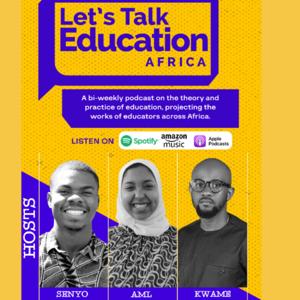


In this episode of Let’s Talk Education Africa, we explore character development in Ghana’s Senior High School curriculum, looking beyond academic performance to the values, attitudes and choices that shape young people.
Senyo speaks with Mr. Bismak Tay, an international leadership consultant and founder and CEO of Bismak Tay Leadership Solutions, to examine school indiscipline, corporal punishment, positive discipline, and teachers' role as models of character.
Can values taught in the classroom translate into values lived beyond it? After all, knowing what is right and choosing to do what is right are not always the same thing.
Should Free SHS be for everyone, or should it be targeted at those who need it most?
At Let’s Talk Education Africa’s first-ever live event, La Presbyterian Senior High School and Kinbu Secondary Technical School faced off in an intense debate on the motion: “The Free SHS Policy Must Be Targeted at Those Who Really Need It.”
The debate brought two compelling perspectives to the table. While one side argued that targeting Free SHS preserves public funds and elevates educational quality for the underprivileged, the other stood firm on universal access, cautioning that targeting risks exclusion, inequality, and social division.
With strong arguments, sharp rebuttals, and passionate delivery from both sides, the students turned a policy question into a conversation about the future of quality and accessible education in Ghana.
And while the debate had a winner, the bigger win was getting young people thinking, questioning and engaging with the policies that shape their education and their future.
Should Free SHS be for everyone, or should it be targeted at those who need it most?
At Let’s Talk Education Africa’s first-ever live event, La Presbyterian Senior High School and Kinbu Secondary Technical School faced off in an intense debate on the motion: “The Free SHS Policy Must Be Targeted at Those Who Really Need It.”
The debate brought two compelling perspectives to the table. While one side argued that targeting Free SHS preserves public funds and elevates educational quality for the underprivileged, the other stood firm on universal access, cautioning that targeting risks exclusion, inequality, and social division
With strong arguments, sharp rebuttals, and passionate delivery from both sides, the students turned a policy question into a conversation about the future of quality and accessible education in Ghana.
And while the debate had a winner, the bigger win was getting young people thinking, questioning and engaging with the policies that shape their education and their future.
At our first-ever in-person event, Let’s Talk Education Africa brought together voices from different perspectives for a candid conversation about the state and future of education in Ghana.
This special panel discussion, moderated by Senyo and featuring Elizabeth Patterson and Divine Kpe, explored the barriers standing between Ghanaian students and a genuinely quality Senior High School education. The conversation touched on unequal resources between schools, the realities faced by students from less-privileged backgrounds, gender-related barriers, examination malpractice, the weight placed on WASSCE, and growing concerns around discipline in our schools.
Can we really call education quality when where you go determines what you have access to?
Should one examination determine what a student has learned over three years?
And are we doing enough to ensure that no student is left behind?
🎧 Listen in and join the conversation as we answer these questions and more.
Access to quality education remains one of Africa's greatest challenges. Not because schools are unavailable, but because affordability, financing, and long-term sustainability continue to limit learning opportunities for millions of children across the continent.
In this episode, Senyo speaks with Irene, founder of the IDP Foundation and author of The School in the Market, about IDP's approach to strengthening low-fee non-state schools through sustainable financing.
They discuss the role of governments, philanthropy, and local entrepreneurship in expanding access to quality education, as well as practical lessons for those seeking to replicate this model in other contexts.
Maybe the problem isn't that young people can't learn tech. Maybe it's how we've been teaching it.
In this episode, Senyo speaks with Michelle, founder of Nyansapo Institute, about why too many learners leave school knowing the theory but lacking the skills to build, create, and solve real problems. They discuss what it takes to prepare young people for careers in tech, why hands-on learning matters more than memorization, and how giving learners real projects (not just lessons) can completely change the way they see STEM.
In this episode, Senyo speaks with Fatma, an education leader whose journey spans public health, child protection, international development, and school leadership, to explore what future-ready education looks like in a world shaped by rapid technological change, artificial intelligence, and evolving workforce demands.Fatma reflects on the purpose of schooling, the skills young people need to thrive, and why critical thinking, leadership, communication, and adaptability are becoming increasingly important. She challenges us to rethink the role of school, the limits of exam-driven learning, and why the future of education begins and ends with the teacher.
In this episode, Aml speaks with Evans Sinkari, Country Director of Right to Play Ghana, an international NGO dedicated to educating, protecting, and empowering children through the power of play.
This conversation addresses the key barriers to children's access to quality education in Ghana, the importance of child-centered learning, and how collaboration among educators, families, and community stakeholders can create lasting change. Evans also shares inspiring stories from the field and gives a glimpse into Right to Play's exciting plans to scale early childhood education training across communities.
In this episode, Senyo speaks with education economist and researcher Dr. Peter Anti-Partey on the realities of education financing in Ghana and across Africa. Far from a simple case of "no money," Dr. Anti-Partey reveals how political interests, inefficient spending, and a disregard for data-driven equity are stalling educational progress.
The episode further examines the role of citizens and civil society in demanding long-term reforms and why sustainable educational development requires leaders willing to think beyond election cycles. Drawing on his extensive field experience with organizations like UNESCO and UNICEF, Dr. Anti-Partey demonstrates that the true crisis isn't just about how much we spend, but how wisely and equitably we invest in the next generation.
In this episode, Kwame speaks with Prof. Ulrich Paquet, Research Scientist at Google DeepMind and Director of AI at the African Institute for Mathematical Sciences (AIMS), and Sepehr Hejazi Moghadam, Senior Programme Manager at Google.org and lead of the Science Ecosystem portfolio, to unpack the launch of a freely accessible AI curriculum. Developed from the ground up with African educators to include culturally relevant cases, the programme is specifically designed to close the technical skills gap facing African universities and students.
With Nobel Prize-winning AI tools like AlphaFold already impacting the work of 25,000 African researchers, and the Ubuntu philosophy "I am because we are" shaping the heart of responsible innovation, this conversation highlights why equipping African AI talent is not just a regional priority, but a global one. Because, as Sepehr puts it: "AI systems reflect those who build them."
Google is betting on African brilliance to close the digital gap and reshape the global tech landscape. Tune in to learn how you can get started on the curriculum today at skills.google.
From the publisher's feed