
Sign up to save your podcasts
Or

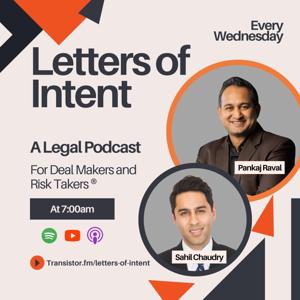


In this episode breakdown, Pankaj Raval and Sahil Chaudry follow the money behind the no money down business acquisition. Working from the SBA's newly revised lending rulebook, SOP 50 10 8.1, they map where acquisition money actually comes from and what each funder takes in return.
Through this practical analysis, Pankaj and Sahil extract critical rules on SBA down payments, seller financing, and leveraged deal structures, that apply directly to founders and leaders of growing private enterprises buying, selling, or financing a business.
This podcast is for informational purposes only and does not constitute legal advice.
Takeaways
Soundbites
Keywords
No Money Down, Business Acquisition, SBA 7(a) Loan, SOP 50 10 8.1, Equity Injection, Seller Financing, Seller Note, Fraudulent Transfer, Merchant Cash Advance, Leveraged Buyout
🔗 Learn More
Website: carbonlg.com
Connect with Pankaj: https://www.linkedin.com/in/pankaj-raval/
Connect with Sahil: https://www.linkedin.com/in/sahil-chaudry-6047305/
Carbon Law Group's links: https://linktr.ee/carbonlawgroup
Click Here To Schedule A Call With Us
In this episode breakdown, Pankaj Raval and Sahil Chaudry return to the 50/50 partner dispute from Part 1 and follow it into its most dangerous week. Working through the Texas Business Organizations Code and the California Corporations Code, they unpack what a bank lockout actually means, what records a locked-out owner can demand, and what really happens when a co-owner asks a court to end the company.
Through this practical analysis, Pankaj and Sahil extract critical lessons on control, records access, and exit strategy, that apply directly to founders and leaders of growing private enterprises sharing ownership with a partner.
This podcast is for informational purposes only and does not constitute legal advice.
Takeaways
Soundbites
Keywords
50/50 Partnership, LLC Deadlock, Partner Dispute, Operating Agreement, Member Inspection Rights, Judicial Dissolution, Texas Business Organizations Code, California Corporations Code, Fair Market Value Buyout, Signature Authority
🔗 Learn More
Website: carbonlg.com
Connect with Pankaj: https://www.linkedin.com/in/pankaj-raval/
Connect with Sahil: https://www.linkedin.com/in/sahil-chaudry-6047305/
Carbon Law Group's links: https://linktr.ee/carbonlawgroup
Click Here To Schedule A Call With Us
In this episode breakdown, Pankaj Raval and Sahil Chaudry take apart the 50/50 partnership, the most common and least documented ownership structure in private business. They work through a line of recent state court decisions and the LLC statutes of Texas, California, and Delaware to answer one question a handshake never answers: does your co-founder actually owe you anything?
Through this practical analysis, Pankaj and Sahil extract critical distinctions in default entity law, governance design, and buy-sell mechanics, that apply directly to founders and leaders of growing private enterprises operating on trust instead of paper.
This podcast is for informational purposes only and does not constitute legal advice.
Takeaways
The Default Rules of Your State: A partnership with no governing document does not operate without rules. It operates under the rules the state wrote, and those rules differ sharply depending on where the entity was formed. Founders who file cheaply and quickly online rarely learn which set they accepted.
Separating Formal Duty from Informal Trust: Courts in some states have held that co-ownership alone creates no formal fiduciary duty between members. A narrower informal duty can still exist, but it has to have existed before and apart from the venture now in dispute, and the other side has to have traded on it.
The Manager-Managed Filing Trap: A California LLC is member-managed by default unless the election appears in both the articles of organization and the operating agreement. Signing a detailed manager-managed agreement while the articles say otherwise can leave the entity carrying full member-to-member duties nobody intended to take on.
The Machinery of a Workable Buy-Sell: A buy-sell with a trigger and no price mechanism resolves nothing. The shotgun clause is elegant but favors whichever owner can raise cash, which makes it a purchase option rather than a coin flip, so a formula price or a defined appraisal process usually serves a founder pair better.
Soundbites
"Twenty years of friendship buys you an enormous amount as a human being. As a matter of default entity law in Texas, it buys you zero."
"So the default is not no deal, the default is somebody else's deal."
"And deadlock does not announce itself, it accumulates."
"And the answer to that can be yes. Asymmetry is completely fine. Undocumented asymmetry is a lawsuit."
Keywords
50/50 Partnership, Fiduciary Duty, LLC Operating Agreement, Member Managed LLC, Buy Sell Agreement, Co-Founder Disputes, Corporate Governance, Entity Formation, Deadlock Provisions, Business Partnership Law
🔗 Learn More
Website: carbonlg.com
Connect with Pankaj: https://www.linkedin.com/in/pankaj-raval/
Connect with Sahil: https://www.linkedin.com/in/sahil-chaudry-6047305/
Carbon Law Group's links: https://linktr.ee/carbonlawgroup
Click Here To Schedule A Call With Us
In this episode breakdown, Pankaj Raval and Sahil Chaudry take apart the single most common question they get from business owners — LLC or S corp — and show why it is the wrong question. They work through the 2026 Social Security wage base, the qualified business income deduction under Section 199A, the eligibility rules that quietly govern who is allowed to hold S corp stock, and the Eighth Circuit's decision in the Watson case, extracting the framework a founder actually needs before making an election.
Through this practical analysis, Pankaj and Sahil extract critical distinctions, thresholds, and failure points, that apply directly to founders and leaders of growing private enterprises choosing how their company is formed and how it is taxed.
This podcast is for informational purposes only and does not constitute legal advice.
Takeaways
The Category Error at the Center of the Question: An LLC is a state law entity — you file with the Secretary of State, you get limited liability, you get an operating agreement. An S corporation is a federal tax election filed on Form 2553. They are different layers, which means an LLC can be taxed as an S corp. One entity, two labels.
Two Questions, Not One: The useful reframe is to ask what legal wrapper you want, and separately, how you want that wrapper taxed. The answer to the first is almost always an LLC, because it is inexpensive, flexible, and the governance document is whatever the partners agree it should be. Skip the election entirely and you still get an answer — a default one nobody chose on purpose.
The S Corporation Guest List: The election carries eligibility restrictions most founders never see at formation: no more than 100 shareholders, individuals and qualifying trusts only, no non-resident alien holders, no entity shareholders, and one class of stock. Violate any of them and the election terminates. There is no warning letter.
Reasonable Compensation and the Watson Standard: David Watson, an Iowa CPA, held a 25% interest in an accounting firm through an S corporation and paid himself a $24,000 salary against $203,000 in distributions in 2002. The IRS valued the market rate for his work at $91,044, the district court recharacterized roughly $67,000 a year as wages, and the Eighth Circuit affirmed in 2012. Intent does not control and the label does not control — substance does.
Soundbites
"One is a state legal wrapper, the other is a federal tax setting. If you're choosing between them, you're asking the question backwards."
"Right, you cannot paperwork your way out of economic reality."
"So the working rule is pay yourself what you'd have to pay a stranger to do your job and write down how you got to that number before anyone asks, not after."
"…that election terminating is you know, there's no warning letter. It just terminates, which is totally fine when it's you and your co-founder and your brother in law. It's not fine on the day a fund wants to buy in, which is the entire subject of next week's episode."
Keywords
LLC Vs S Corp, S Corporation Election, Form 2553, Reasonable Compensation, Watson Case, Section 199A, Qualified Business Income, Social Security Wage Base, California Franchise Tax, Entity Structure
🔗 Learn More
Website: carbonlg.com
Connect with Pankaj: https://www.linkedin.com/in/pankaj-raval/
Connect with Sahil: https://www.linkedin.com/in/sahil-chaudry-6047305/
Carbon Law Group's links: https://linktr.ee/carbonlawgroup
Click Here To Schedule A Call With Us
In this episode breakdown, Pankaj Raval and Sahil Chaudry demystify one of the most critical (and often misunderstood) elements of startup compensation: the 409A valuation. Using a composite case study of "Meridian Robotics," they explain how a company can do everything right and still inadvertently hit a key employee with a massive, unexpected tax bill on phantom income.
Through this detailed analysis, Pankaj and Sahil unpack the hidden dangers of the 409A Safe Harbor, exploring how material economic events—like signing a Letter of Intent—can instantly invalidate a valuation and expose both founders and employees to massive liabilities.
Takeaways
Soundbites
Keywords
409A Valuation, Stock Options, Startup Equity, Phantom Income, Safe Harbor, Fair Market Value, Letter of Intent, IRS Section 409A, Corporate Law, Deferred Compensation.
🔗 Learn More
Website: carbonlg.com
Connect with Pankaj: https://www.linkedin.com/in/pankaj-raval/
Connect with Sahil: https://www.linkedin.com/in/sahil-chaudry-6047305/
Carbon Law Group's links: https://linktr.ee/carbonlawgroup
Click Here To Schedule A Call With Us
In this special episode of Letters of Intent, co-hosts Pankaj Raval and Sahil Chaudry peel back the curtain to discuss the human side of law, business, and entrepreneurship. They trace their relationship back to its origins in a shared tent during an Indicorps service project in India, unpacking how that transformative experience shaped their worldview and their legal practice today.
Through this philosophical conversation, Pankaj and Sahil explain why they reject the traditional "savior" mindset of public service, how they integrate generosity into their business model, and why democratizing complex legal information is central to the mission of Carbon Law Group.
Takeaways
Soundbites
Keywords
Public Service, Entrepreneurship, Indicorps, Corporate Law, Business Strategy, Carbon Law Group, Legal Advice, Dealmaking, Value Creation, Democratizing Information
🔗 Learn More
Website: carbonlg.com
Connect with Pankaj: https://www.linkedin.com/in/pankaj-raval/
Connect with Sahil: https://www.linkedin.com/in/sahil-chaudry-6047305/
Carbon Law Group's links: https://linktr.ee/carbonlawgroup
Click Here To Schedule A Call With Us
In this episode breakdown, Pankaj Raval and Sahil Chaudry dissect the corporate architecture behind the NBA's salary cap circumvention findings against the LA Clippers. They trace the three-legged payment structure at the center of the case — a capital source, an intermediary partner company, and a single-member holding LLC — and extract what it reveals about how entity layers actually behave under investigation.
Through this practical analysis, Pankaj and Sahil extract critical distinctions around contractual intent, economic substance, and third-party exposure, that apply directly to founders and leaders of growing private enterprises building entity structures they expect to hold up under scrutiny.
This podcast is for informational purposes only and does not constitute legal advice.
Takeaways
Soundbites
Keywords
Salary Cap Circumvention, Corporate Veil, Alter Ego Doctrine, Economic Substance Doctrine, Single-Member LLC, Special Purpose Vehicle, Forensic Accounting, Bankruptcy Discovery, Entity Structuring, Third-Party Risk
🔗 Learn More
Website: carbonlg.com
Connect with Pankaj: https://www.linkedin.com/in/pankaj-raval/
Connect with Sahil: https://www.linkedin.com/in/sahil-chaudry-6047305/
Carbon Law Group's links: https://linktr.ee/carbonlawgroup
Click Here To Schedule A Call With Us
In this episode breakdown, Pankaj Raval and Sahil Chaudry tackle a rapidly evolving area of law that is currently dominating the entertainment industry and corporate boardrooms alike: The Right of Publicity in the era of AI clones and deepfakes.
Prompted by a surge of client inquiries from actors and content creators, Pankaj and Sahil dissect the critical difference between copyright (what you make) and the right of publicity (who you are). They unpack the legal history of imitation, the dangers of assigning your voice in perpetuity, and the massive implications of the pending federal No Fakes Act for founders and creators.
Takeaways
Soundbites
Keywords
Right of Publicity, Copyright Law, Artificial Intelligence, Deepfakes, No Fakes Act, Entertainment Law, Corporate Law, Dealmaking, Risk Management, Contract Negotiation
🔗 Learn More
Website: carbonlg.com
Connect with Pankaj: https://www.linkedin.com/in/pankaj-raval/
Connect with Sahil: https://www.linkedin.com/in/sahil-chaudry-6047305/
Carbon Law Group's links: https://linktr.ee/carbonlawgroup
Click Here To Schedule A Call With Us
In this episode breakdown, Pankaj Raval dives into one of the most instructive cautionary tales in modern business history: the acquisition of FanDuel. When the daily fantasy sports giant was sold for nearly $600 million, the founders and rank-and-file employees famously walked away with nothing, while certain executives and preferred investors made tens of millions.
Through a detailed analysis of this transaction, Pankaj unpacks the complex mechanisms of venture capital and private equity deals. He extracts critical lessons on liquidation preferences, drag-along rights, and management carve-outs, providing actionable advice for founders negotiating their next term sheet.
Takeaways
Soundbites
Keywords
Liquidation Preference, Drag-Along Rights, Term Sheets, Venture Capital, Private Equity, FanDuel, Cap Table Management, Exit Waterfall, Corporate Governance, Founders.
🔗 Learn More
Website: carbonlg.com
Connect with Pankaj: https://www.linkedin.com/in/pankaj-raval/
Connect with Sahil: https://www.linkedin.com/in/sahil-chaudry-6047305/
Carbon Law Group's links: https://linktr.ee/carbonlawgroup
Click Here To Schedule A Call With Us
In this episode breakdown, Pankaj Raval and Sahil Chaudry dive into the complex world of executive compensation and employee incentive plans. Using a real-world SEC filing as a case study, they demystify "Phantom Equity" and explain how founders can reward key employees with the economic benefits of ownership—without actually giving up any control of their company.
Through this practical analysis, Pankaj and Sahil extract critical lessons on vesting schedules, contractual rights, and equity structures that apply directly to founders and leaders of growing private enterprises looking to incentivize top talent.
Takeaways
Soundbites
Keywords
Phantom Equity, Executive Compensation, Employee Incentive Plans, Vesting Schedules, Stock Options, Corporate Law, Dealmaking, Risk Management, Cap Table Management, Profits Interest.
🔗 Learn More
Website: carbonlg.com
Connect with Pankaj: https://www.linkedin.com/in/pankaj-raval/
Connect with Sahil: https://www.linkedin.com/in/sahil-chaudry-6047305/
Carbon Law Group's links: https://linktr.ee/carbonlawgroup
Click Here To Schedule A Call With Us
From the publisher's feed