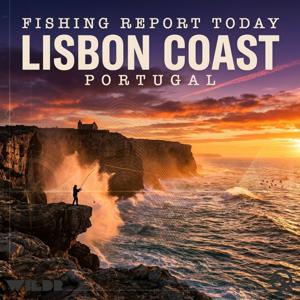
Name’s Artificial Lure, checking in with your Lisbon Coast fishing rundown.
We’re sitting on a weak pressure gradient with light **north to northwest winds**, generally 8–14 knots along the coast, and relatively calm seas, around 1–1.5 m swell from the northwest. Skies have been mostly clear with some coastal haze at dawn and late afternoon, and air temps running mid-teens at first light, up into the low-to-mid 20s by mid‑day.
First light is early, with **sunrise just after 6 a.m.** and **sunset just before 9 p.m.** That gives a long fishing window, but the real action has been concentrated in the low‑light slots and around tide turns.
The tide cycle is running on a moderate range: an early‑morning **flood tide pushing in** through mid‑morning, then an **afternoon ebb** that lines up nicely with that late‑day bite. Shore anglers have done best working the last hour of the incoming and the first of the outgoing, especially around structure where current pinches – points, reef edges, harbor mouths.
Reports from local skippers and tackle shops along Cascais, Oeiras, and Costa da Caparica show **consistent mixed bags** the past couple of days:
- **Robalo (European seabass)** in the 1–3 kg class, with a few better fish to 5 kg on the reefs and beach cuts.
- Plenty of **carapau (horse mackerel)** and **chicharro**, plus small **cavalas (mackerel)** under the lights at night and at first light.
- **Sargos** and **douradas** steady on the rocky patches and near harbor walls.
- Offshore boats that pushed a bit deeper have picked up **boca negra**, some **pargos**, and the odd **dourado** around floatsum and temperature breaks.
In terms of activity, the seabass bite has sharpened up with the stable weather and light swell. Robalo have been pushing bait tight to the beach at dawn along Carcavelos and Costa da Caparica, and staging off the rock ledges near Cascais in the evening. When the wind drops at dusk, you can almost set your watch by that short, intense surface window.
For **lures**, keep it simple and local:
- On the beaches: slim **surface walkers** and **pencils** in natural sardine or ayu patterns for the dawn topwater run, then **shallow‑diving minnows** once the sun creeps up.
- Around reefs and harbor mouths: **soft plastics** on 10–20 g jig heads, pearl, white, or olive backs, worked low and slow in the current.
- For mackerel and horse mackerel: small **metal jigs** and **sabiki rigs** fished vertically under boat lights or pier lights – a steady lift‑and‑drop has been producing fast.
On **bait**, you can’t beat:
- **Live or fresh sardinha** strips for robalo and dourada.
- **Casulo (ragworm)** and **camarão (shrimp)** for bream and mixed reef fish.
- Small **chum trails of mashed sardine** have helped pull fish into casting range on the calmer evenings.
A couple of **hot spots** to circle:
- **Cabo Raso to Cascais**: Work the points and reef edges on the last of the flood and first of the ebb for robalo and sargos. Be mindful of surge and footing – it’s productive but unforgiving ground.
- **Costa da Caparica beaches**, especially near the canal exits and any visible sandbars: great for surf‑casting robalo at first light and into the evening, with plenty of carapau and mackerel within easy reach when they push in.
Night sessions have been underrated: light onshore breeze, clear skies, and the smaller swell have made it comfortable and productive for those soaking bait or working slow‑rolled soft plastics.
That’s your Lisbon Coast fishing report from Artificial Lure.
Thanks for tuning in, and don’t forget to subscribe so you never miss a tide.
This has been a quiet please production, for more check out quiet please dot ai.
Great deals on fishing gear https://amzn.to/44gt1Pn