
Sign up to save your podcasts
Or

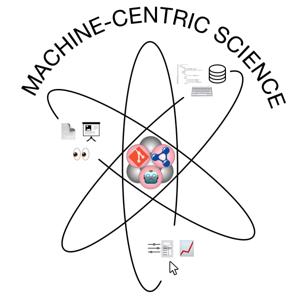


An interview about FAIR software, workflows, and virtual research environments (VREs) / science gateways with Sandra Gesing, currently a Senior Research Scientist and Scientific Outreach and Diversity, Equity, and Inclusion (DEI) Lead at the Discovery Partners Institute at the University of Illinois, Chicago.
https://doi.org/20.500.14132/chris -->
https://doi.org/20.500.14132/chris?noredirect -->
https://www.dona.net/team/christophe-blanchi
Digital Object Identifier Resolution Protocol (DO-IRP): https://www.dona.net/sites/default/files/2022-06/DO-IRPV3.0--2022-06-30.pdf
DIKW pyramid / DIKW hierarchy - https://en.wikipedia.org/wiki/DIKW_pyramid
"Data becomes information when it is stored *in* a given *formation*."
From B. Fong and D. I. Spivak, “Seven Sketches in Compositionality: An Invitation to Applied Category Theory,” Ch. 3 - Databases, arXiv, Oct. 12, 2018. doi: 10.48550/arXiv.1803.05316.
"There are only three things we can do with data. We can accrete data by adding it to an existing collection, reduce data by discarding information from an existing collection, or reshape data by placing it in a different kind of collection."
From Z. Tellman, *Elements of Clojure*, Ch. 4 - Composition. Monee, IL: Lulu.com, 2019.
types of information: situational, methodological, philosophical (epistemological, axiological, ontological)
From Dorian Taylor, "2022-05-11 types of information", (May 11, 2022). Accessed: Sep. 27, 2022. [Online Video]. Available: https://www.youtube.com/watch?v=zNUNgZ6RTmQ
Inductions vs deductions vs abductions
Informed by M. K. Bergman, A Knowledge Representation Practionary: Guidelines Based on Charles Sanders Peirce. Cham: Springer International Publishing, 2018. doi: 10.1007/978-3-319-98092-8.
"programs must be written for people to read, and only incidentally for machines to execute."
From preface to first edition (and included in subsequent editions) of H. Abelson, G. J. Sussman, and J. Sussman, *Structure and interpretation of computer programs*, Cambridge, Mass.: MIT Press.
`.split()`s on strings and `filter`s on `None`
I fought the Law and the Law won
I fought the Law and the Law won
I needed spec compliance; I got none
I fought the Law and the Law won
I fought the Law and the Law won
I varied my output with the latest fad
Breakin' every downstream run
Needed Postel more than I ever had
I fought the Law and the Law won
I fought the Law and the
Scatterin' parsing like a shotgun
I fought the Law and the Law won
I fought the Law and the Law won
I lost robustness and I lost my fun
I fought the Law and the Law won
I fought the Law and the Law won
I varied my output with the latest fad
Breakin' every downstream run
Needed Postel more than I ever had
I fought the Law and the Law won
I fought the Law and the
- Linked Data
- Project Jupyter (Notebook, Lab, etc.)
- UI Blocks: Block Protocol
- Personal Knowledge Graphs: Roam, Logseq, Obsidian
- Solid: decentralized data stores
- Resource Description Framework (RDF)
- Twitter: Martynas, AtomGraph
- LinkedDataHub (Apache-2.0 license)
- AtomGraph: Website, GitHub
Just about a week ago,
I set out to download.
Seekin' supplementary data,
lookin' for a pot of gold.
Things got bad, and things got worse,
I guess you will know the tune.
Oh lord, stuck data mining again.
Rode in on semantics,
I'll be hand-waving out if I go.
Trying controlled vocabularies,
must've been seven of 'em or more.
No corresponding authors
have replied to my emails yet.
Oh lord, I'm stuck data mining again.
The man from Stack Overflow
said I was on my way.
My code kept raising exceptions.
I was reading tracebacks for days.
I wanted to run a one-off benchmark.
Looks like my plans fell through.
Oh lord, stuck data mining again.
If I only had metadata
that was machine-actionable
every time I've had a dataset
that I's told was interoperable.
You know I'd catch the FAIR train
and breeze through my planned reuse.
Oh lord, I'm stuck data mining again.
Oh lord, I'm stuck data mining again.
Oh give me mappings, lots of mappings, with resolving URIs. Don’t silo me in.
Let me prance through semantics of namespaces that I love. Don’t silo me in.
Let me use an open protocol to access these bytes, and for metadata promise me you’ll keep on the lights. Authenticate me repeatedly, but give clear usage rights. Don’t silo me in.
Just give me data bare. Let me reuse my old CPUs and mint my URIs.
With my own software, let me wander over yonder with least surprise.
I want to probe the provenance of metadata rich and plural, and represent my knowledge to be machine actionable. And I can’t look at schemas if they’re not interoperable. Don’t silo me in.
* [Materials Project](https://materialsproject.org/)
* [Environmental Systems Science Data Infrastructure for a Virtual Ecosystem (ESS-DIVE)](https://ess-dive.lbl.gov/)
* [National Microbiome Data Collaborative (NMDC)](https://microbiomedata.org/)
* [W3C Provenance (PROV) specs](https://www.w3.org/TR/prov-overview/)
* [Research Equals (R=)](https://www.researchequals.com/)
* [JSON-LD](https://json-ld.org/)
* [Ecological Metadata Language (EML)](https://eml.ecoinformatics.org/)
* [DataCite](https://datacite.org/)
* [OSTI](https://www.osti.gov/)
* [DOI](https://www.doi.org/)
* schema.org
* [OAuth](https://oauth.net/2/)
* [OpenID Connect (OIDC)](https://openid.net/connect/)
* [OpenAPI](https://www.openapis.org/)
* [REST](https://en.wikipedia.org/wiki/Representational_state_transfer)
* [IGSN](https://www.igsn.org/)
* [Data Observation Network for Earth (DataONE)](https://www.dataone.org/)
* [Frictionless Data](https://frictionlessdata.io/)
From the publisher's feed