
Sign up to save your podcasts
Or

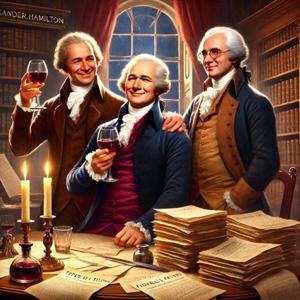


When the Constitution was signed in 1787, it contained no explicit guarantees of freedom — no right to speech, religion, or due process. That silence nearly doomed it. Across an ocean, Thomas Jefferson demanded those rights be written down; James Madison hesitated, then listened. Their exchange of letters — one pushing from Paris, the other reasoning in New York — changed American history. “How We Got the Bill of Rights” tells the story of friendship, persuasion, and the birth of the ten amendments that turned the Constitution into a promise of liberty — for every American.
Visit my website at Critical Skills | By the Author of WANTED: Eight Critical Skills You Need To Succeed (criticalskillsblog.com)
Thomas Jefferson’s letter of December 20, 1787, stands as one of the founding documents of American liberty. It transformed the Constitution’s silence on individual rights into a national conversation — one that would culminate two years later in the adoption of the Bill of Rights.
By praising Madison’s work while exposing its dangers, Jefferson did what he always did best: he improved by questioning. He believed that even a noble government must answer to a higher law — the law of human rights.
“A bill of rights is what the people are entitled to… and what no just government should refuse.”
That single sentence, penned in a Paris apartment in the winter of 1787, crossed an ocean and changed the course of American history.
Visit my website at Critical Skills | By the Author of WANTED: Eight Critical Skills You Need To Succeed (criticalskillsblog.com)
James Madison Reconsiders
By the fall of 1788, the Constitution had been ratified—but only after fierce debate.
James Madison, once skeptical of a Bill of Rights, wrote to Thomas Jefferson with new humility:
“I have favored it because I supposed it might be of use, and if properly executed could not be of disservice.”
This episode of Making a Great America tells the story of Madison’s turning point—the letter where he began to accept Jefferson’s vision and prepared to lead the fight for the amendments that would enshrine liberty in law.
Visit my website at Critical Skills | By the Author of WANTED: Eight Critical Skills You Need To Succeed (criticalskillsblog.com)
In March 1789, Thomas Jefferson wrote one last letter to his friend James Madison. “If we cannot secure all our rights,” he said, “let us secure what we can.”
It was both encouragement and command — urging Madison to fulfill his promise to champion a Bill of Rights.
Within months, Madison would do exactly that.
This episode of Making a Great America concludes our four-part series, The Madison–Jefferson Letters: The Road to the Bill of Rights — the story of two friends whose dialogue turned ideas into law and secured the liberties we hold today.
Visit my website at Critical Skills | By the Author of WANTED: Eight Critical Skills You Need To Succeed (criticalskillsblog.com)
This is a postlude – a reflection and commentary about where we have been in this series.
The Federalist Papers, authored by Hamilton, Madison, and Jay, laid the foundation for a balanced system of government with a strong union, a deliberative legislature, an energetic executive, and an independent judiciary. While these ideals have shaped the U.S. government, modern challenges such as political polarization, legislative gridlock, and the growing power of the executive have tested this balance. A significant danger that has emerged in recent years is the rise of authoritarian tendencies in the executive branch. If left unchecked, this could undermine democratic institutions, erode individual liberties, and lead to chaos. The judiciary, intended to remain independent, faces increased politicization, further complicating the balance of power. The Federalist and Anti-Federalist perspectives both offer valuable insights into these challenges, reminding us of the importance of vigilance in preserving the principles that safeguard our democracy.
Visit my website at Critical Skills | By the Author of WANTED: Eight Critical Skills You Need To Succeed (criticalskillsblog.com)
From the publisher's feed
Welcome to "Making a Great America," a podcast dedicated to exploring the meticulous thought and effort that went into the design of the Constitution of the United States.
This series…
During the fall of 1787 and the spring of 1788, three remarkable men—John Jay, Alexander Hamilton, and James Madison—worked tirelessly to write a series of essays known as the Federalist Papers. These essays were crafted to convince the citizens of the newly independent states to ratify the Constitution, establishing a constitutional republic that balanced power and safeguarded liberties. Their efforts were instrumental in shaping the framework of the government we know today.
In "Making a Great America," we do not argue for or against any political position.
Instead, we aim to report history accurately, informatively, and with easy listening.
By delving into the writings and ideas of the Founding Fathers, we provide listeners with a deeper understanding of the Constitution's origins and the profound care taken to ensure a balanced and fair government. Our episodes are designed to be engaging and accessible, making complex historical concepts easy to grasp.
We believe that knowledge of our government and its creation is essential to its continued survival. As such, we encourage you to subscribe to our podcast and share it widely with friends, family, and colleagues. Together, let's foster a greater appreciation for the history that continues to shape our nation.
Benjamin Franklin explained to a curious woman after the continental congress finished about what kind of government was created.
His response: "A Republic . . . . IF you can keep it!"