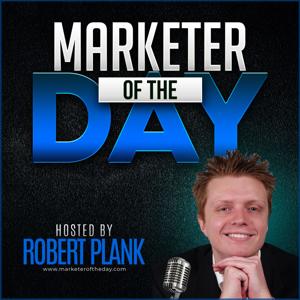
Marketer of the Day with Robert Plank: Business Growth & Entrepreneur Stories

Marketer of the Day with Robert Plank: Business Growth & Entrepreneur Stories

Download on the App Store

Marketer of the Day with Robert Plank: Business Growth & Entrepreneur Stories episodes

  • 249: Your Uniqueness, Your Authenticity, Your Superpower and Your Messaging with MaryJo Cranmore
    MaryJo Cranmore from MaryJoCranmore.com and Message2Media.com says that you have a unique ability (a superpower) and that can be the basis for the branding that you cultivate. Take those raw materials, hobbies, your skillset (what you've learned), your accomplishments (your experiences), and that unique piece of you to get noticed and stand out from the crowd.
    https://www.youtube.com/watch?v=F7D7XY1JC4E
    Quotes:                                                                                                                                   
    “We are truly in the age of the authenticity movement. It's about not being afraid, as a company or entrepreneur, to allow yourself to be part of the offering.” – MaryJo Cranmore
    “Your superpower is something you haven't necessarily cultivated, but you've used your whole life. When people talk about you when you're not in the room, that's generally what they mention.” – MaryJo Cranmore
    “You have to be interesting and break through the fog of what people understand about your business to give them something new and tell them something they don't know.” – MaryJo Cranmore
    Takeaways:
    09:02 Finding your unique "superpower" helps you stand out from competitors and attract the right clients.
    11:19 Testimonials and word-of-mouth recommendations are more powerful than traditional advertising.
    16:09 Media exposure is about offering a fresh perspective on current events, not just creating news.
    18:19 When appearing on camera or in interviews, focus on helping the audience and being yourself rather than trying to be clever.
    20:08 Authenticity in business means allowing your personal traits and experiences to be part of your professional offering.
    Resources:
    Connect with Mary Jo Cranmore on LinkedIn
    24 min
  • 248: Intuitive Art Academy: Certification Programs, Relaxation, Knowledge and Intuition with Rachel Archelaus
    Rachel Archelaus from RachelArchelaus.com and IntuitiveArtAcademy.com has some entrepreneurial advice to share with you when it comes to tapping into your creativity, getting outside of your own head, and turning on your brain flow.
    https://www.youtube.com/watch?v=ag5aGsIJ0S4
    Her method involves asking the right questions of yourself, drawing on crayons (or colored pencils) and paper, scribbling with your eyes closed, and then decoding the drawings and colors used in that drawing to achieve huge insights. She also talks about the up's and down's of her business journey and shares ways to be more productive and give yourself more credit for your accomplishments.
    Quotes:                                                                                                                                   
    “The more I trust my intuition or instincts, the less I have to strategize and think about things.” – Rachel Archelaus
    “Your intuition is never really going to tell you not to pursue your dreams; it might tell you to hold off on making a decision, and something better will come along.” – Rachel Archelaus
    “The path to success or whatever outcome you're seeking is never a straight line.” – Rachel Archelaus
    Takeaways:
    01:49 Intuition is your first voice - the initial instinct before overthinking kicks in.
    05:18 Creative activities like doodling or walking in nature help clear mental space for intuitive insights.
    17:42 Developing a certification program can expand your business reach and create additional revenue streams.
    18:43 Automating business processes and hiring a part-time assistant can free you to focus on strategic thinking and travel.
    23:39 Trusting your own knowledge and capabilities is more powerful than constantly seeking external validation.
    27 min
  • 247: Tame the High Cost of College: Pursue Side Hustles and Entrepreneurial Adventures with Brad Baldridge
    Brad Baldridge is a Certified Financial Planner with over 20 years of experience who specializes in college financial planning. Since 2004, he has been a college consultant and founder of "Taming the High Cost of College," a consulting service aimed at helping families navigate college expenses. Brad hosts a podcast under the same name, which features over 100 episodes discussing various aspects of college planning, including test preparation, scholarships, and financial strategies. He offers free resources on his website, including an EFC calculator and a scholarship guide for parents.
    https://www.youtube.com/watch?v=H8eB2MM-BLI
    Quotes:                                                                                                                                   
    “A lot of entrepreneurs' successful business was their sixth try, not their first. And if it's going to take you six tries, the sooner you get the first five done, the sooner you start making money.” – Brad Baldridge
    “College planning is a challenge for many families. You can think of planning for college like planning a large family vacation, buying a car, and finding a job for your student all rolled into one.” – Brad Baldridge
    “I always tell people there are probably 100 strategies out there or more, and five or ten are going to be right for you. The challenge is figuring out which five or ten those are and getting out there and doing them.” – Brad Baldridge
    Takeaways:
    03:14 Involving kids in family businesses can be an effective way to fund college expenses while teaching entrepreneurial skills.
    09:08 Entrepreneurial strategies for college funding can include side hustles, hiring kids in the family business, and exploring tax-efficient income methods.
    13:31 Not every family or student is suited for entrepreneurial approaches, so multiple college funding strategies should be considered.
    17:08 College planning is complex and requires early preparation, starting as early as sophomore year of high school.
    22:13 Educating yourself about college planning through podcasts, resources, and early research can significantly reduce financial stress.
    Resources:
    I’ll Show You How to Save on College Costs | Taming the High Cost of College
    Connect with Brad Baldridge on LinkedIn
    31 min
  • 246: Authority Content: Document Your Magic, Delegate Your Business, and Get Off the Hamster Wheel with David Jenyns
    David Jenyns from AuthorityContent.com heard of a marketer who sold pieces of the Brooklyn Bridge and modeled this success to sell the Melbourne Cricket Ground (MCG).
    He's discovered that you can model (not copy) an idea to make it your own and then own that success or failure. Drill down to a speciality, find a specific need, and sell it to the immediate crowd in front of you.
    https://www.youtube.com/watch?v=SzlgjFIPETg
    David has a number of insights about direct mail, online marketing and SEO, getting attention, systems/processes, and delegation. He talks with us today about recurring revenue and the 3 P's of content marketing:
    Present: organize a (one-take) live event to teach your best content to a real crowd (take photos)
    Product: repurpose that content in a 4-day cash machine
    Promote: repurpose into hundreds of pieces of audio and video
    Resources
    Authority Content (Book)
    System Hub (Website)
    Mebourne SEO Service (YouTube)
    David (Twitter)
    37 min
  • 245: Wow Factor Marketing: Stop Spraying Bullets and Use Direct Response Techniques to Adapt and Thrive with John Dwyer
    John Dwyer joins Robert Plank to discuss direct response marketing built around a desirable customer and a result the business can measure. His Wheel of Wow framework connects the audience, a distinctive incentive, problem-and-solution messaging, the website, and a reason for customers to return.
    John argues that broad exposure is difficult to evaluate when the business has no way to connect it with a response. A restaurant example replaces a broad advertising approach with collecting diner details and sending targeted offers. The customer information makes it possible to act when the restaurant has empty seats rather than hope a general advertisement reaches someone at the right moment.
    A bank campaign supplies a different example of redirecting an existing budget. John describes replacing an introductory-rate discount with a tangible travel bonus, then adding a celebrity identified through audience research. These are his reported campaign experiences, and the interview explores the choices behind them rather than presenting the results as an expectation for every business.
    The discussion also considers loyalty and the attention drawn by an appealing extra, including John's family experience with Happy Meal toys. He returns to understanding the most profitable buyer and finding more people with a similar fit. The episode gives small-business owners a way to question where marketing money goes, what a prospect is being asked to notice, and how the business will know whether the activity worked.
    Designing an offer and a response you can track
    Identify the customer the business most wants to serve.
    Use an incentive that makes sense to that audience.
    Collect contact details with a useful reason to stay connected.
    Measure a campaign's response before repeating the spend.
    Resources mentioned
    TheInstituteOfWow.com
    https://www.youtube.com/watch?v=S-GPvpXe-mE
    36 min
  • 244: The Business of Life: Achieve Financial Freedom, Personal Freedom, and Create the Type of Business You Want with Keith Callahan
    Keith Callahan joins Robert Plank to discuss building a business around the life it is supposed to support. His experience across real estate, consulting, and network marketing leads to a conversation about income, time, systems, and the difference between working from necessity and choosing meaningful work.
    Keith describes early property transactions that made entrepreneurship look straightforward, followed by a market reversal that exposed assumptions behind those successes. A later consulting operation also became unsustainable when its turnaround time changed dramatically. The stories make clear that a working model can be affected by conditions the owner does not control.
    He encourages defining the desired lifestyle, income, hours, and business model before building a company that demands something different. In his own account, reaching greater freedom involved a period of very long workweeks and developing systems and other leaders. The discussion examines that tradeoff rather than presenting freedom as something that arrives without effort.
    Taking an extended break after the business exceeded his family's financial needs revealed a further issue: having no need to work did not automatically provide fulfillment. Keith found value in returning to purposeful challenges and service. Robert and Keith explore how financial breathing room can change the reason someone works, while leaving the need for direction intact. The episode invites listeners to define both the freedom they want and the work they would still find worthwhile once they have more choice.
    Designing freedom with a purpose behind it
    Define the income and time requirements of the life you want.
    Recognize when market conditions undermine an existing model.
    Build systems and leadership beyond the owner's individual effort.
    Consider what meaningful work would look like after financial pressure eases.
    https://www.youtube.com/watch?v=d4l5p6KHOho
    Resources
    Keith Callahan (Official Website)
    The Business of Life Podcast (Podcast)
    32 min
  • 243: Run Live Events and Workshops with Direct Response Event Planner Sherrie Sokolowski
    Sherrie Sokolowski joins Robert Plank to discuss planning live events and workshops around a clear business purpose. Their conversation covers the experience in the room, the work attendees should complete, the offers they may receive, and the recordings or relationships that can retain value after the event ends.
    Sherrie contrasts training that leaves people holding a blueprint with a workshop that gives them time and support to implement it. That choice affects the room, schedule, equipment, and internet connection. Robert recalls the difficulties of early laptop workshops, and they discuss negotiating connectivity based on what attendees actually need to accomplish rather than treating Wi-Fi as an afterthought.
    A dental-training example illustrates the role of different audiences. Prospects and existing clients received different preparation before coming together to hear practitioners describe their experience. The event created room for useful training and conversations about results without making every session a continuous pitch. Sherrie also considers how phones, laptops, and event hashtags can support promotion when used deliberately.
    Livestreaming and audiovisual production bring their own tradeoffs. Sherrie describes seeing in-person registrations decline when a cheaper streaming option was announced too early. She also stresses budgeting for professional production and recording valuable presentations for later use. The episode gives an event organizer practical questions to resolve before choosing logistics: who is coming, what should happen for them, and how does the event support the business?
    Designing an event around the outcome
    Decide whether attendees need information, implementation time, or both.
    Plan connectivity and production around the actual workshop activities.
    Consider how a streaming offer affects in-person attendance.
    Capture useful presentations so their value can continue afterward.
    Resources mentioned
    SLSEventPlanning.com
    https://www.youtube.com/watch?v=JMhdDZWuQmw
    36 min
  • 242: The Four D’s of Reputation Marketing: Discover, Define, Develop and Defend with Pamela Gockley
    Pamela Gockley joins Robert Plank to discuss reputation as something a person or business develops through repeated actions. Her four-D framework—discover, define, develop, and defend—connects honest feedback with the identity and relationships someone wants to build.
    Discovery begins with learning how other people experience you. Pamela recalls an assessment that described behavior she had not recognized in herself, including a tendency to explain technology before understanding the listener. The uncomfortable feedback became useful because it revealed a gap between her intentions and the effect of her communication.
    Defining a reputation means choosing what it should support now, then developing it through practical decisions about messaging, a website, a market, or a career. The discussion emphasizes authenticity rather than constructing a public character that ordinary behavior cannot sustain. A clear direction also makes it easier to judge whether the daily choices reinforce it.
    Defending the reputation requires preparation for a complaint or crisis. Pamela describes a motel owner who responded to a bug complaint by attacking the reviewer instead of acknowledging and addressing the concern. She ended the consulting relationship after that response. The example shows how the reaction can become a second problem larger than the original complaint. The episode encourages deciding who speaks, how facts are checked, and how accountability is expressed before emotion takes over a public exchange.
    Developing trust before a crisis tests it
    Seek feedback about the effect of your behavior.
    Choose a clear direction for the reputation you want to build.
    Align everyday communication with that identity.
    Prepare an accountable response rather than attack the person raising a problem.
    https://www.youtube.com/watch?v=4BO4jxaK3Yc
    Resources
    Reputatus (Website)
    The Art of Running Red Lights (Book)
    The Reputation Factor (Book)
    28 min
  • 241: Stop Overpaying Your Taxes and Avoid Entrepreneurial Mistakes That Cost You Thousands with Diane Gardner
    Diane Gardner from TaxCoach4You.com is a tax superhero and wants you to avoid mistakes you're making on your taxes, such as using the wrong entity type or not deducting meals and entertainment. You can make use of your home office deduction, hire your kids, make use if health insurance and retirement if you know what to do.
    https://www.youtube.com/watch?v=3lBH_1OBZ2s
    Quotes:                                                                                                                                   
    “I firmly believe in being a giver. So if we can get that information into people's hands, they can start learning about some of these things that possibly their accountant or their tax preparer isn't really telling them about.” – Diane Gardner
    “Choosing an accountant is an awful lot like dating because you want to get to know that person. You want to find out if they are entrepreneurial and if they understand your industry.” – Diane Gardner
    “A lot of people don't feel comfortable doing it themselves, so I always suggest that you should hook up with a good, solid professional of some sort to make sure that those expenses are being recorded.” – Diane Gardner
    Takeaways:
    02:52 Small business owners can reduce tax burden by implementing strategic planning like hiring family members and writing off specific expenses.
    04:52 Regular tax analysis can uncover hidden profit and potential savings opportunities.
    08:00 Choosing the right business entity type can save entrepreneurs thousands in taxes each year.
    14:25 Tracking and documenting business expenses is crucial for maximizing tax deductions.
    21:49 Internet marketers and solopreneurs often miss significant tax deduction opportunities due to poor record-keeping.
    Resources:
    Connect with Diane Gardner on LinkedIn
    24 min
  • 240: Web Design and SEO: Optimize Your Website Using Cutting Edge (and Common Sense) Tweaks and Factors with Jeremy Knauff
    Jeremy Knauff is a US Marine Corps veteran, proud father, and husband who has dedicated over 17 years to helping businesses grow through digital marketing. As the founder of Spartan Media, he specializes in web design and search engine optimization (SEO). Jeremy is also an author for Search Engine Journal, a prominent industry publication. His expertise spans web development, digital marketing strategies, and helping companies improve their online presence.
    The low-hanging fruit is to use the Google PageSpeed tool to measure your site's speed (remove slow plugins), as well as the mobile friendly test (refine your tap targets and adjust images that are too big).
    Next, optimize your site for what your users want, as well as their intent (for those customers who come to your site for a specific purpose, for example, to find a phone number or address).
    https://www.youtube.com/watch?v=w0Pb68zc-eE
    Quotes:                                                                                                                                   
    “When somebody comes to a website, they're coming there for their own needs. So that's an example of basically setting the stage for the customer, not for the owner.” – Jeremy Knauff
    “Most websites tell you right off the bat how great they are and how they're the best. But that's not what anybody cares about.” – Jeremy Knauff
    “You have to figure out what the particular visitor is trying to accomplish, and route them in a way that's going to be most efficient for them.” – Jeremy Knauff
    Takeaways:
    07:39 Website speed matters more than most business owners realize, with even a tenth of a second delay potentially impacting revenue.
    12:53 Most websites make the mistake of talking about themselves instead of focusing on what users actually want.
    14:00 Before building a website, understand the different intents of potential visitors and create pathways that efficiently guide them.
    17:40 Mobile responsiveness is now critical, with Google using a mobile-first index that prioritizes mobile-friendly websites.
    24:10 Adding too many plugins can dramatically slow down a website's performance, especially on WordPress.
    Resources
    Spartan Media (Website)
    Spartan Media (Facebook)
    Spartan Media (Twitter)
    Amazon found every 100ms of latency cost them 1% in sales (Blog post)
    Jeremy Knauff on Search Engine (Journal)
    Mistakes Smart Web Designers Make That Can Kill SEO (Podcast)
    Google PageSpeed Tool (Tool)
    Mobile Friendly Test (Test)

    26 min

About Marketer of the Day with Robert Plank: Business Growth & Entrepreneur Stories

From the publisher's feed

Marketer of the Day with Robert Plank is a daily business podcast for entrepreneurs, solopreneurs, consultants, agency owners, coaches, authors, speakers, and expert-led service businesses that want…