
Sign up to save your podcasts
Or



The story of the Platonic solids for kids: the five perfect shapes studied by Theaetetus and Plato in ancient Athens, and how Euclid proved around 300 BCE there can never be a sixth.
• What makes a solid perfect: the same faces and the same corners
• Why only five shapes work, worked out with triangles, squares and pentagons at a corner
• Why each one makes a fair die, and where they turn up in salt crystals and viruses
• Quiz questions to answer along the way
Maths is Not Boring: rated 5★ on Apple Podcasts and 4.7★ on Spotify. Follow or subscribe to hear the story of a new great idea in maths every day.
The story of averages for kids: how around 1950 Gilbert Daniels measured 4,063 United States Air Force pilots and found that not one was average in every way.
• Why cockpits built for the average pilot fitted nobody
• What an average tells you about a crowd, and what it cannot tell you
• How the answer was seats and pedals that adjust, like the seats in a car
• Quiz questions to answer along the way
Maths is Not Boring: rated 5★ on Apple Podcasts and 4.7★ on Spotify. Follow or subscribe to hear the story of a new great idea in maths every day.
The story of binary for kids: how Gottfried Wilhelm Leibniz wrote out a way of counting with only 0 and 1 in 1679, long before computers.
• How to count one, two, three and four in binary
• How Leibniz published his work in Paris in 1703
• Why switches that are only off or on made binary perfect for computers
• Quiz questions to answer along the way
Maths is Not Boring: rated 5★ on Apple Podcasts and 4.7★ on Spotify. Follow or subscribe to hear the story of a new great idea in maths every day.
The story of triangles for kids: why a triangle will not squash flat when a square does, and how Gustave Eiffel built his tower in Paris from triangles in 1889.
• What engineers mean by rigidity
• How more than 18,000 iron pieces in the Eiffel Tower are laced into triangles
• Where triangles hold things firm, from bicycle frames to bridges
• Quiz questions to answer along the way
Maths is Not Boring: rated 5★ on Apple Podcasts and 4.7★ on Spotify. Follow or subscribe to hear the story of a new great idea in maths every day.
The story of the googol for kids: how nine-year-old Milton Sirotta named the number one followed by a hundred zeros for his uncle, mathematician Edward Kasner, around 1920.
• Why a googol is bigger than the number of atoms in the known universe
• The even bigger googolplex that Milton dreamed up
• How the word spread and gave a famous search engine its name
• Quiz questions to answer along the way
Maths is Not Boring: rated 5★ on Apple Podcasts and 4.7★ on Spotify. Follow or subscribe to hear the story of a new great idea in maths every day.
The story of fractions for kids: how the Egyptian scribe Ahmes wrote down problems about sharing loaves of bread fairly about 3,500 years ago, in the scroll now called the Rhind papyrus.
• How the Egyptians built fractions from pieces with a one on top
• Why two thirds got a special sign of its own
• Where the Rhind papyrus is kept today
• Quiz questions to answer along the way
Maths is Not Boring: rated 5★ on Apple Podcasts and 4.7★ on Spotify. Follow or subscribe to hear the story of a new great idea in maths every day.
The story of tessellation for kids: shapes that cover a floor with no gaps, and how David Smith from Bridlington in Yorkshire found a tile in 2022 whose pattern never repeats.
• Why squares, triangles and hexagons make repeating patterns
• How Roger Penrose found a never-repeating pattern with two shapes in 1974
• How David Smith's 13-sided hat was proved by a team of four in 2023
• Quiz questions to answer along the way
Maths is Not Boring: rated 5★ on Apple Podcasts and 4.7★ on Spotify. Follow or subscribe to hear the story of a new great idea in maths every day.
From the publisher's feed
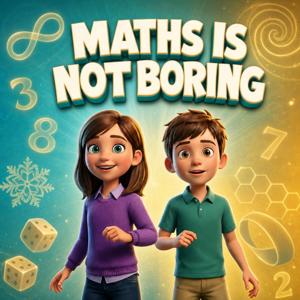
A groundbreaking podcast for curious kids aged 4-12 that proves maths is anything but dull.
Join our fictional AI hosts Mira, a brilliant 9-year-old, and her younger brother Finn, age…
A note on why we use AI. For us, AI allows us to deliver learning at a scale and quality that previously would have been too expensive. If we make the odd technical error, or the sound goes a bit funny, bear with us, we’re trying our best. We hope you enjoy the show!