
Sign up to save your podcasts
Or



The story of exponential growth for kids: why folding a sheet of paper 42 times would reach the Moon, and how Britney Gallivan set the folding record in California in 2002.
• How Britney Gallivan folded a single sheet of paper in half twelve times
• The old legend of rice doubling on every square of a chessboard
• Why a pond half covered in lily pads is full the very next day
• Quiz questions to answer along the way
Maths is Not Boring: rated 5★ on Apple Podcasts and 4.7★ on Spotify. Follow or subscribe to hear the story of a new great idea in maths every day.
The story of zero for kids: how Brahmagupta in India wrote down the first rules for zero as a number in 628 CE, and how it travelled to Europe.
• How the Babylonians and the Maya used a mark to hold an empty place open
• Brahmagupta's rules for adding, taking away and multiplying with zero
• How Arabic scholars and Fibonacci's 1202 book brought zero to Europe
• Quiz questions to answer along the way
Maths is Not Boring: rated 5★ on Apple Podcasts and 4.7★ on Spotify. Follow or subscribe to hear the story of a new great idea in maths every day.
The story of symmetry for kids: why a snowflake looks unchanged when you turn it, and how Emmy Noether showed in Germany in 1915 that symmetry hides the laws of physics.
• How flips, turns and slides show up in butterflies, starfish and honeycombs
• How Noether linked symmetry in time to the rule that energy never disappears
• Why water freezing into hexagons gives every snowflake six arms
• Quiz questions to answer along the way
Maths is Not Boring: rated 5★ on Apple Podcasts and 4.7★ on Spotify. Follow or subscribe to hear the story of a new great idea in maths every day.
The story of the Mobius strip for kids: how one twist in a loop of paper makes a shape with only one side, and how August Mobius described it in Germany in 1858.
• How to make a Mobius strip and trace its one side with a finger
• Why Johann Listing found the same shape in the same year
• How the strip opened the door to topology and turned up in conveyor belts
• Quiz questions to answer along the way
Maths is Not Boring: rated 5★ on Apple Podcasts and 4.7★ on Spotify. Follow or subscribe to hear the story of a new great idea in maths every day.
The story of prime numbers for kids: numbers like 2, 3, 5, 7 and 11 that only split into ones, and how Euclid of Alexandria proved around 300 BCE that they never run out.
• How Euclid's argument shows there can never be a biggest prime
• The giant prime found in October 2024 that would fill about 20,000 printed pages
• Why prime numbers lock our messages and help cicadas come out every 13 or 17 years
• Quiz questions to answer along the way
Maths is Not Boring: rated 5★ on Apple Podcasts and 4.7★ on Spotify. Follow or subscribe to hear the story of a new great idea in maths every day.
The story of permutations for kids: why a well shuffled pack of 52 cards is almost certainly in an order no one has ever held before, and how Dave Bayer and Persi Diaconis studied shuffling in 1992.
• Why seven riffle shuffles are enough to mix a pack properly
• How 52 cards can be ordered in about as many ways as there are atoms in the Milky Way
• How Persi Diaconis went from card tricks with a magician to maths at Harvard
• Quiz questions to answer along the way
Maths is Not Boring: rated 5★ on Apple Podcasts and 4.7★ on Spotify. Follow or subscribe to hear the story of a new great idea in maths every day.
The story of infinity for kids: why there is no biggest number, and how Georg Cantor showed in the 1870s that some infinities are bigger than others.
• How the even numbers pair up with all the whole numbers, one to one
• Hilbert's Hotel, where a full hotel always has room for one more guest
• Why other mathematicians mocked Cantor, and why he kept going
• Quiz questions to answer along the way
Maths is Not Boring: rated 5★ on Apple Podcasts and 4.7★ on Spotify. Follow or subscribe to hear the story of a new great idea in maths every day.
The story of the birthday paradox for kids: why in a room of just 23 people it is more likely than not that two share a birthday, and how Richard von Mises published the idea in 1939.
• Why the question is about any two people, not about matching you
• How counting pairs of people makes the chances grow so fast
• What the maths of chance tells us about coincidences
• Quiz questions to answer along the way
Maths is Not Boring: rated 5★ on Apple Podcasts and 4.7★ on Spotify. Follow or subscribe to hear the story of a new great idea in maths every day.
The story of pi for kids: why the distance around any circle is always a little more than three times the distance across, and how Archimedes of Syracuse pinned the number down around 250 BCE.
• How Archimedes trapped pi between shapes with up to 96 straight sides
• Why the digits of pi go on forever without repeating
• Where pi turns up, from bike wheels and coins to ripples on a pond and the orbits of planets
• Quiz questions to answer along the way
Maths is Not Boring: rated 5★ on Apple Podcasts and 4.7★ on Spotify. Follow or subscribe to hear the story of a new great idea in maths every day.
From the publisher's feed
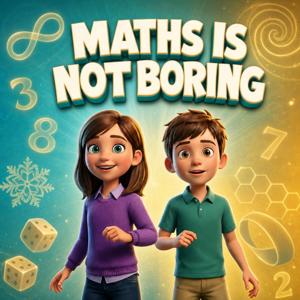
A groundbreaking podcast for curious kids aged 4-12 that proves maths is anything but dull.
Join our fictional AI hosts Mira, a brilliant 9-year-old, and her younger brother Finn, age…
A note on why we use AI. For us, AI allows us to deliver learning at a scale and quality that previously would have been too expensive. If we make the odd technical error, or the sound goes a bit funny, bear with us, we’re trying our best. We hope you enjoy the show!