Sign up to save your podcastsEmail addressPasswordRegisterOrContinue with GoogleAlready have an account? Log in here.
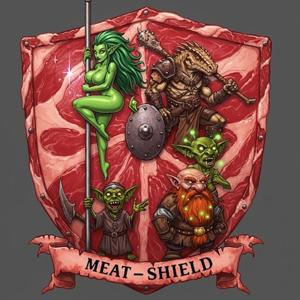
This D&D game appears to be a darkly humorous take on fantasy tropes, with a strong emphasis on the "meat" part of "meat-shield." The image suggests a blend of classic D&D races ... more
FAQs about Meat-Shield:How many episodes does Meat-Shield have?The podcast currently has 24 episodes available.
March 24, 2026Casino the Movie 2: the hardest of decks and the boniest of handsLucious and his broad axe meets Otis and his long dong in this gamle of an episode. Mfkrs grab them bags and get weird! Welcome to the real casino episode yall!Become a supporter of this podcast: https://www.spreaker.com/podcast/meat-shield--6530514/support....more2h 59minPlay
March 24, 2026The Elephant, The T-Rex, and the Holiest of TroutmanThere has been players being caught cheating. A new moonman has joined the groupHubbaBubba is a snitch, Kodi Lee is a real assholeThis episode might be the most uplifting one so far!Big thanks to Cody Troutman! May all of his dreams come true!Become a supporter of this podcast: https://www.spreaker.com/podcast/meat-shield--6530514/support....more2h 58minPlay
January 16, 2026Slaves and Butter-ScotchThe MoonTangClan Finally learns that guns ARE real Also.... impulsive words and actions hurt the outcome of gameplay and can kinda come off as bigoted sometimes.Good thing they had Kill-O-Bot to help move them to the proper path!PRAISE MOOONGOOOODDD!Become a supporter of this podcast: https://www.spreaker.com/podcast/meat-shield--6530514/support....more3h 3minPlay
December 30, 2025Busted Locks and Booming Beanstalks Part2In this episodethe crew meets Will Perish Tssr Slaughter scores some nifty beans Kodilee screws the whole group overSir Cadian toys with the elemental plane of fire.Hubba bubba morns the loss of Ace FrehleyHackson is still tripping sackEnjoy!Become a supporter of this podcast: https://www.spreaker.com/podcast/meat-shield--6530514/support....more1h 41minPlay
December 30, 2025Busted Locks and Booming Beanstalks Part2In this episodethe crew meets Will Perish Tssr Slaughter scores some nifty beans Kodilee screws the whole group overSir Cadian toys with the elemental plane of fire.Hubba bubba morns the loss of Ace FrehleyHackson is still tripping sackEnjoy!Become a supporter of this podcast: https://www.spreaker.com/podcast/meat-shield--6530514/support....more1h 43minPlay
December 30, 2025Busted Locks and Booming BeanstalksIn this episodethe crew meets Will Perish Tssr Slaughter scores some nifty beans Kodilee screws the whole group overSir Cadian toys with the elemental plane of fire.Hubba bubba morns the loss of Ace FrehleyHackson is still tripping sackEnjoy!Become a supporter of this podcast: https://www.spreaker.com/podcast/meat-shield--6530514/support....more1h 39minPlay
November 18, 2025Maybe It's Mab - part 2Lost the recording chip but then found it!Part 2 coming at you! The gang is going off the rails.Thank you for all the supportive emails! Become a supporter of this podcast: https://www.spreaker.com/podcast/meat-shield--6530514/support....more1h 39minPlay
October 22, 2025Maybe It's Mab - part 1With help from new friend, Sigmond Hammurstriek aka SIGSOURThe Moontang clan is accedentally forced to split up. It works well for one half and very poorly for the other half. Join us!Become a supporter of this podcast: https://www.spreaker.com/podcast/meat-shield--6530514/support....more1h 8minPlay
August 22, 2025The Baby Owl-Bear and the Really Chill Guy (Part b)Wow that last one felt a bit wild and unnessecary. I feel this next one might be better on the pallet. Send any fun drawings to [email protected] or DM us hereAgain Speacial Thanks to Comedian Dace Carlson and The Copper ValhallaBecome a supporter of this podcast: https://www.spreaker.com/podcast/meat-shield--6530514/support....more1h 3minPlay
August 21, 2025The Baby Owl-Bear and the Really Chill Guy (Part 1)The gang finds a Ranger friend who might be the most chill guy ever.Upgrades and Boons turn the guys into vile monsters. HubbaBubba shows a vulgar display of power after the gang throws a birthday party for a new friend! THANKS AGAIN to Comedian Dace Carlson and The Copper Valhalla guys for joining in on the carnige! Become a supporter of this podcast: https://www.spreaker.com/podcast/meat-shield--6530514/support....more1h 41minPlay
FAQs about Meat-Shield:How many episodes does Meat-Shield have?The podcast currently has 24 episodes available.