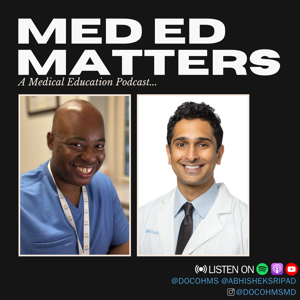
What does it really mean to transition from studying medicine to practicing it?
In this episode, we explore that pivotal shift through the lens of a fourth-year medical student, diving into the questions many trainees are asking but not always sure how to approach. Together with faculty perspectives, the conversation unpacks three key areas: evolving from a learner to a clinician, how learning changes across the continuum from undergraduate to graduate medical education, and how to advocate for yourself with confidence and professionalism.
Our guests share insights on the mindset shifts required to step into clinical responsibility, the different types of learning and expectations at each stage of training, and the traits that distinguish successful students, residents, and fellows. The discussion also tackles timely topics in medical education, including work-hour restrictions, access to surgical training opportunities, and strategies for supporting learners who may be struggling.
The episode closes with a “Med Ed Moment” from each guest—one key takeaway they hope every listener carries forward.
Whether you’re a medical student preparing for residency, a trainee navigating your next step, or an educator supporting learners along the way, this conversation offers practical advice and thoughtful reflection on growth in medicine.
4:06 – As a medical student, what questions might you have? What would you like to know?
5:30 – Transition from “studying” to “practicing” medicine / mindset shifts (Dan → Omar → Alex)
10:46 – Tyler: How are medical students approaching the transition from “studying” to “practicing” medicine?
12:52 – Dan: Throughout your career, what has the evolution of learners been like?
16:35 – Omar: What advice do you have for faculty to give learners more autonomy?
20:00 – Alex: How should students and residents advocate for themselves when seeking learning opportunities and autonomy?
22:43 – Tyler: Share the medical student experience of advocating for yourself (Group follow-up discussion)
31:00 – General discussion on hot topics
32:06 – Dan: How do you approach learners when there may be fewer surgical cases to maximize skill development during residency? Alex: How would you advise learners or faculty navigating fewer opportunities?
37:45 – Omar follow-up
40:16 – Med Ed Moment