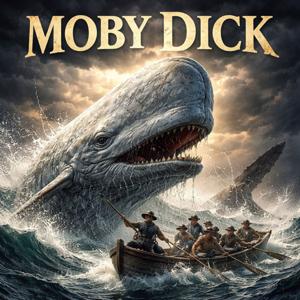
Moby Dick

Moby Dick

By Herman MelvilleArtsBooksFictionHistory
Download on the App Store

All Moby Dick episodes

  • Piazza Tales-Herman Melville
    Piazza Tales by Herman Melville.

    A collection of six short stories by American writer Herman Melville, published in May 1856. Except for the newly written title story, "The Piazza," all of the stories had appeared in Putnam's Monthly between 1853 and 1855. The collection includes what has long been regarded as three of Melville's most important achievements in the genre of short fiction, "Bartleby, the Scrivener", "Benito Cereno", and "The Encantadas", his sketches of the Galápagos Islands. (Billy Budd, arguably his greatest piece of short fiction, would remain unpublished in his lifetime.) One should note that the era's prevalent racism occasionally surfaces, as in describing blacks as "indisputable inferiors", to be found in "Benito Cereno".

    Featured on Moby Dick.

    Public-domain recording courtesy of LibriVox (librivox.org).

    9 hr 46 min
  • Billy Budd-Herman Melville
    Billy Budd by Herman Melville.

    Young naive sailor Billy Budd is impressed into military service with the British navy in the 1790s, framed for conspiracy to mutiny, summarily convicted in a drum-head court martial, and hanged. Billy Budd is the final published work by Herman Melville, discovered in his personal papers three decades after his death.

    Featured on Moby Dick.

    Public-domain recording courtesy of LibriVox (librivox.org).
    3 hr 7 min
  • Bartleby The Scrivener - Herman Melville
    Bartleby The Scrivener by Herman Melville.

    "Bartleby the Scrivener: A Story of Wall Street" is a short story by Herman Melville. The story first appeared, anonymously, in Putnam's Magazine in two parts. The first part appeared in November 1853, with the conclusion published in December 1853. It was reprinted in Melville's The Piazza Tales in 1856 with minor textual alterations. The work is said to have been inspired, in part, by Melville's reading of Emerson, and some have pointed to specific parallels to Emerson's essay, "The Transcendentalist." The story has been adapted twice: once in 1970, starring Paul Scofield, and again in 2001, starring Crispin Glover.

    Featured on Moby Dick.

    Public-domain audiobook.
    1 hr 29 min
  • Moby Dick - Part 1 - Herman Melville
    Moby Dick by Herman Melville is a profound exploration of obsession, revenge, and the struggle against nature, encapsulated in Captain Ahab's relentless pursuit of the elusive white whale. This enduring tale delves into themes of humanity's relationship with the natural world, the limits of knowledge, and the consequences of vengeance, making it remarkably relevant even today. The novel serves as a cautionary reminder of the dangers of single-minded ambition and the complexities of fate, urging listeners to reflect on their own pursuits and the potential costs involved. With its rich symbolism and philosophical depth, Moby Dick invites audiences to immerse themselves in a narrative that transcends time, offering insights into the human condition that continue to resonate profoundly. Discover the layers of meaning in this classic work that challenges the boundaries of literature and the very essence of existence.
    10 hr
  • Moby Dick - Part 2 - Herman Melville
    Moby Dick by Herman Melville is a profound exploration of obsession, revenge, and the struggle between man and nature. The tale follows Ishmael, who embarks on a whaling voyage led by the enigmatic Captain Ahab, whose singular focus is to hunt down the great white whale, Moby Dick. This timeless narrative delves into themes of fate, the limits of knowledge, and the complexities of human ambition, making it a significant reflection on the human condition. The enduring relevance of Moby Dick lies in its cautionary tale about the perils of obsession and the consequences of defying nature, reminding listeners of the intricate relationship between humanity and the world around us. Its rich symbolism and philosophical depth continue to resonate, inviting audiences to contemplate the eternal struggle against the unknown.
    10 hr
  • Moby Dick - Part 3 - Herman Melville
    Moby Dick by Herman Melville is a profound exploration of obsession, revenge, and the human condition, encapsulated in the relentless pursuit of the titular white whale. This classic novel delves into themes of fate, the struggle against nature, and the complexities of existence, making it a timeless reflection on humanity's place in the universe. The narrative invites listeners to confront the darker aspects of ambition and the consequences of single-minded pursuits, resonating deeply in a world still grappling with similar existential dilemmas. As the characters navigate the treacherous waters of both the sea and their own psyches, Melville's rich prose and philosophical insights challenge us to consider the depths of our own obsessions and the moral implications of our choices. Moby Dick remains an enduring work that speaks to the timeless struggle between man and the forces that seek to define him.
    4 hr 17 min
  • Imperialism and World Politics, Part 3 of 4-Parker Thomas Moon
    "Imperialism and World Politics, Part 3 of 4" by Parker Thomas Moon delves into the intricate dynamics of imperialism and its profound impact on global politics. This segment continues to explore the themes of power, dominance, and the complex relationships between nations, making it a crucial listen for those interested in understanding historical and contemporary geopolitical landscapes. The insights offered in this work resonate today as nations grapple with issues of influence and control, reflecting the enduring nature of imperialistic ideologies. Moon's analysis provides a thought-provoking perspective that encourages listeners to reflect on the legacy of imperialism and its relevance in shaping modern world affairs.
    6 hr 38 min