
Sign up to save your podcasts
Or



What would social media newsfeeds have looked like during the Bosnian Genocide? In this episode, Georgio Konstandi introduces Voices from the Drina, a new educational project that simulates a social media newsfeed to present the events of the Bosnian Genocide (1992-1995) as if unfolding in real time through the voices of survivors. Georgio also discusses the significance of understanding the broader context of the Bosnian Genocide beyond Srebrenica and the ongoing implications of the Dayton Peace Agreement.
Links mentioned in the episode :
Support More Than A Statistic!
Hosted on Acast. See acast.com/privacy for more information.
Dealing with the trauma of war, genocide and displacement while navigating new countries and systems is never easy. In this episode, Berina and Lamija reflect on their journeys of being made refugees because of the Bosnian Genocide and having to navigate life in the US and Canada. They also discuss the lasting impact of genocide, the complexities of diaspora identity, and the need for activism and community engagement to foster change.
Learn more about Jedna BiH
Hosted on Acast. See acast.com/privacy for more information.
Since October 7th 2023 and for the last 76 years, the Zionist regime has ruthlessly committed genocide and war crimes against Palestinians while occupying and creating an apartheid on sovereign Palestinian land. In this episode, Basma speaks about her experiences as a Palestinian, growing up in a refugee camp in Lebanon and how we can be better allies to Palestinians and for Palestine.
Read our previous interview with Basma here - We need to highlight refugee contributions
Hosted on Acast. See acast.com/privacy for more information.
Ma’ruf Dallas is a non-profit organisation based in Dallas, Texas. It advocates social justice by providing holistic assistance to asylum seekers, refugees and the local community. In this episode, Aisha highlights what led her to found Ma’ruf, their approach and the US asylum system.
If you would like to learn more about Ma'ruf and follow their work, please visit their website:
https://marufdallas.com/
Hosted on Acast. See acast.com/privacy for more information.
In 1995, 8,372 Muslim men and boys were systematically murdered in the Srebrenica Genocide by Serb nationalist forces in front of the UN Dutchbat Peacekeepers. 29 years later, the remains of the victims are still being found amid growing denial of the genocide by Serb nationalists. In this episode, Alma speaks about her experiences of surviving genocide, holding the Dutch state responsible for murder, raising awareness about the Bosnian Genocide through theatre, and what she believes we can all learn from the Srebrenica Genocide.
If you would like to read our previous interview with Alma, please follow this link.
If you would like to contact Alma or learn more about her work, please follow the links below:
Twitter , LinkedIn
Picture credit: Tom van den Dool
Hosted on Acast. See acast.com/privacy for more information.
When people are displaced, the physical needs of providing food, water and shelter are prioritised, but the effects of war and forced displacement go beyond just physical impacts and needs. The mental health needs of people who have been displaced often go unmet for reasons ranging from stigma to lack of resources. In this episode, Selma shares her journey from being made a refugee because of the Bosnian Genocide to finding her way to becoming a psychotherapist to guide others through their trauma.
If you want to learn more about Selma's work, follow her on Instagram!
Hosted on Acast. See acast.com/privacy for more information.
South Lebanon has been misrepresented by portraying the region as having a ‘culture of death’. In this episode, Zainab speaks about her experiences of living through the 2006 Lebanon War against the colonial settler state of Israel and the current situation in South Lebanon in light of the ongoing Palestinian Genocide.
You can read Zainab’s article in Missing Perspectives here: On ‘neighbouring’ the oppressor: living under the constant threat of war
If you would like to keep up with Zainab, her projects and life in South Lebanon, follow her on:
If you would like to support content creators from South Lebanon by amplifying their voices, please follow:
Eye on South Lebanon
Hasan
Sara Rammal
Hasan Atieh
Hosted on Acast. See acast.com/privacy for more information.
Hosted on Acast. See acast.com/privacy for more information.
The Partition of the subcontinent resulted in one of the bloodiest partitions in history and caused the rapid displacement of millions of people overnight. In this episode, Anam shares her personal journey of learning more about 1947 and 1971, the importance of collecting oral histories to combat state narratives and what she hopes her books can achieve.
To learn more about Anam and her work visit, https://www.anamzakaria.com/
To learn more about Anam's books, visit:
Footprints of Partition: Narratives of Four Generations of Pakistanis and Indians
1971: A People's History from Bangladesh, Pakistan and India
Between the Great Divide: A Journey into Pakistan-Administered Kashmir
Hosted on Acast. See acast.com/privacy for more information.
Storytelling is an art that allows us to see the world through someone else's eyes and acts as a record to prevent historical revisionism. In this episode, we're joined by Smajo and Emlyn to talk about how storytelling can rehumanise the rhetoric surrounding refugees and raise awareness about the Bosnian Genocide by placing the narrative where it belongs, with the people themselves.
You can learn more about Smajo's work on Twitter and the Bosnian Genocide Education Trust
You can learn more about Emlyn's work on TikTok.
Hosted on Acast. See acast.com/privacy for more information.
From the publisher's feed
Uncivilised. Illegal. Security threat.
Labels and statistics have been used to dehumanise refugees and displaced communities around the world to justify…
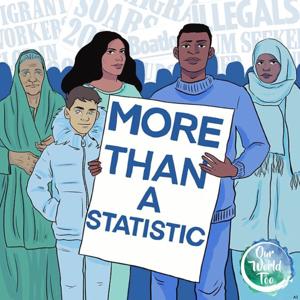
Join us as More Than A Statistic takes you on a journey to destroy one stereotype at a time and rehumanise the narrative, by putting the narrative back where it belongs, with the people themselves.
Hosted on Acast. See acast.com/privacy for more information.