
Sign up to save your podcasts
Or

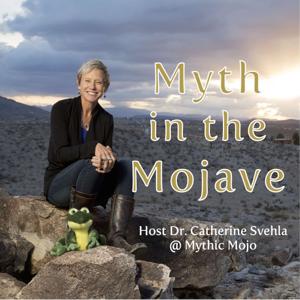


Sometimes you turn on the news or get on-line and what you read makes you want to rage or cry. So much suffering, hatred, and destruction... Is this a time of breakdown or breakthrough? I think it's up to us to decide, and our myths can help us find the way through.
Includes wise words from the Hopi Elders and poet Naomi Shabib Nye.
Support the show
From around the world and across time, experiences of the unseen realms and the beings that populate it come down to us in the form of religion, myth, and story. Some of these stories feed living rituals like the Day of the Dead (Dia de Muertos), that still hold meaning for people today.
I recorded this program on the cusp of the full Hunter’s moon, a few days before Halloween, to honor the powerful, annual transition from light to darkness. May it inspire you to extend an invitation to your ancestors and helpers in the spirit world.
“. . . Is it true one really lives on the earth? Not forever on earth, only a little while here. Though it be jade it falls apart, though it be gold it wears away…”
—-Nezahualcoyotl, Aztec king and sage from the 15th century
Support the show
In this program I tell a couple of stories about the Trickster Raven drawn from the Haida tradition in British Columbia. Like Coyote, Raven is present at the very beginning, a reminder that paradox is essential to a dynamic world.
Support the show
Chiron is a figure in Greek mythology who is best known as “the wounded healer.” He is often evoked in astrological readings as the personification of one’s deepest childhood wounds.
This interpretation holds a lot of value. But close examination of his story can lead us into reflection on collective attitudes about such wounds, tragedy, and the wise response to what cannot be healed.
Support the show
This is a beautiful and frightening world. It’s no wonder that so many of us long for certainty, for principles and concepts and moral ground that doesn’t shift too much beneath our feet. But there’s a flip side to everything.
When we get too certain, too sure, our hearts and minds get rigid. In the Hindu story Viddhi Kooshmandam, the career of a simple young man gives us a glimpse into another alternative.
Support the show
“When we study other people’s myths and rituals we may do so out of pure intellectual curiosity, to see what they believe in and do that we do not believe in or do. But sometimes we may begin to wonder what would happen if we ourselves came to believe those myths…” —-Wendy Doniger O’Flaherty, Other People’s Myths
In this program I share a couple of Mythic Coyote stories from the creation mythology of the Chemehuevi people. The Chemehuevi are native to the Mojave and have lived here for centuries, primarily near the Colorado River. My telling of these stories is adapted from versions found in Mirror and Pattern by Carobeth Laird.
I originally told these stories as part of a public lecture that was sponsored by the Morongo Basin Historical Society. I invited that group to reflect on them as a source of information about the Chemehuevi and about themselves. Many of our assumptions and beliefs about life and the world are unconscious. Bringing them to awareness is the first step in truly owning them, living them, and potentially changing them.
I extend that same invitation to you and fear not, you’ll get a laugh or two from this program as well as food for thought.
Support the show
“I remember Alan Watts asked me one day, ‘Joe, what kind of meditation do you do?’ I said, “I underline sentences.” — Joseph Campbell
In this program, Dr. Slattery talks about what it means to see a book as a friend and teacher, and shares his insight into reading as a contemplative practice. Learn how to open yourself to a text—-whether it be a poem, literary classic, or other written work that captures your interest— to bring yourself closer to your personal myth and encounter the text as an Other, with its own subjectivity, unconscious, and mythic dimension.
Dennis Patrick Slattery, Ph.D., is Core Faculty at Pacifica Graduate Institute in the Mythological Studies and Depth Psychology Programs. Honored as Distinguished Professor in 2007, Dr. Slattery is the author of over 200 articles and book reviews, as well as the author, co-author, editor, or co-editor of 23 books. His recent books are Bridgework: Essays on Mythology, Literature, and Psychology and Creases in Culture: Essays Towards a Poetics of Depth.
For more information about Dr. Slattery’s work visit www.dennispslattery.com.
Support the show
“This poem is the most sophisticated exploration of anything I’ve ever read, of the way that the soul moves; complexly, and slowly, and with determination, from unconsciousness to consciousness.” — Dr. Dennis Patrick Slattery
Dante’s Divine Comedy is an iconic literary work that has influenced Western culture for centuries. The story of his pilgrimage through Hell and Purgatory to Paradise still resonates with us today, and the image of being lost in a dark wood is familiar to many who have never read the poem.
According to Dr. Slattery, contemplation of the symbolic world that Dante created can reveal the contours of your personal myth. In his book Day to Day Dante: Exploring Personal Myth Through the Divine Comedy, Dr. Slattery guides the reader through the poem and connects Dante’s journey with the contemporary experience.
Dennis Patrick Slattery, Ph.D., is Core Faculty at Pacifica Graduate Institute in the Mythological Studies and Depth Psychology Programs. Honored as Distinguished Professor in 2007, Dr. Slattery is the author of over 200 articles and book reviews, as well as the author, co-author, editor, or co-editor of 23 books. His recent books are Bridgework: Essays on Mythology, Literature, and Psychology and Creases in Culture: Essays Towards a Poetics of Depth.
For more information about Dr. Slattery’s work and to buy Day to Day Dante: Exploring Personal Myth Through the Divine Comedy, visit www.dennispslattery.com.
Support the show
“He who tells the stories rules the world.” Hopi proverb
On June 17, 2015, nine black Americans were murdered during a Bible study at Emanuel African Methodist Episcopal Church in Charleston, S.C. A young white man named Dylann Storm Roof killed them because he believes that “Blacks are taking over the world and someone has to do something about it for the white race.”
In the aftermath of this tragedy, this insanity – two questions come to the forefront: why did it happen and what can I, can we, do to prevent racial violence, bridge the divide, and heal with Jon Stewart calls “our gaping racial wound?”
In this program I consider the connection between mythology, images of the Other, and “Us versus Them” thinking, and the opportunity that myth and story work offers each of us to be part of a life-affirming culture and just society.
Support the show
This program is the third and final episode in my telling of the ancient Sumerian myth of Gilgamesh, the hero-king of Uruk. Gilgamesh was two-thirds god and one-third human, and the gifts and challenges of this in-between situation are a major theme in the story.
In Part 1, Gilgamesh wreaked havoc instead of being a good king to his people because he had no peers. Without limits he couldn’t fulfill his potential. So the gods provided him with Enkidu the wild man, his foil and friend. In Part 2 I told of their adventures and how they fulfilled Gilgamesh’s destiny to perform heroic deeds and make a name for himself.
But this came at a cost. Enkidu is dead. It seems that this was necessary to maintain the proper balance of power between the gods and the semi-god Gilgamesh, and his mortal companion. And now Gilgamesh will struggle with the ultimate problem presented by his human side….
Support the show
From the publisher's feed