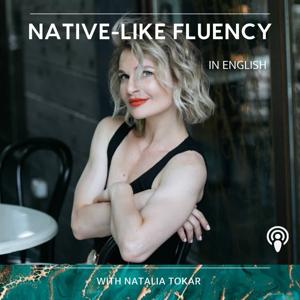
Native-like fluency in English

Native-like fluency in English

By Natalia TokarBusinessTechnologyEducation
Download on the App Store

Native-like fluency in English episodes

  • Russian vs English rhythm & stress patterns. Tips to improve the clarity of your communication

    This episode explains the differences in stress patterns in Russian and English. We will look at how and why Russians hear/don't hear the rhythm of English, and how Americans/British hear the Russian language.


    Intonation helps us hear the essence of what's being said, the shades of meaning, the context, the attitude and the intention of a speaker. People who learn a language to succeed in sales or business communication in an international team, rarely pay attention to the effect that intonation can have on their relationships with people.


    Non-native speakers can improve the quality of their communication in English if they learn to hear and use intonation and stress patterns correctly.


    The episode was created primarily for native speakers of Russian who are working on advancing their communication skills in English.


    Why can't we hear certain sounds?

    What can poetry explain?

    What if you can't tell the difference between the falling and the rising intonation in English?

    How to divide your speech into clear "thought groups" or "chunks"

    and a lot more in this episode.


    Here is another video with examples of what rising and falling intonation sounds like in English - youtu.be/HgRTig8Cpk8

    Hosted on Acast. See acast.com/privacy for more information.

    47 min
  • Public Speaking, inner confidence, and fear of judgment in business
    In this episode I'm sharing unimpressive reasons why you should stop trying to impress people with your presentations. Here are the highlights: - Public speaking in business has nothing to do with acting. Learning acting skills does not help people to become more confident presenters. - Why technical teams don't like public speaking and how to help them be more comfortable with presenting in front of people - Why people feel drained and exhausted after giving a talk in front of a big audience - The purpose of public speaking is not to impress your audience.... Why this mindset fails people - Public Speaking tips for non-native speakers who need to present in English - Three exercises to learn to be more confident and more comfortable with yourself - What is the real reason behind the fear of public speaking? - You don't need to teach people "correct" body language - How to deal with external interruptions during your talk (technical issues, somebody starts taking a video of you, somebody stands up and leaves the room, people ask unwanted questions etc..) If you resonate with the ideas shared in this episode let me know in the comments. You're welcome to ask questions too.

    Hosted on Acast. See acast.com/privacy for more information.

    49 min
  • How to measure fluency. Part 2. A message for non-native speakers
    Fluency is measurable. This episode (in two parts) explains how non-native speakers can measure fluency based on 4 criteria: - How much I hear - How much I understand - How clearly do I formulate my ideas in English - Do I speak English or a version of English that other non-native speakers understand? Natalia Tokar, the founder of UpSkillMe, is a non-native speaker herself. She helps international teams communicate their ideas in business in a clear, concise, and powerful way, and in English. The blog post I am referring to - upskillme.ru/news/fluency_part_2 The live video I'm referring to where I walk you through the ways to edit the way you think in English - www.youtube.com/watch?time_contin…e=1&v=g5DejIqtnBU Online courses for non-native speakers -courses.nataliatokar.me/ Instagram - @nataliatokarr

    Hosted on Acast. See acast.com/privacy for more information.

    33 min
  • How to measure fluency. A message for non-native speakers
    Fluency is measurable. This episode explains how non-native speakers can measure fluency based on 4 criteria: - How much I hear - How much I understand - How clearly do I formulate my ideas in English - Do I speak English or a version of English that other non-native speakers understand? Natalia Tokar, the founder of UpSkillMe, is a non-native speaker herself. She helps international teams communicate their ideas in business in a clear, concise, and powerful way, and in English. The blog post that Natalia refers to - upskillme.ru/news/fluency_eto_i…erimaia_vielichina The video exercise to check how much you hear - www.youtube.com/watch?v=DDoV_gy9WWQ Online courses for non-native speakers -courses.nataliatokar.me/

    Hosted on Acast. See acast.com/privacy for more information.

    29 min
  • Starting a speech right. Why I Never Introduce Myself
    How to start a speech? Or a meeting? How important are introductions and why is everyone trying to impress people with their credentials before they give any value? Natalia Tokar Founder & CEO at UpSkillMe (Communication & Public speaking coaching for startups, sales teams, and business leaders) upskillme.ru/ Linkedin - www.linkedin.com/in/nataliatokar/ Instagram - @nataliatokarr

    Hosted on Acast. See acast.com/privacy for more information.

    15 min
  • Carving Out Your Value through Communication: How Funds Can Improve Their Chances For Allocations
    This is a podcast on communication for fund managers aiming to get more allocations. - How do you stand out among all the other funds? - How to pitch your value and which common mistakes to avoid? - What is an incubator for fund managers and how to reach $250M AUM when you're starting a fund? - Criteria that are vital for investors. - Cross-cultural communication tips for fund- and asset managers with global outreach. - How to sell and pitch to non-native speakers. Speakers: Tyra Jeffries, Founder & CEO at CreativeCap Advisors www.creativecapadvisors.com/ Emerging Manager Incubator -www.creativecapadvisors.com/incubator/ Tyra on LInkedIn -www.linkedin.com/in/tyra-jeffries-8293a118/ Natalia Tokar Founder & CEO at UpSkillMe (Communication & Public speaking coaching for startups, sales teams, and business leaders) upskillme.ru/ Linkedin - www.linkedin.com/in/nataliatokar/ The LInkedIn Publication I mentioned in the podcast about how to reach out to new people on LinkedIn - www.linkedin.com/pulse/linkedin-c…tter-ways-tokar/

    Hosted on Acast. See acast.com/privacy for more information.

    56 min
  • How to give confident presentations when people always interrupt you
    People often get thrown off balance when someone interrupts their presentations that they have been prepared meticulously for a long time. People think it's annoying and disrespectful to interrupt while big clients, investors, shareholder, actually....very often interrupt presentations... because everyone craves a conversation, not a presentation. More of my thoughts on how to use interruptions to actually create meaningful connections with people are in the podcast. If English is not your first language but you use it as a business language, you probably can relate to this more than you think...

    Hosted on Acast. See acast.com/privacy for more information.

    30 min
  • The secret to a good pitch is knowing when to shut up
    Natalia Tokar is a communication coach to business leaders and sales teams and a founder of UpSkillMe.ru. Natalia has been using cross-cultural communication strategies to successfully run business projects in the UK, USA, Middle East, Russia, and Europe. She believes that communication is what helps to clear any mess in any business. Natalia has been actively involved in the blockchain space doing Business Development and Investor Relations. She is currently helping startups crystalize their message to investors and potential partners, and prepare for public talks and interviews with the media. Learn more at UpSkillMe.ru Feel free to reach out: www.linkedin.com/in/nataliatokar/ www.facebook.com/nataliatokarr www.instagram.com/nataliatokarr/

    Hosted on Acast. See acast.com/privacy for more information.

    33 min
  • "Depression for free!" Inspiring story of Stefan Siepmann
    -Did you know that 90% of serotonin is produced not in the brain but in your digestive tract? -Did you know that some people just do not produce enough serotonin by default? -Did you know there’s a way to handle depression and learn from it? Listen to Stefan Siepmann’s story. He is a certified yoga teacher and he’s been going through cycles of depression since he was 25. “I am 25 – I was on antidepressants for the whole year until my condition stabilized” 2011 – I feel the same but antidepressants don’t work anymore 2015 – I am hit by depression again, and I choose to try a different, more holistic approach… And the story begins… Share this with anyone you know who needs support. Listen to them. Give them a hand. Spread the message. Depression is not a diagnosis for life, but it can hit anyone. You never ask for it but it might be served daily. Natalia Tokar. Business English Coach and Entrepreneur. FB: www.facebook.com/nataliatokarr Websites: upskillme.ru/public_speaking careerboost.ru/ Stefan Siepmann. Certified Yoga Teacher and Entrepreneur. FB: www.facebook.com/stefan.siepmann.7 Website: yoga-metamorphose.com/ LINKS and NAMES we mentioned in the podcast: 1.The saliva test Stefan mentioned in the podcast was taken here swisshealthmed.de/ 2.JON KABAT-ZINN and his approach that didn’t work for Stefan www.umassmed.edu/cfm/ 3.The natural additives Stefan takes daily – see the pictures below. (will appear soon, stay tuned for the update)

    Hosted on Acast. See acast.com/privacy for more information.

    1 hr 18 min
  • Great presentations in English start with a feeling of physical comfort. Motivating guide on how to find it
    When people give business presentations in a second language, most of the time they feel stressed. People experience almost physical pain when they have to say something important in front of others who certainly have high expectations of them. They may be brilliant speakers when they present in their first language. However, when they switch to English, they lose all their confidence. This podcast explains how to: - find the confidence when you need to speak in front of people in a second language (in English) - how to feel encouraged rather than intimidated by the English-speaking audience - what exactly does it mean to "practice"? How do you do it and how often? - how is feeling confident connected to your physical sensations in your own body? - how can you be playful about your practising routine? - how to motivate yourself and where to find the courage to speak? You can always learn more at our website upskillme.ru Join us on FB and Instagram to get more practical tips. And come to our workshops to UpSkill your business communication skills in English. www.facebook.com/upskillme.ru/ www.instagram.com/nataliatokarr/

    Hosted on Acast. See acast.com/privacy for more information.

    24 min

About Native-like fluency in English

From the publisher's feed

Hi, I'm Natalia Tokar, and I am not a native speaker.


I created the methodology and the system of exercises to achieve native-like fluency in English because I couldn't find it anywhere.…