
Sign up to save your podcasts
Or



In October 1892, a young woman arrived quietly at a respectable house in Putney.
Within four days she was dead.
The death certificate appeared entirely straightforward — embolism, thrombosis, and chronic kidney disease. Natural causes. The body was buried, and the matter might easily have ended there.
But suspicion soon began to grow.
Within weeks the Home Secretary ordered the grave to be opened, and what Victorian forensic surgeons discovered during the post-mortem revealed that the medical certificate had told a very different story.
A doctor and his wife were arrested.
An undertaker was accused of helping conceal the truth.
And the man believed to have carried out the fatal operation — Dr Richard Freeman — had already vanished.
The newspapers soon gave the case a name:
The Putney Mystery.
Tonight we explore the strange death of Ellen Matilda Franklin — the hurried burial, the evidence hidden inside the coffin, and the sensational Old Bailey trial that followed when Victorian forensic science began to expose what had really happened in a quiet house in Chelverton Road.
Today we travel to Cambridge in the summer of 1871, where a young labourer collapsed after his morning meal and died within hours.
The symptoms pointed unmistakably to poison.
The chemistry insisted there was none.
And between the two, a newly married wife found herself facing the full weight of public suspicion.
This is the story of Henry Day — a sudden death that baffled doctors, divided neighbours, and revealed just how uncertain early forensic science could be.
A case of meat pudding, mixed evidence, and a courtroom struggling to make sense of answers that simply refused to align.
If you enjoy these deeper Victorian mysteries, we’d be delighted to have you join us over on Patreon, where we keep our longer investigations, early releases, and a great deal more from the archives.
Settle in — Cambridge awaits.
Tonight we travel to Brighton in the summer of 1866, where the sudden illness of a newly married woman set in motion one of the most troubling Victorian inquests of the decade.
Ellen Warder’s decline was abrupt, her symptoms baffling, and every doctor who attended her agreed on one unsettling point: nothing about her illness could be explained by natural causes.
But it was only when investigators began looking more closely at her husband’s past that the real unease began. For Ellen was not his first wife to die suddenly. Nor his second.
As the evidence gathered pace — and as the era’s leading toxicologist was called to examine her organs — the case widened into a far darker question:
How many tragic “misfortunes” can surround a single man before coincidence becomes impossible?
If you enjoy our Victorian true-crime investigations and would like access to our full archive, plus early ad-free episodes and bonus material, you can find all of that on Patreon, where we post additional stories that never appear elsewhere.
Settle in, and let’s step back to Brighton, 1866.
A quiet Surrey hotel. A routine morning remedy. And within minutes, a respected publican is dead on the floor in violent convulsions. When the doctor arrives, nothing makes sense: the salts taste bitter, the bottle has been mysteriously rinsed clean, and strange white crystals are scattered across the bar parlour.
This is the Byfleet Poisoning of 1924 — a case that led detectives from a village inn to a French chemist’s shop, a Biarritz hotel, and finally to one of the most dramatic murder trials of the decade. Was Alfred Jones the victim of accident, jealousy, desperation… or a calculated plan carried out under his own roof?
Tonight we follow the forensic trail, the conflicting testimonies, and the sudden appearance of a charming stranger whose arrival in England would change everything.
If you enjoy deep-dive historical true crime, you’ll find many more extended investigations and archive-only stories in our growing library over on Patreon — you’re very welcome to join us there for exclusive series, early releases, and long-form episodes.
A quiet summer evening in 1919.
A country lane in Leicestershire.
A young woman found beside her bicycle… and a mystery that would grip Britain for the next year.
In this episode, we unravel the Green Bicycle Mystery — a case that began as a presumed cycling accident but quickly deepened into one of the most perplexing investigations of the early 20th century. A bullet overlooked for nearly a day, a vanished cyclist on a distinctive green B.S.A., and a courtroom battle led by the formidable Sir Edward Marshall Hall all combine to create one of the era’s most enduring puzzles.
Join us as we follow the investigation step by step: the forensic misjudgements, the conflicting witness accounts, the disappearance and dramatic recovery of the bicycle, and the question that still divides historians more than a century later — what truly happened on that quiet Leicestershire lane?
If you enjoy immersive historical true crime, you’ll find a great deal more waiting in our archive.
You’re warmly invited to join us on Patreon, where members receive early episodes, hundreds of additional investigations, and our full Victorian–Edwardian true-crime library — a quiet corner of the internet where curiosity is very much encouraged.
Settle in.
The lane is quiet, the evidence is troubling, and the mystery remains unsolved.
A young woman found beside her bicycle in 1919, a missing cyclist on a green B.S.A., and a bullet no one noticed for nearly a day — we unravel one of Britain’s most perplexing early forensic mysteries.
Today, we travel to Paris in the spring of 1887, where an elegant apartment off the Rue Montaigne became the centre of one of the most sensational investigations of the Belle Époque.
A courtesan of considerable means, her trusted housekeeper, and a twelve-year-old girl were found murdered behind locked doors — no struggle, no intruder seen, and only the faintest collection of clues left behind.
What followed was a case that gripped Europe: a chase across France, a courtroom overflowing with spectators, and a man whose shifting identity and charm made him both captivating and deeply suspect.
This is the story of Henri Pranzini, and the triple murder that shocked Paris to its foundations.
And in our Further Particulars, we lighten the mood just a little with a gastronomic scandal from the Boulevard Haussmann, involving a pâté, an unexpected pigeon, and a delicatessen owner whose confidence exceeded his culinary accuracy.
If you enjoy these atmospheric journeys into historical true crime, we’d love to welcome you to our Patreon community, where we share exclusive series, early ad-free episodes, and a vast archive of documentaries. Your support helps us continue researching and producing these stories each week.
Settle in — Paris awaits.
Today we travel back to Boston in 1849, to one of the most unsettling disappearances of the Victorian age.
Dr George Parkman — a man known for his precision, his routine, and his unshakeable punctuality — leaves home one afternoon and never returns. The last place he was seen? The quiet, red-brick halls of Harvard Medical College.
What follows is a mystery that gripped Boston, unsettled Harvard, and pushed the courts into the earliest days of forensic science. Locked rooms, burning furnaces, shifting statements, and a breakthrough that would change criminal investigation forever.
Settle in as we explore the disappearance — and the murder — that became known as the Harvard Mystery.
And for listeners who enjoy diving deeper into Victorian true crime, we also have an archive of more than 500 ad-free episodes, exclusive series, and early releases over on Patreon.
Now — let’s step into 1849.
n 1844, the quiet town of Crewe was shaken by a crime that startled even seasoned Victorian magistrates. When Richard Gallop fell suddenly and violently ill, suspicion soon turned to the person closest to him: his young daughter, Mary.
What began as a family dispute over a forbidden romance spiralled into one of the era’s most unsettling arsenic cases. Drawing entirely from surviving inquest testimony, courtroom reporting, and contemporary medical evidence, this episode traces the final days of Richard Gallop, the repeated poison purchases, and the investigation that revealed a carefully executed plan inside an ordinary household.
We also close with a remarkable Further Particulars tale from Northumberland — involving two burglars, a fearless servant girl, an elderly woman armed with a scythe, and the sort of Victorian resourcefulness that belongs in a novel rather than a police report.
If you enjoy exploring historical true crime through original sources, you can find more weekly episodes, extended archive access, and advert-free listening on our Patreon:
👉 https://www.patreon.com/newsofthetimes
London, October 1880.
A quiet walk in Finsbury Park ends in horror when three gunshots echo across the lake and a young woman collapses to her knees. Her name was Jane Messenger, twenty-nine years old, respectably dressed, navigating a troubled marriage and an increasingly fraught entanglement with her brother-in-law, William Herbert.
What followed was one of the Victorian era’s most startling public murders — a broad-daylight shooting witnessed by families, park-goers, and off-duty officers. In this episode, we trace the tangled domestic history behind the crime, Herbert’s delusional hopes of an Australian inheritance, and the months of emotional turmoil that led to a fatal confrontation on a cold October afternoon.
We explore the police response, the medical findings, the inquest before Dr Hardwicke, and Herbert’s chilling admissions that revealed his intentions long before he walked Jane into the park. The case would grip London, dominate the papers, and end at Newgate with a crowd waiting for the black flag.
And in Further Particulars, we lighten the mood with the story of a gentleman who believed the most effective way to critique the House of Lords was to break a window and demand a publishing contract. As one does.
If you enjoy archival Victorian true crime, forensic history, and carefully reconstructed storytelling, this episode brings together jealousy, delusion, and the darker side of respectability in 1880s London.
If you’d like to explore our full archive — including exclusive series and early releases — you’re warmly invited to join us on Patreon at patreon.com/newsofthetimes.
In the spring of 1881, a quiet butcher’s shop in Slough became the centre of one of Victorian England’s most baffling crimes. Mrs Reville, the butcher’s wife, was found murdered in her own back room — no struggle, no witness, and barely a minute in which her killer could have acted.
The shop layout offered no hidden corners. The doors were visible from her desk. Anyone entering would have been immediately seen. And yet, within this impossibly narrow window of time, an assailant struck four blows, removed the money from her pocket, and vanished without leaving a trace.
Suspicion soon fell on the young apprentice, Augustus Payne, whose movements, handwriting, and prior disputes raised troubling questions… but whose innocence the jury ultimately upheld.
Tonight, we walk through the original testimony, the strange timings, the “H. Collins” letter, and the unanswered questions that left Victorian investigators — and later generations — utterly at a loss.
A quiet evening. A familiar shop. An impossible crime.
And still, after more than a century, no one can say how it was done.
In our Further Particulars: a lighter tale from 1881 involving missing cabbages, a suspiciously woolly sheep-dog, and a gardener whose evening surveillance took a most unexpected turn.
If you enjoy these deep dives into Victorian crime and curiosities, you’ll find many more investigations — including exclusive episodes — available on our Patreon.
From the publisher's feed
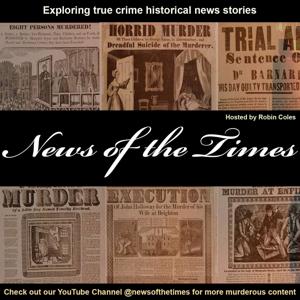
Welcome to News of the Times!
Step into the shadowed alleyways and gaslit parlours of the 18th and 19th centuries with News of the Times — a meticulously curated journey through…
With over 500 episodes and counting, we explore true accounts of mischief, murder, and mayhem from days gone by — all delivered with a wry nod and a love for the curious corners of the past.
🕵️ For those with a taste for the peculiar, you may also enjoy our new side project: Volume 1: Slightly Unreliable Memoirs — a whimsical collection inspired by the lives (and occasional misadventures) of our research team. Think cravats, crumpets, and the occasional cactus on the lam. Intrigued? Find it here:
👉 https://ko-fi.com/s/b406f6f11e
2,770 Listeners

15,157 Listeners

10,657 Listeners

910 Listeners
1,867 Listeners
25,319 Listeners

2,047 Listeners

204 Listeners

810 Listeners

1,385 Listeners

517 Listeners
1,148 Listeners
1,450 Listeners

28 Listeners

68 Listeners