
Sign up to save your podcasts
Or



Before the New Year, neighbors gather at Nobleman Zavalnia's house to pass the day in talk, and young Stas offers a story he heard from the landlord he lodges with: the tale of Twardowski. Twardowski studied at the schools in Polatsk. He learned his lessons well but ignored his teachers, and read forbidden books in secret until he no longer feared mortal sin. He learned sorcery and sold his soul to an evil spirit, yet the professors and the priest, knowing nothing of it, put him in charge of a group of young pupils.
He entertains the boys with marvels, and once makes tiny winged devils appear, riding on their soap bubbles. His favorite is Hugon, whom he praises above all the others and never refuses money. At nine in the evening, when the boys go to bed, Twardowski often slips out into the city, and he keeps one room locked, with books no one is allowed to see. Then one night, as the bell of the Jesuit church strikes midnight and Twardowski has not yet come home, Hugon notices that the key has been left in the lock.
Glossary and notes:
Pan, Pani: sir, madam; titles for the gentry
souls: serfs; a dowry or estate was measured by the number of souls it held
Part of the frame story rather than one of the book's fourteen numbered tales.
The complete book, with all the tales, is available in print, ebook and audiobook at grunwald.ca:
https://grunwald.ca/products/nobleman-zavalnia-or-belarus-in-fantastical-tales-jan-barszczewski?utm_source=podcast&utm_medium=audio&utm_campaign=nobleman_zavalnia&utm_content=zav-bonus-twardowski
Translated from the Belarusian by Olya Ianovskaia.
Artwork by Nasta Lee.
Published by Grunwald Publishing.
It is nearly Christmas Eve, and Nobleman Zavalnia keeps looking out at the frozen lake, waiting for Rodzka to bring the fish. Rodzka lives on a distant island in Lake Nieszczarda and never comes home empty-handed, even in the worst storms. People say he can summon the wind and still the waves, that the vadzianik (вадзянік), the water spirit, obeys him, and that he must be a sorcerer. Rodzka only smiles: his messengers are the white terns, he says, and God helps those who work hard. Then, over a glass of harelka (харэлка), he agrees to tell young Janka how evil spirits came to breed in these parts.
His stories move from lake to lake across the Polatsk country. A coal-black demon sits cross-legged in the middle of Lake Rasony, playing the bagpipes. During Kaliady (Каляды), fishermen cast their net at midnight on a lake near Halubova manor, and in the blizzard a neighbor knocks at a window, begging to borrow a cart. And on Hluhoe Lake, where neither sun nor moon is ever reflected, a proud nobleman, Pan Z., orders his men to fish waters no one has fished in living memory, and refuses to have them blessed.
Glossary and notes:
vadzianik (вадзянік): the water spirit
harelka (харэлка): Belarusian vodka
Kaliady (Каляды): the midwinter festival, kept until the Feast of the Three Kings
Astashou fishermen: outside fishermen hired by landowners each winter, said to send an evil spirit under the ice to drive fish into their nets
corvée: unpaid labour a serf owed the landlord
verst: an old measure of distance, about a kilometre
Part of the frame story rather than one of the book's fourteen numbered tales: the narrator, Janka, is spending the winter with his uncle, Nobleman Zavalnia, whose house by Lake Nieszczarda takes in travelers and storytellers.
The complete book, with all the tales, is available in print, ebook and audiobook at grunwald.ca:
https://grunwald.ca/products/nobleman-zavalnia-or-belarus-in-fantastical-tales-jan-barszczewski?utm_source=podcast&utm_medium=audio&utm_campaign=nobleman_zavalnia&utm_content=zav-bonus-rodzka
Translated from the Belarusian by Olya Ianovskaia.
Artwork by Nasta Lee.
Published by Grunwald Publishing.
In Volhynia, where the Teteriv runs between steep cliffs past the town of Cudnau, the cholera of 1848 has left many widows and orphans, and in autumn neighbours gather to remember the dead. Maciej mourns the healer Samatnitsky, who rubbed the sick with mysterious ointments and lost no patients, then died alone on his homestead. Pan Mikola insists that Samatnitsky lives there still, shorter, darker and older, and tells how a seeker of nature’s secrets came to live in another man’s body. As they talk, the door opens on a pale, bloodless stranger with eyes dull as fog, who claims the name, says he is the Samatnitsky Zyanon once knew in Vilnia, and asks him to come to his hut.
The next day, sitting as still as a wooden effigy, Samatnitsky tells Zyanon of his travels: the Sofia Park in Uman; the wild orchard of Pan Haynar near Teplyk, dug to bring rain to the steppe; the cliffs of the Buh and the Dniester in Padolle (Падолле); and Odessa, where he carries two bottles of sapphire and carmine water to the scholar Pan Ryliec, who drinks fire in honour of the Solimandra. His thoughts keep returning to Adelya.
Glossary and notes:
Cudnau: Chudniv, a town on the Teteriv river in Volhynia
Palesse (Палессе): Polesia, the forest and marsh country of southern Belarus and northern Ukraine
Padolle (Падолле): Podolia, a fertile region of western Ukraine
haidamaks: 18th-century Cossack-peasant rebels in Ukraine
Solimandra: the salamander, a spirit of pure fire
verst: an old measure of distance, about a kilometre
The complete book, with all the tales, is available in print, ebook and audiobook at grunwald.ca:
https://grunwald.ca/products/nobleman-zavalnia-or-belarus-in-fantastical-tales-jan-barszczewski?utm_source=podcast&utm_medium=audio&utm_campaign=nobleman_zavalnia&utm_content=zav-soul
Translated from the Belarusian by Olya Ianovskaia.
Artwork by Nasta Lee.
Published by Grunwald Publishing.
Deep in the night at Pan Ziamelski’s house near Polatsk, old Pan Rotmistr, who carried arms through Napoleon’s wars in the hope of dying in peace among his countrymen, speaks of his son, somewhere in a foreign land, whom he expects never to see again, and he weeps. As the men sit in silence, a strange vision rises before them. Then, after the second cock-crow, the mistress of the house comes in with a wondrous dream of her own.
The next day brings farewells and a last look at country life: a walk through the groves and the early buckwheat by the lake, where wild ducks rise like a cloud and a bear has trampled a field of oats; a summer storm with hail, when the family throws holy herbs on the coals and kneels; an evening of stories about the northern capital and the sea; and a song from the old Jesuit theatre in Polatsk, once sung to the kobza (кобза), that the host has always loved. Anelya sings to the guitar. Part Six, the close of the cycle The Wooden Old Man’s Tales.
Glossary and notes:
Rotmistr: a cavalry captain
second rooster: the second cock-crow, shortly before dawn
kobza (кобза): a lute-like folk instrument
holy herbs: herbs blessed in church and burned to ward off storms
northern capital: St Petersburg
percale: a fine, closely woven cloth
The complete book, with all the tales, is available in print, ebook and audiobook at grunwald.ca:
https://grunwald.ca/products/nobleman-zavalnia-or-belarus-in-fantastical-tales-jan-barszczewski?utm_source=podcast&utm_medium=audio&utm_campaign=nobleman_zavalnia&utm_content=zav-wom-6
Translated from the Belarusian by Olya Ianovskaia.
Artwork by Nasta Lee.
Published by Grunwald Publishing.
Pan Rotmistr remembers a schoolfellow from Polatsk named Seviaryn, one of the best students, in love with poetry. The pastoral idylls of Theocritus, Gessner and Shymanovich shape the way he sees everything. Walking outside the city, he finds naiads in the streams, nymphs dancing in the meadows and dryads smiling from under the trees; he does not know misfortune exists. One day, on a school visit to the museum, he runs up to the Wooden Old Man with a handful of flies and asks it to guess what he is holding. The Old Man warns him that he will be cast out of the Eden of his dreams. Seviaryn lets the flies go and laughs.
He leaves school like a bird let out of a cage and gives his heart to Panna Adelya, the beautiful mistress of an estate. Years later the Rotmistr, travelling through Seviaryn’s part of the country, calls on his childhood friend and finds him alone in his room, pale and dishevelled, afraid of the flies at the window, eager to show his guest the locusts by the river. Part Five of the six-part cycle The Wooden Old Man’s Tales.
Glossary and notes:
Arcadia: the shepherds’ paradise of ancient pastoral poetry
Theocritus, Gessner, Shymanovich: poets of pastoral idylls, ancient Greek, Swiss and Polish
naiads, nymphs, dryads: in Greek myth, the spirits of streams, meadows and trees
Panna: ‘Miss’, the title of an unmarried lady
Rotmistr: a cavalry captain
The complete book, with all the tales, is available in print, ebook and audiobook at grunwald.ca:
https://grunwald.ca/products/nobleman-zavalnia-or-belarus-in-fantastical-tales-jan-barszczewski?utm_source=podcast&utm_medium=audio&utm_campaign=nobleman_zavalnia&utm_content=zav-wom-5
Translated from the Belarusian by Olya Ianovskaia.
Artwork by Nasta Lee.
Published by Grunwald Publishing.
Old Pan Rotmistr recalls a Polatsk student his friends call simply the Philosopher. The authors taught in school are not enough for him: he hunts down forbidden, anti-religious books by French philosophers, and whenever the prefect-priest burns them before his eyes, he only learns to hide them better. On the day he finishes school, he and his friends pay a farewell visit to the Wooden Old Man, and the student asks the head of wise Socrates what it thinks of all his reading. The answer makes everyone laugh, and the Philosopher spits in anger.
Settled on his village estate, he spares no expense on a library in many languages, holds forth to admiring young neighbours on mysteries he does not understand himself, and hires a well-paid foreign assistant who calls him a genius and feeds his contempt for faith. Soon he looks down on everyone, as one looks down on ants from a mountain top. He heeds no warning, and strange things begin to happen, first at Sunday Mass, then on a walk in the fields. Part Four of the six-part cycle The Wooden Old Man’s Tales.
Glossary and notes:
prefect: the priest in charge of students’ conduct at a Jesuit school
Iron Age: in classical myth, the last and worst age of mankind
Rotmistr: a cavalry captain
The complete book, with all the tales, is available in print, ebook and audiobook at grunwald.ca:
https://grunwald.ca/products/nobleman-zavalnia-or-belarus-in-fantastical-tales-jan-barszczewski?utm_source=podcast&utm_medium=audio&utm_campaign=nobleman_zavalnia&utm_content=zav-wom-4
Translated from the Belarusian by Olya Ianovskaia.
Artwork by Nasta Lee.
Published by Grunwald Publishing.
At the hilltop house near Polatsk, the host, Pan Ziamelski, will not let his returning schoolmate or old Pan Rotmistr leave. Anelya sings her morning hymn to the guitar, the family walks through a grove the host raised from wasteland, and the eldest son shows the Rotmistr a dragonfly and asks whether the Insect Woman looked like that. In the evening the Rotmistr remembers the Wooden Old Man’s prophecies to certain Polatsk students, as his landlord there, long in service at the Jesuit monastery, told them.
One of them is a gifted, idle boy who keeps running away from the collegium. At the end of the school year, when the students crowd round the Old Man with their questions, he gets a name instead of an answer: Lucifuga, a cockroach hiding from the daylight. He laughs it off. Knowledge does not bring happiness, he says, Fortune does. Later he sleeps through the days, plays cards through the nights, and in a great city meets Panna Aurelia, thin, pale and airy, who dances until dawn, rises at sunset and owns a fine estate. Part Three of the six-part cycle The Wooden Old Man’s Tales.
Glossary and notes:
Lucifuga: Latin for ‘one who flees the light’
collegium: the Jesuit college in Polatsk
Panna: ‘Miss’, the title of an unmarried lady
Rotmistr: a cavalry captain
The complete book, with all the tales, is available in print, ebook and audiobook at grunwald.ca:
https://grunwald.ca/products/nobleman-zavalnia-or-belarus-in-fantastical-tales-jan-barszczewski?utm_source=podcast&utm_medium=audio&utm_campaign=nobleman_zavalnia&utm_content=zav-wom-3
Translated from the Belarusian by Olya Ianovskaia.
Artwork by Nasta Lee.
Published by Grunwald Publishing.
Old Pan Rotmistr, a white-haired cavalry captain bent by age, offers a story of his own that touches the Wooden Old Man himself. Long ago, a wealthy lady in their land believes her serfs are her property like any other object. She dresses in silk and diamonds while her peasants starve, punishes the innocent along with the guilty, and chains any girl who hopes to marry a free man. Old and ill, she turns devout, gives money to the monasteries of Polatsk, and is granted a long life to repent. She lives to a hundred, and her cruelty only grows.
Forgotten by all, she withers into a dwarf, then to the size of an infant, and at last into a strange insect with long transparent wings and the same malice in her heart. Then a new master, Pan A., arrives from afar to take over the estate. He laughs at his servants’ talk of phantoms under the floorboards, frogs and beetles with cat-like heads and eyes like embers, until the Insect Woman comes for him. Part Two of the six-part cycle The Wooden Old Man’s Tales.
Glossary and notes:
Rotmistr: a cavalry captain
Pan: a gentleman’s title, like ‘Sir’
Polatsk (Полацк): an old town in northern Belarus, home of a Jesuit college and monastery
serf: a peasant bound to the land and owned by its landlord
The complete book, with all the tales, is available in print, ebook and audiobook at grunwald.ca:
https://grunwald.ca/products/nobleman-zavalnia-or-belarus-in-fantastical-tales-jan-barszczewski?utm_source=podcast&utm_medium=audio&utm_campaign=nobleman_zavalnia&utm_content=zav-wom-2
Translated from the Belarusian by Olya Ianovskaia.
Artwork by Nasta Lee.
Published by Grunwald Publishing.
Eighteen years after leaving home to seek his fortune, a traveler returns on foot to the country around Polatsk. At sunset, still forty versts from the town, he asks for shelter at a gentry house on a hilltop, and its master turns out to be an old schoolmate from Polatsk. The household is full of children, the eldest a raven-haired daughter, Anelya. On a corner shelf stands a wooden bust, bald and broad-nosed like Socrates, its face pitted, battered and scorched: the Wooden Old Man, who once peered from a narrow window in the Jesuit cloister, dispensing warnings and advice.
Over harelka (харэлка) and tea from the samovar, with the white-haired Pan Rotmistr just arrived, the host tells of the Old Man’s wanderings. Thrown out with the rubble when the Jesuit walls are rebuilt, he passes to a merchant who takes him for Socrates; to the merchant’s wife, Efima, who calls him a monstrosity; to Usvoisky, an innkeeper who scoffs at miracles; and to Pan Khapatsky, a former judge educated to the point of believing in nothing. Each treats the Old Man in his own way. Part One of the six-part cycle The Wooden Old Man’s Tales.
Glossary and notes:
Pan: a gentleman’s title, like ‘Sir’
Rotmistr: a cavalry captain
verst: an old measure of distance, about a kilometre
harelka (харэлка): Belarusian vodka
factor: a Jewish agent who handled a landowner’s or merchant’s business
Dzvina (Дзвіна): the Western Dvina river, which carried Belarusian flax to Riga
The complete book, with all the tales, is available in print, ebook and audiobook at grunwald.ca:
https://grunwald.ca/products/nobleman-zavalnia-or-belarus-in-fantastical-tales-jan-barszczewski?utm_source=podcast&utm_medium=audio&utm_campaign=nobleman_zavalnia&utm_content=zav-wom-1
Translated from the Belarusian by Olya Ianovskaia.
Artwork by Nasta Lee.
Published by Grunwald Publishing.
The third traveller at Zavalnia’s house, a young man with a soft beard, remembers a story from the long winter evenings. Aleshka, an honest, hardworking servant, serves a wealthy master without complaint for three years. In the fourth he is paid just three talers for all his labour, and sets off, wishing he had money to help those too old or crippled to earn their bread. On the road he meets a one-armed beggar, a blind man led by a boy of ten, and an old man bent low, his beard and hair white as snow. He gives each of them a taler. The last hands him the staff that supported him in old age: raise the end that touches the earth toward the sky, and whatever you wish will come true.
Aleshka puts the staff to the test against fire, storm and drought, then journeys beyond forests, waters and mountains to a vast country laid waste by the Great Sorcerer. Its borders are guarded by giants: Dubina, who uproots ancient oaks with one hand; Prud, who fishes the river with his moustache; and Harynia, who stacks mountains into a wall higher than the clouds.
Glossary and notes:
Taler: a large silver coin
Dubina (дубіна): a cudgel; the forest giant is named for it
Prud (пруд): a pond; the river giant’s name
Harynia: a giant named for the mountain (hara, гара)
The complete book, with all the tales, is available in print, ebook and audiobook at grunwald.ca:
https://grunwald.ca/products/nobleman-zavalnia-or-belarus-in-fantastical-tales-jan-barszczewski?utm_source=podcast&utm_medium=audio&utm_campaign=nobleman_zavalnia&utm_content=zav-staff
Translated from the Belarusian by Olya Ianovskaia.
Artwork by Nasta Lee.
Published by Grunwald Publishing.
From the publisher's feed
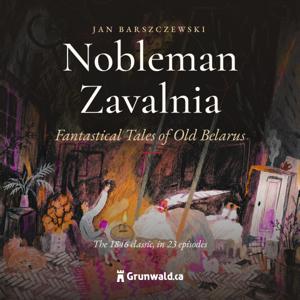
Witches and werewolves, restless souls and a huntsman who meets the Serpent King: the fantastical tales of Nobleman Zavalnia, a Belarusian classic of 1846 by Jan Barszczewski, one tale per episode,…