
Sign up to save your podcasts
Or

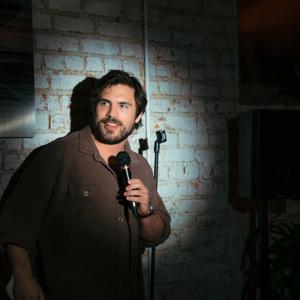


“Hey Dan, we’re going to cancel the late show--not enough tickets sold. Sorry buddy.”
I sit in a greenroom on a maroon couch that was most likely a completely different color when it was carried into this comedy club several decades ago. It might have been bright red when the first ass, belonging to some vaudeville performer, imprinted itself on its cushion. I’ll bet even back then performers would often be told something similar, like “Hey hep-cat, we had to 86 the late show. Not enough swingers and kittens doing the Charleston through the front door.”
For a stand up comedian, there are generally two shows a night: the early show and the late show. The club will cancel a show if the ticket sales aren’t enough to justify the cost of staying open, but they don’t make this decision until they’re absolutely sure they can’t make any money. It’s cruel, but it’s an old cruelty, like illness or being forced to listen to a coworkers favorite music. I feel as though I’m playing part in an ancient tradition of performers as I meekly accept what the manager has just told me.
“Yeah sure, no problem, the early show is going to be fun,” I say, as he gives me a sympathetic nod and exits, closing the door behind him, trapping me in the strange mildewed air of the green room. The smell is thick with the flop sweat of countless acts before me. I sit and think about how I’ve failed before I’ve even gotten on stage, failed in the ever present challenge of every live performer in history. I’ve failed to sell enough tickets.
There was a time in my career when I didn’t consider ticket sales. I was a beautiful little minnow swimming through the murky waters of comedy, where all was new and nothing was expected of me. I would show up to a venue and the booker would say, “sorry, we didn’t sell a lot of tickets,” and I’d say, “who cares, there’s a microphone, right? What’s there to worry about?” Little did I know that the booker most likely went home after those shows and drank even more hand sanitizer than show bookers usually drink. My first experience wrangling an audience came in 2022, and god, did it hurt.
I had just amassed a decent-sized following by posting myself telling jokes while washing dishes in my sink. My minor success, coupled with my ever-expanding ego, turned me into the most volatile and damaged archetype possible: a man who is drunk on a very, very, small amount of power.
My arrogance ballooned to maximum capacity when famous booker Frank P messaged me. He asked if I wanted to headline an iconic Los Angeles venue. I said yes immediately. I had headlined in San Diego before, and, even though the venue I performed at drew its own crowd, I felt that I was responsible for at least a few ticket sales. When I was done messaging Frank I posted a story that said I would be headlining in LA and everyone should buy tickets now.
I put my phone down, put my head on my pillow, and fantasized about the virtual stampede that was now taking place to buy tickets. LA was a huge city, and certainly a high percentage of the people who follow me would rush to buy tickets. The website might crash, the venue might need to add seats, I might need to start a charity in order to launder the money that will undoubtedly be injected into my pockets in one month’s time. I didn’t think much about the show after that, seeing a sell-out as an inevitability. Three weeks passed, and I received a text message from the booker. I’ve received this message many times and in many forms since then, and no matter how many times it flashes across my screen, it always causes a pit of unfathomable depth to form in my stomach.
“Hey Dan, we only have three tickets sold for your show. Could you maybe post about it again?”
I studied the words to be sure I read them right. Three tickets? Did he mean three hundred? Was the message intended for a lesser act, like Jeff Dunham and his puppets? How will the puppets react? I bet Peanut will have ALOT to say about this one.
Unfortunately I read the message correctly, and more unfortunately, Jeff Dunham manages to sell more tickets than me to this day, just because he’s more talented and likable. The world is as cruel as it is unfair.
I went back on Instagram, more desperate this time. I used the word please about five times.
“Hey, please buy tickets now. We need to get an idea of how many people are going, so please get your tickets now and please tell your friends before I “please” myself in the head with a gun,” I wrote.
Under pressure, I am an incredible and persuasive writer. Unfortunately, my message went unheeded, and I arrived at the venue with six tickets sold. As though having three more people than expected had the potential of raising my spirits, the booker informed me that the other three were comped tickets he gave to tourists who he met at a spin class. I did my act in front of three audience members and three fitness enthusiasts, all of them brought together by a shared desire to politely nod as I told jokes and looked out at the mostly empty room. Going into my closer, I watched a janitor start sweeping, getting an early jump on a purposeless night of work. The venue was just as clean as when I found it.
I greeted the three audience members. They were very nice and told me they had a great time. This was surprising because I could see their faces the entire show and their expressions told a different story. The stationary cyclists were equally, and eventually more enthusiastic than the people who came to see me on purpose. I waved goodbye to the tragedy-stricken-family-sized crowd and went back to my car. The car is a wonderful place to scream because of its soundproof nature, but you have to be careful of the fact that the front window is see through. Otherwise you run the risk of screaming in anger, then opening your eyes to see all six recent audience members staring at you with grave concern. You may then have to smile and wave, thinking you’re putting the car in reverse, slamming into the car in front of you, then driving away.
That booker stopped booking me, and I embarked on my long journey of acceptance, perseverance, and tampered expectations. I learned that having a following does not mean you have a bunch of people who are willing to pay money, leave their homes, and see you. My videos are luckily humor-based (at least, when I write them well,) so it’s not like I have zero crossover. Maybe somewhere there is a person who makes taxidermy “how-to” videos who wants to cross over into standup. He would most likely have a harder time making that switch, even though his material would be easier to write. That being said, I struggle to sell tickets compared to other standup comedians with similar or smaller followings, and that can be hard to accept.
I began to go on the road under similarly-false preconceptions about what followers mean. I would go to a city where I had ten thousand followers, and ten would show up. The ten that did show up got a good show. I have been doing standup for much longer than I’ve been making videos, but nevertheless, it’s hard to perform in rooms so small you don’t have to move your head to see everyone. If you’re selling a bunch of tickets on the road, you have the potential to have fun when you fly out to perform. You can afford to bring your friends, and afford to buy those friends matching sequin jumpsuits that you require them to wear at all times. Real fun. But if you don’t sell a lot of tickets, your experience is wildly different.
I get on the plane to my shows nervous about whether I will make enough money to justify the flight, and I stay in the hotel the comedy club provides, if the comedy club provides accommodations. If I’m left to get my own hotel, I look for the cheapest place that hasn’t been mentioned in an article about a local homicide in the last six months. Because of that rule, Motel 6 is almost always out of the question.
Leading up to the show, I am checking and refreshing the ticket count about ten times an hour, imagining what performing in front of the meager number will feel like. After shows, I am constantly trying to think up ways I can charm the manager so they will have me back at the club. I’ve considered resorting to doing magic tricks for them.
Not all the shows on my last tour were poorly sold, but enough were to give me a sense of fear over my upcoming tour. I want to be clear: I have no issue performing for small crowds. I’ve performed for a single couple before, and will happily do it again (as long as it’s not the same couple--they left halfway through my set. I don’t know why they left, though I assume we can take agoraphobia off the table.)
My fear as it relates to ticket sales is not selling enough to stay on the road. There is a limit to what a booking agent is willing to do for you. I have a wonderful booking agent, so wonderful that I know he has better things to do with his time than gamble on having me as a client for the rest of his life (but Ben, if you’re reading this, please keep believing in me. I will make over $2,000 in a year some day, you just wait.) So my fear is ever-present and has been for the last two years. You might think my anxiety is unsustainable, but almost every performer feels this way. Just look at every career comedian, who hasn’t died from overdose or suicide, or their wife killing them...okay, maybe it is unsustainable.
Every comedian feels this way, even the famous ones. My friend Laura Peek, who is extremely funny and professional but is not yet a celebrity, was recently talking to Mark Normand, a famous comedian. She was telling him that she was worried about ticket sales in Chicago, and Mark looked at her and said, “hey...me too! Comedy!”
It’s hard to imagine a man who regularly sells out theaters being worried about anything other than what kind of wrap to get around his solid-gold Porsche, but they have anxiety too. You don’t get into comedy because you have a healthy relationship to rejection and acceptance--you measure yourself off of how funny you are, and how many people want to see you. The second you sell a show out is the second you start thinking, dang it, I should have done a bigger venue.
Like most things, this problem is remedied by being in the moment. I think my comedy career has huge upward potential, and some day I’ll be doing theaters and disappointing certain people at a much higher level. The trick is enjoy the seats that are filled now, instead of thinking about the seats you want to fill in the future. I have a phrase that I invented, so if you see this phrase somewhere else just know they stole it from me: “Never do anything you think you’re too good for.”
I’ve seen comedians making asses out of themselves because they think they’re beyond the show they’re performing on. It’s gross and off putting and disrespectful. Someone who bought tickets has devoted time and money to you, and they deserve to get your undivided attention. There is nothing grosser than someone who thinks they’re better than what is in front of them. Right now I am selling about 20-50 tickets a city. Next year it might be 100, in three years it might be 1000, but none of that matters now. What matters is who shows up tonight. With that being said, consider coming to a show--here is the link.
Tickets to all upcoming shows
Starting in late October, I will embark on my 2025 tour. Tickets are available for Sacramento, San Francisco, New York, Cleveland, and Boston, with more to be added soon. Buy tickets here. My first time touring was winter of last year, and as a way to ready myself for my upcoming travel, as well as subtly incentivize you to buy tickets (if you don’t, it’s fine--just get ready for months of angsty substack posts about destitution and hopelessness,) I’d like to tell you a little bit about what I learned on the road last year.
It’s currently 5AM in Hollywood, a part of Los Angeles which is talked about incessantly outside the city while being ignored by the local government like a stuttering stepchild. I live near the Walk of Fame, a tourist attraction that somehow has less culture than Times Square. I stand with a backpack slung across my shoulder, on a corner just a few streets down from the stars with names like Bill Cosby, Chris Brown, and Benito Mussolini written on them. I am waiting to be picked up by my friend, AJ, who is as reliable as a well trained horse, and as intelligent as a horse that has been taught to count by tapping its hoof on the ground. I met AJ in Boston. He’s a large vegetarian, and like most mammalian herbivores, he holds in his eyes a kind of vacant knowingness.
I don’t like using Uber, and I’m waiting for AJ to pick me up because Los Angeles refuses to have readily-available public transportation to the airport. Instead, LAX has a beautiful, intelligent system of transport already in place. The way LAX works--and this is really brilliant--is that you drive your car directly into four lanes of perpetually-gridlocked traffic that flows around one horseshoe. As you keep driving at two miles per hour, the traffic gets increasingly lighter because people decide to take their own lives instead of following through with their original plan of going to Jacksonville, Florida. Because you have to drive there, I opt to pay my friends to bring me to the airport. AJ was an obvious choice for me because he has a job as a delivery driver, which means he is already used to waking up early and has a saint’s patience when it comes to traffic. AJ has continued to be a fixture of my life on tour. Every time I wake up at 5AM, even if it’s just because I can’t sleep, I half expect a rickety old Prius to come creaking along my street to pick me up. The car rides with AJ to the airport have been lovely because we’re both generally delirious from sleep deprivation, which means laughs are easy to come by.
“AJ, turn down this alleyway,” I say as we drive, with mischief in my eyes that are underscored by dark bags.
“Why?” he replies, playing along.
“AJ, I have a business opportunity down that alleyway that will revolutionize both of our financial futures.”
“Are you going to buy fentanyl from a guy in that alleyway?”
“Yes.”
And we both giggle like idiots.
After stepping out of AJ’s Prius, the sun only a suggestion on the horizon, I say goodbye, and turn toward the terminal with either excitement or dread, depending on what airline I was able to afford for this trip. If it’s Delta, it means I sold enough tickets the last go around to justify comfort. More often it’s Spirit or Frontier, but I’ve taken flights on even more obscure airlines. Have you ever taken a direct flight to Cleveland courtesy of Kyrgyzstan Airlines? The flight is smooth, but the only thing you can watch on the headrest TVs is an obscure horseback sport called Kok boru.
I try to be friendly towards TSA. Sometimes it’s reciprocated, but often it’s met with the blank stare of a farmer looking at a cow that just mooed. Once I’m through, I walk into a world of chance. I never know exactly what I’m flying to. I’d like to share both a positive and negative experience, using Pittsburgh and Whistler as examples.
A love letter to Pittsburgh:
For cities in the United States, sometimes a bad reputation is the only thing that can save you. Nashville, to me, is getting uglier by the second. What was once a thriving artistic sanctuary, is now just a place where you’re forced to watch endless bachelorette parties parade across your condo window as you finish your work call with your managers at the “Buy and Pollute All The Clean Water In The World” start-up. This is because Nashville is known to be cool, and corporate money sniffs out cool like a pig sniffs out truffles. Because you rarely hear people clamoring to move to Pittsburgh, it has been temporarily saved from this level of development. I’m sure the city has changed significantly over the years, but when I drove into the city, a level of comfort washed over me like warm, if not a little polluted, river water. Pittsburgh was gorgeous. When I was there, I performed at a venue called the Bottlerocket Social Hall. It is the best venue I have ever performed at. The night of my show, I got to the venue early and went to the nearest coffee shop. It was called Grim Wizard, and it’s a goth coffee shop that plays heavy metal instead of Nora Jones. Don’t like that? Go to Starbucks, snowflake--we’ll be over here drinking espresso and playing Ozzy Osbourne pinball. This was the first of many small businesses I encountered in Pittsburgh that actually felt like someone’s passion. Not a cookie-cutter coffee shop made so a rich guy’s wife has something to do with her miserable, Percocet-fueled life. It had real, honest-to-goodness vision. There was also a goth weightlifting gym called Death Comes Lifting. Do you know the sign of a good local economy? Industrious goths.
When I got hungry, I went to a diner where seven men, still in their reflective construction vests, were sitting in a row at the counter. I assumed they were doing road work and pot hole fill-ins, which is desperately needed in Pittsburgh. The roads look like the face of a life long frycook. There was one exhausted-looking server, and one overly-energetic chef you could see through a little window where he would plop down plates like a Vegas dealer distributing cards in a game of Blackjack. When I walked in, the server looked at me, made no attempt to alter her facial expression, and nodded to a stool. I sat down and proceeded to eat the best, cheapest breakfast I’ve ever had, while listening to the road crew talk to each other, picking up several new racial slurs on the way. I walked away from the diner with a full belly and a lot of questions about what a “gourd salesman” was.
Maybe it was a fluke--I was only there for a day and a night in total--but it felt like the city of Pittsburgh greeted me with open, heavily-tattooed arms. As the sun went down that night, a crackling liveliness seemed to emerge like fireflies on the sidewalks, and every bar had a bartender who you knew at least five regulars had quietly fallen in love with. Do bar owners specifically select women and men who are easy to go head over heels for, or is it something about their control over alcohol that gives bartenders their evil, seductive charm?
The show was perfect. The microphone cut out several times, which gave me something to talk about for about ten minutes before having to dip into material. Speaking to audience members after was a dream--everyone was courteous, no one overstayed or understayed their welcome. I’ve always been happy with my audience. They aren’t a massive bunch, but those who show up tend to be kind people and good laughers. There was a man in the crowd who told me and my feature Killian he was a camera man for gay porn in the 90s, and we ended up talking to him for an hour.
As I went to bed later, a thought swam through my head that 24 hours before I would have never anticipated having: I need to come back to Pittsburgh.
Whistler is not all Sunshine and Rainbows. (Whistler is not the actual city this happened in, don’t go after any Whistler venues.)
People have been perplexed with the delusion and apparent stupidity of stand-up comedians in recent months. Comedians with podcasts have been bringing on guests that are war criminals, sex criminals, or reanimated German dictators who assure the audience they no longer want to take over the whole of Europe and only want to promote their supplement brand. These guests beg the question: how could these comedians be so deluded to think their actions will be received positively? Well, I have an answer, and it’s one I got in Whistler. I learned, on two cold nights, in front of even colder audiences, that a comedian needs to be delusional almost to the point of psychosis in order to make it through the part of their career I am currently trudging through. Those delusions don’t necessarily need to be the evil, self-aggrandizing kind, but they do need to exist, ferrying you through the rough waters of reality on a ship of fantasy.
My first show in Whistler was so poorly sold that we had to do it in the smaller upstairs room, which was still too big for the tiny crowd that showed up. People were seated so far away from one another that there was no chance for them to form a real audience, just a patchwork of infrequent chuckles. The worst thing about shows like this is that when you don’t sell a lot of tickets, the club sort of ignores you. Servers are less excited because they don’t have as many tables, and therefore expect fewer tips. The manager of the club will sort of slink around, and sometimes not even show up at all. It feels like you failed an entire group of people that you didn’t know existed before your plane landed, and it’s hard to be funny for an hour when you just walked through the kitchen and heard a waitress’s forlorn sigh. You need delusion to get through these shows--the kind of delusion where you tell yourself, “It won’t always be like this--some day I’ll sell enough tickets for people here to be excited, some day the manager won’t roll his eyes at me. Some day, I’ll sell so many tickets the servers will be on rollerskates and the manager will carry me into the green room like a newborn.”
I had three shows before my last show on Saturday night. I was told by the ticket taker that the audience was the drunkest one they’d ever seen, and the longer they held off the start of the show, the more intoxicated they would become. I also had a 4AM flight the next morning, so I was almost begging for them to start the show, but there was something strange in the way the assistant manager was answering me.
“Yeah, we just had something come up…no big deal, but were going to hold off for a little,” he said. I was perplexed, so I did what anyone should do when they really want to know what’s happening in an establishment: I talked to a server.
I flagged a young man down and asked, “What’s happening here?”
He paused and looked over both shoulders in a way that indicated that what he had to say was going to be worth the wait. “You can’t tell anyone I told you.”
I agreed wholeheartedly. He proceeded to tell me that earlier in the evening, when a white server was seating two Black women with their party, one of the women told him “I hope we can find them,” and the server responded by saying “don’t worry, you’re usually able to smell those people.”
The two women were obviously shocked, then angry, and the kid who said it promptly ran away. Imagine planning a night out, paying for tickets, showing up, and a server tries to do shitty crowd work on you before you’re seated. Now, the party was rightfully livid, intoxicated, and still expecting to see a show, which was postponed because the assistant manager was speaking to one of the members of the party to see how much he would need to comp in order for this incident to not end up on Twitter. They settled on free drinks.
When the show finally started, the host and feature ate it. They were funny, but unable to quell a potential race war with their jokes about dating. I went up next, and was immediately assailed by a table that yelled, “Freddie Mercury!”
Then a different table yelled, “Tell a joke!”
Then a third table yelled, “he does look like Freddie Mercury!”
This was all before I reached the microphone. The only table that seemed to be content was the Black family up front, who were all laughing at the absurdity of the situation. There were about fifty other tables, and they were all yelling before I spoke a word. I grabbed the microphone like a man grabbing a slingshot to ward off an army of encroaching zombies. I shouted down some of the hecklers, but when I dealt with one, several more appeared. I kept looking at the family up front, and the only solace I got from that night is that they were laughing the whole way through--not necessarily at me, but at the situation.
At the midpoint of the show, a woman yelled, “Do you have a girlfriend?”
I responded, “Yes, and I’m glad she’s not here to see this.”
She then responded, “I don’t see my kids anymore.” I looked to the back of the room, and saw the kid who made the “smell them” comment give his apron to the assistant manager. I’m not sure, but I think, during one of the most insane sets of my entire life, I watched a man get fired.
After the show, the people I spoke to were exceedingly positive, as if I’d somehow given them exactly what they wanted. They were so drunk that most of their congratulations came in unwanted hugs and slaps on the back that were way too hard. I went back to the condo that night, walking through the cold, still air like a submarine through dark waters, and I couldn’t sleep. The next night I went to Portland, and had the best set of my life. And that’s the road. There are ups and downs, but one thing remains: I would love to sell more tickets.
With that in mind, come see me at any of the dates above, subscribe to the paid tier, and as always, have a good one.
The demographic of young, lonely men has been endlessly speculated on. Why are there so many young, lonely men? We need to save these young, lonely men! Honey, come quick, I think there's a young, lonely man under our bed!
I was member of this demographic for the better part of my early to mid-twenties.
If there is any consolation for those depressing, isolating years, it is that I now have firsthand experience in a matter of important public discourse. As a second consolation, I’m now really good at positioning five screens all playing separate podcasts around me while I eat so it feels like I have friends.
"Lonely" is a very broad umbrella. Lonely men sort of have ranks, much like the volunteer militias many of them eventually end up taking part in. I was a gymcel: someone who sublimated sexual frustration into exercise. I didn't know I was a gymcel until I heard the term when I was twenty five years old. Sometimes you spend four years thinking something is a personality quirk that ends up being a diagnosable mental disorder--go figure. What interests me about my time as a gymcel was my media intake. I read several books and listened to countless podcasts during this period, and looking back at it, the degree to which I was reinforcing my isolated and emotionally-stunted lifestyle was shocking. The material I was drawn to at the time is what I want to write about here. There is an entire subgenre of self-help geared towards isolated young men that does not actually serve to help them round out their lives, but instead sends them deeper down the road of alpha brain, testosterone replacement therapy, and morning routines so constrictive they rival the schedule prisoners have in offshore enhanced interrogation facilities. It's a genre I refer to as Militarized Self-Help.
When you look at David Goggins, it almost takes a moment to register him. There is an uncanniness about the width of his shoulders coupled with the comparative narrowness of his head, it's like the statue of a head put on an exceedingly wide pedestal. An easter island head on an endless beach. He almost has a monk's disposition, but where a monk's face is calm and serene, David’s is always somewhat angry and aggrieved like you just told him there was no estimate on how long his connecting flight would be delayed. David is a holy man of sorts who pushes a brand of asceticism to the youth of America. Instead of walking on hot coals, he runs for hundreds of miles at a time and does thousands of pull-ups in the span of a day. He speaks very little about relationships and friendships, and when he does, he usually advises that you should not allow them to take time away from your pursuits as a high achiever.
In college, I loved David Goggins. I was already working out excessively, but he gave me the license to work out more. I was already isolated, but he told me isolation was good. David Goggins seemed to be a kindred spirit, which should have been concerning because he never seems to smile, laugh, or exhibit any of the normal human emotions one would associate with joy. Goggins and his supporters praise this lack of emotion, seeing happiness as frivolous and ultimately meaningless. To them, one should sacrifice happiness for the extremely meaningful pursuit of running really far and doing a bunch of pushups. There is this resentment in this sentiment that always comes through so clearly in the comment section under a David Goggins video. Basically, men who feel like society has given them no outlet can only find comfort in physical exertion to the point of self harm. Here are a few I found all under the same video.
David Goggins wasn't the only man I listened to for advice at this time. Jocko Willink and Tim Kennedy were also integral parts of my descent into cynical, self-flagellating destruction. Each of these influencers are ex-military, they all preached similar doctrines, and they were all extremely popular with young men like me. Each one has the body of a super hero and will often recite war stories with the mix of self-aggrandizement and false humility which is a hallmark of this sort of influencer. I don't use influencer as a pejorative here; that is simply what they are, and understanding them as such helps to understand their rise and popularity. There is an attempted smokescreen used in the self-help influencer space which is both common and effective: denying that you are a self-help influencer. These influencers do this because they want to separate themselves from the earth-mama yoga influencers who tend to be women and push Yoni Eggs instead of creatine and Black Rife Coffee. Both groups spend a lot of time preaching to people who already share their mindset, both groups offer a feeling of superiority through the acceptance of esoteric principles, and both groups can really ruin a gathering by getting five beers deep and telling everyone “No, you need to read this book with a clearly insane person on the cover, it changed my life.”
Jocko Willink and David Goggins have untold numbers of YouTube videos with titles like, "Building Unbreakable Discipline" and "Do It Yourself," which are primarily watched by men who already have ample discipline and already do everything themselves. These videos are not primarily for the slovenly, unmotivated hordes who need a guiding light to direct them out of their hedonistic lifestyles. They are made to reinforce the tendencies of overly rigid young men who see empathy as a feminist-marxist curse which will bring about a pagan apocalypse. They also reinforce the idea that people who are not hyper-motivated, regimented, and willing to crawl through broken glass at a moment's notice, are ‘soft.’ This idea hurt me most of all, looking down at people who took time to enjoy their lives. I saw students at my college who got together and had a few beers as weak, and that made me the perfect audience for Militarized Self-Help. I mean, do you think someone who doesn't already have a rigid mindset is going to buy a book with this kind of cover?
What I'm trying to say is, reinforcing your own world view isn't a strategy for self improvement--it's the opposite. It entrenches you deeper in preexisting patterns and tendencies. What most of the people who are purchasing books like, “You Can't Hurt Me” actually need is fiction. They need to get into the minds and lives of characters who aren't hotdog-skinned 50-year-olds fighting male pattern baldness brought on by massive steroid cycles. Reading books about how you're a bitch is actually a cowardly thing to do if you already think that about yourself.
Pushing yourself to read something that you think is frivolous is actually an act of bravery, because you’re pushing past mental boundaries set not only by yourself, but by society as a whole. I'm not saying things like discipline are bad--I have a morning routine and a workout regimen, and I've been doing Jiu-Jitsu for about ten years (I’m not that good, but I’ve recently started to hold my own against this 15-year-old in class who's been giving me problems.)
My issue is with a specific type of discipline being peddled like a supplement to men who don't need more of it. I was given the message that solitude, exercise, and hard work are what life really is, and if you stray from them you're being lazy. For me, that turned out to be completely untrue. Solitude and hard work came easily to me, because I never had to interrogate how I was feeling or deal with other people on an emotional level, which is what I was actually afraid of. If you think deadlifting 500 pounds is hard, I wonder if you've ever talked to a stranger at a party and tried to find something in common with them. Both are just as strenuous, though I’ve yet to see if the latter is helped by wearing a weight lifting belt. Anyone spouting that friends are a liability because they get in the way of your plans to conquer the world is a weird idiot. Do you know why people try to conquer the world? Because they don't have any friends. Friends are the whole point to this stupid life we're living, and no amount of push-ups or hack squats is going to make that less true.
Underneath all of these concepts of machismo and solitude is something even darker. The majority of these materials serve as a recruitment tool for the military. There is a reason most of the military influencers were in the special forces, even though the special forces make up a comparatively small portion of the military. Their recollections of specifically-targeted missions sanitize the reality and scope of war. Hearing Tim Kennedy recall his team killing Abu Musab al-Zarqawi is a story which is wrapped in a tight bow, and doesn't mention the countless civilians killed by less targeted American action in the Middle East. I only became aware of the nefarious undertones of these influencers material much later, but it still leaves a bad taste in my mouth when I think about it.
The American Military Industrial Complex has many clandestine tools for recruitment, but I didn't know one of them was being used on me. At the time, I was already firm in my stance that American involvement in the Middle East was unjustified, and wrote off the actions of these men as good deeds done in a bad situation. But if I’d been younger when I was exposed to these messages, who knows what I’d have felt. The influencers I mention both directly and indirectly espouse the idea that the American Military is the gold standard for personal development. That’s not true; it's a specific organization with the specific goal to train soldiers. Looking at it as anything other than that is a patronizing fantasy.
I am now thirty years old, so I'm about five years removed from what I would refer to as self-imposed solitude. I try not to regret the days I spent listening to and reading material that reinforced my most harmful qualities, but it's a tall task. Recently, I've become an avid fan of fiction, and I've even started writing my own, and that feels like a big step forward. I've started to try to understand my emotions, and listen to my body instead of telling it to be quiet while I do 100 more burpees. And I've even started to learn how to try and feel where other peoples emotions are coming from instead of writing them off as weakness. My emotions are definitely still foreign to me, and I often wish I could go back to the days where if I felt something I would just hit a heavy bag for two hours straight, but that would be the easy way out. In the end, it really is all about being brave.
I met Rick in Boston at an open mic. At the time, I lived in western Massachusetts, but ventured to Boston once or twice a week. Two hours there, two hours back. The drive to Boston always made me feel the kind of excitement only the naive have access to, their nerve endings yet to be ground down by years of disappointment. My mood on the drive back from Boston would vary depending on how my set went. If I did well, my head would be swimming with fantasies of becoming a professional comedian. The thought would soak in my brain like a narcotic; not a good narcotic, but one of those awful homemade ones like krokodil or jenkem. The euphoria was always tainted by its delusional basis.
I was not good at standup at the time, so when I did well it was generally due to an overly receptive audience--a type of audience that does far more harm to a young comedian than a hostile one. When an audience is mean, you may feel bad for a few days afterward and consider quitting, which is as healthy to a young comedian as a brisk jog is to a marathon runner. When an audience is too supportive, and you're showered with waves of ill-gotten laughter, you risk wandering through the bowels of open mic comedy for the rest of your life. You will become a derelict bottom feeder, shambling from stage to stage with your tawdry material, trying to get laughter out of crowds like a man tries to get nicotine from cigarette butts on the sidewalk.
If my set went poorly, I would always have a mind-numbing, soul-deadening drive back to Amherst, Massachusetts. The scattered rows of tail lights in front of me would blur and grow into orbs of red like the auras of twin demons, and my thoughts would sink into hopelessness and suicide. These weren't the kinds of suicidal ideations that would make a therapist concerned, they were just the defense mechanism of an artist who wasnt quite there yet in terms of talent. It was my brain saying, "well, either we have a lot of work to do, or we could kill ourselves…and doesn't the latter sound easier?" Every time I’ve seen a therapist, they always ask, "have you ever thought seriously about harming yourself or others?" and my answer is always something along the lines of, "Obviously…but not really." I wonder if there is a single person on earth who answers that question with a simple "no." Maybe the Dalai Lama, but if I had to wear that robe every day I might have some second thoughts about the everlasting tranquility of mindful existence.
The night I met Rick in Boston was an anomaly, because I had a bad set, but I still drove home with that buzzing narcotic feeling that usually signaled success. My success that night was not on stage: it was in the parking lot of a bar called "Tavern At The End Of The World," when I made Rick laugh.
That night, I had shown up late and was number thirty five on the list. Luckily, my friend Killian was there, and he introduced me to a group that would become my friends for the year and a half I lived in Boston: Zack, Jack, Kitra, and Rick. I was intimidated by all of them, but none more than Rick. I had seen him crush in a way that up to that point was unthinkable--by just being naturally funny. I clung to written material, and wouldn't dare deviate from it. Rick wrote jokes, but didn't need them. He had this ability to stand onstage, seemingly completely comfortable, and turn whatever the crowd gave him into something funny.
"Where are you from?" Jack Burke asked me cordially.
"Oh, western Mass. Not much of a scene out there, but there are a couple of good mics. Well, not 'good' like the mics out here, but they have a lot of normal people in the crowd. Well, not 'normal,' like you guys aren't normal or something. The scene out there is fun," I said, flinching and recoiling at each inane word that dropped out of my stupid mouth.
"Cool," Jack said, kind of being an asshole but also just moving the conversation along. Jack, Kitra, and Zack kept talking, but I noticed something to my right and turned. There was Rick. He was slight and wiry, with an intelligent, almost reptilian smile. He put his hand on my shoulder and said, "Western Mass, lots of Oxycontin out there."
"Yeah," I replied, a little uncomfortable that someone was actually choosing to speak to me.
"You know, the thing about Oxycontin is, it's great, but you always keep having to trade these sexual favors for it."
I laughed, not just at what this strange, small man was saying, but at the way he was saying it. He was in his mid twenties, but sounded like a grandfather at the sweet spot of senility where he can still form thoughts and sentences, but is no longer fettered by the social contract.
"Yeah," I said when I looked up. "And when you want more than one pill, you have to use both your hands."
"Or your feet."
"But not your mouth," I said, "You need your mouth to talk and remind everyone that you're straight."
Now he laughed. Hard. Too hard for what the joke was, but God knows I was happy to take it. "I'm Rick," he said, extending a frail hand.
"Dan," I replied, shaking his hand with extreme care, like I was handling a rare bird.
Then, Rick turned to the group, interrupting them mid-conversation. They were happy to stop talking. I gathered that they respected Rick and wanted to know what he had to say. "Hey, this is Dan," Rick said.
I waved awkwardly, and they returned the greeting with warm smiles.
"Dan just said something really funny..."Rick said, and proceeded to recant our conversation to the group as I stood there awkwardly. As I expected, the punchline about using my mouth didn't hit as hard with them as it had with Rick. "...Well, I thought it was funny," he concluded, then turned back to me.
We talked until the sun went down and the streetlights clicked on with their buzzing, yellow glow. Shabby men with thick coats began to congregate outside the liquor store next to us as if drawn by some natural internal compass, like salmon returning to their spawning ground. Rick told me about other mics I should go to, and which ones I should avoid.
"Tomorrow at six, you should really check out Ed's basement. It's...really cool, lots of cool people go. It's like a salon of expression, or some other dumb shit like that," Rick mused, in his tone that was simultaneously sarcastic and sincere in a way I have never heard reproduced by another human being. I then followed him back into the tavern, which was loud and boisterous in a way that harkened back to a time where bars were for construction workers and alcoholics to blow off steam, and not built to appease tech job lackeys in Patagonia vests who have one and a half IPAs and call it a night. I would come to learn that Boston had several premiere mics with the same set-up the tavern had: a stage simply placed in the middle of an extremely loud bar. Can't get the attention of the alcoholics in the first fifteen seconds of your set? Welcome to hell, where you are resigned to perform three-to-five minutes of standup comedy to a room of people who seem completely unaware of your being there. I don't know what it feels like to be a ghost, but I do know what it feels like to look at a table full of people directly in front of me and ask them, "Hey how are you guys doing?" while my voice is amplified by two separate speakers, and not have a single one of them look up.
Rick was completely unfazed by this set-up. He got everyone's attention milliseconds after taking the stage, and held it for the duration of his set as he talked about suicide and 9/11 (in millennial alt comedy, those are now looked at as two deeply hacky premises, but back then they were still on the table.)
Watching this little man entertain a room full of people who seemed to be nowhere near his target demographic was incredible. After my set, where I managed to lose just about everyone in the room, I hopped in my car and drove the two hours back to Amherst. I already knew I would be driving the same route back to Boston the next day, to find out what was going on in Ed's Basement.
Every famous scene that had a significant cultural impact had an equally-famous central meeting spot. The comedy boom of the 70s and 80s had the Comedy Store, the American punk explosion had CBGBs, and pedophiles had Epstein's Island. What is talked about less are the equally-fascinating meeting spots for scenes that never had a cultural impact. These scenes rise with the intention of nurturing a new generation of talent, and wither and die without seeing the light of day. Nevertheless, people's individual lives are forever changed by incubation in said scenes, and for me and about thirty other people, that scene was Ed's basement.
The following night, I drove into Allston at about 6 pm, cruising slowly through its tangled, illogical streets to try and find parking. In 2017, Allston was in a transitional phase. It had a reputation for being a grimy enclave for would-be artists, which it wore with pride. Old brick buildings, standing three or four stories, housed the unshaved, unwashed future bass players of a generation. But prices were going up, and many of the dirtbag writers and musicians who would have lived there were relegated to other more obscure parts of Boston.
For a few years, before almost everyone without family money was pushed out, there were two predominant camps of young people who lived there. Either college students whose parents could pay their rent on a halfway decent apartment, or real, honest-to-goodness city rats willing to hunker down in soon-to-be-condemned apartment buildings. The rich kids were numerous, and generally pleasant. They were young men who would try their hand at painting until they realized a job at their dad’s hedge fund might suit them better, and young women who wanted to be poets until they got treatment for their BPD and realized they just wanted to be happy. They lived similarly to everyone else, with one or two incongruities that you would figure out pretty quickly after meeting them. Why does this guy who wears a tattered beanie and sells percocet live in a two bedroom on Beacon Hill? The answer was pretty easy to come by, and it wasn't that he was really, really good at selling percocet.
Then there were the city rats, who were living on top of one another, cramped to the point of claustrophobia, but somehow always willing to have a friend stay on their couch. They always found ways to out-do each other with the absurdity of their living situations. One lived in a kitchen, one rented a small walk-in closet, many couch surfed, and somehow all of them traversed the city with no car so expertly that you would think they could teleport. They would all mix together at bars, comedy venues, or the shabby domiciles of those stupid enough, or kind enough, to open their doors to a bunch of 24-year-olds who will most likely leave them far worse than when they found them.
Alston was the perfect place for the experiment that was Ed’s basement, a subterranean comedy venue below one of the most reprehensible dwellings I've ever seen. You would enter through a side gate, and walk into an alleyway which was always packed tightly with open mic-ers who were taking a break from filling their lungs with the dust and asbestos of the basement, to fill their lungs with every kind of tobacco available to the general public--and some which were not widely available. Ed, the man who was the namesake of the basement, once told us that he was taking part in a medical experiment on tobacco, and produced a pack of cigarettes that had the emblem of Harvard university on it.
"We're not supposed to smoke anything else during the study, but I think this is the placebo so I'm cutting it with real tobacco," he once said, slicing open one of the laboratory loosies and sprinkling in some American Spirit.
In the alleyway, you would usually pass the same characters. There was Tim, the polyamorous plumber, who was married, but you couldn't tell because he wore huge silver rings on every finger. There was Vincent, a former Marine who now had a pot belly to go with his shockingly-broad shoulders, making him large in every dimension. Everyone loved that Vincent left his life in the military to pursue comedy with a bunch of dirtbag kids, until we realized he had a family with two children he was responsible for. And there was also Cammy, a rail-thin, deeply kind woman who looked and spoke like an art teacher. She would yelp and shriek in unpredictable outbursts, but her many Tourette’s-like noises during shows and mics were politely tolerated.
After passing through the puffy, cumulus-like smoke in the alley, you would walk up three wooden steps and reach an absurdly flimsy door, the honor system was the only thing keeping anyone out. It was shrewd to not pay for repairs on the door. Any would-be burglar would take one step inside the house, look right to the living room where the couch was propped up with cinder blocks and the glass table in the middle was so scratched up by the process of cutting and distributing coke that it looked like a disgruntled cat had exacted some sort of revenge on its surface, and immediately leave, realizing he could find more valuables in the alleyway. What a burglar wouldn't know was that if he took a left, and followed more flimsy wooden stairs down, down, down, he would find a space that would’ve made him think he was transported to a strange alternate reality. The basement had been outfitted with a stage, a sound system, and about fifty fabric hiking chairs with mesh cup holders. They were made to be portable, but were completely stationary for the year and a half I would hang out at Ed's.
I showed up to the mic that first night about thirty minutes before its scheduled start time. I soon realized that the start time at Ed's basement was more of a gentle suggestion--the mic could potentially start at 6 pm in the same way a tsunami could potentially hit Cincinnati, Ohio. I stood outside, stiff and uncomfortable, clean cut among the grungy beards and denim jackets, which could’ve been either predistressed or distressed by honest means (you had to get to know the owner before making a judgement.) No one talked to me or even acknowledged me until Rick showed up. He was greeted like the beloved mayor of a very loving and stinky town, and the alleyway became completely blocked due to the surge of people around him. Finally, he walked into the house, passing me and saying hello in an "oh, you showed up," sort of way, before pied-pipering all of us down to the basement to start the show.
The host that night was one of the city rats. He did abstract one-liners during his opening set, which were at best amusing, and at worst, awful. He said stuff like, "Did you hear about the ghost who threw a stick that would always come back to him? It was called a BOOmerang."
Then a few other comics went up, and some of them were really talented. John Paul Rivera, with his delivery so large and animated it felt like his jokes were being told by a cartoon bear, made me laugh to the point of convulsion. I learned later he was one of several comics who also worked for historical tours in Boston, where they would dress in outfits befitting the 1700s and scream at tourists. Some really awful comedians went up next, doing their versions of "alternative" comedy, which basically just meant lazily cycling through tropes made popular in the mid 2000s like singing their punchlines and ending their jokes with quirky phrases like "so...I guess that's normal."
Rick went up next, and he crushed once again. He definitely got a lot of inspiration from Norm Macdonald, but I didn't hold that against him, because his jokes were original and refreshing. When I finally went up I decided to break out a joke I had written months ago but had never found the venue to try it at. It was a true story about when I was 8 years old and I tried to commit suicide with my karate white belt. The punchline was something like, "if my parents had found me, they would be really surprised at my dedication to karate, and my level of honor." The crowd at Ed’s loved it. I could hear John Paul Rivera and Rick laughing above the rest of the audience as I drove home, and I felt like I had found something I had been looking for ever since I started comedy: a scene. I still look back fondly on my early times in the basement, even though it ended in gut-wrenching heartbreak, for me, and everyone else who descended.
For all of part two next week, join the paid tier!
Hank was lumbering back from the shotput circle when he saw a news truck with a big number three on its side. He watched as the crew piled out, two heavy set long haired men with goatees, and a small woman in a pants suit that was still somehow suggestive. She had a waterfall of blond hair gleaming in the morning sun. Hank thought it was funny how easy it was to tell who was the crew and who was in front of the camera. Even if they were all wearing the same outfit it would be easy to pick out the anchor. Hank would have loved one of the fat goateed men to deliver the news. "Ya hey, this is Frank with the news. A whole bunch of shit happened in Fairhaven today, let's go to Mike on the scene."
"Ya hey thanks Frank, anyway ya, whole bunch of shit happening, ok back to you."
Hank smiled at this thought as he made his way back to the shed. He then thought about how it was almost like the crew was assigned to their positions at birth. Sure you might see a small pretty woman in a film crew, but you never see one of those slobs delivering the news. They were like the guys he worked with at the DPW. Hank would sometimes try and picture them as anything other than what they were. He tried picturing Joey, his dumb racist boss, as a professor or a librarian. He pictured Rodger, the geezer of the crew, as a lawyer or a politician advocating for open container laws or universal basic lottery tickets.
Sometimes Hank would look at himself in the mirror and try to picture himself living a different life. All he saw was a cumbersome body that felt like a burden to be dragged around and an ugly face full of crooked teeth. He even had an unfavorable view of his own brain which was always slipping into day dreams and could never process what someone told him the first time. He imagined himself out on a sale boat like some other boys in Marion, in one of those stupid polos or a pair of those ugly salmon colored short shorts that made you curse god for creating legs. He pictured himself at parties, talking to girls, one of them taking interest in him, going “I actually have a thing for ogres, do you want to go in another room and I can make out with you insane style?” Hank didn't know how girls talked.
He would get fleeting images of a different life, but it would never stick, and he'd always find himself back in the office bathroom, or behind the shed at the Old Landing cemetery with Rodger shouting "Hey! Gentle giant! How long does it take you to piss?" Hank thought about Rodger, and if he'd still be working this summer. Rodger was close to seventy, but something in Hank knew he would be there. The other guys would always joke with Rodger about how he was going to die soon. Hank suspected the reason they had Rodger work groundskeeping at the grave yard was so all the other guys could laugh and say "Hey Rodge, instead of going home why don't you just claim a plot now?"
Then Hank's mind slowly started to slip into daydream about the peace and quiet of Old Landing, when Bill screeched the gator to a halt in front of the shed. Hank flinched whenever he was brought back to the real world.
“What are you doing?” Bill asked.
“What?” said Hank, even though Hank was trying to say 'what' less so he could come off as less stupid.
“I said what are you doing, just standing around.”
“I, uh, I was waiting for you to tell me what to do.”
Bill studied the kid for a moment before saying “good answer, at least you're not on your god damn phone. Hop in the gator were going to fill the water dispensers.” Hank nodded and hopped into the passenger seat. Bill wasn't the first adult to praise Hank for his unusually unplugged lifestyle. The truth was Hank was never on his phone, because he and his mother couldn't afford for him to have one, but Bill didn't need to know that.
The sun was warm and gentle, and as the gator puttered along at eight miles per hour, the breeze cooled the light layer of sweat on Hank's face. They took the paved path up into the parking lot, and beyond the pavement, the tree line produced jack rabbits that grazed on the soon to be mowed greenery, looking up in suspicious intervals.
“What are the news crews here for?” Hank asked, taking another peak at the crew, all of whom were leaning against the van, looking down on their phones at what Hank imagined were three very different versions of the internet. Bill glanced over at Hank incredulously. “You know why, don't you? They're here to see Abby.”
Hank was embarrassed. He often found himself in situations where everybody but him seemed to know something. “I, uh, no I don't know who that is.” Bill stopped the gator in front of the athletic trainers office. He got out and grabbed one of the big orange water dispensers and Hank grabbed the other. He followed Bill to a spigot with a three foot hose attached, and Bill began to fill his dispenser. “Abby is a distance runner on the verge of breaking the state record in the mile.” Bill spoke in a way that made Hank feel this was something very important. Bill motioned for Hank to place the second dispenser next to the first.
“I haven't heard of her, what grade is she in?” Hank asked.
“Yours, she's a Junior, but she's homeschooled now. I don't think she could go to normal classes in school because-” Bill looked up at Hank, like he forgot who he was speaking to. He quickly finished by saying, “Well, she takes running pretty seriously, you'll see. Now grab your dispenser and load it in the back of the gator.”
The water dispensers were ten gallons each and weighed about 80 pounds a piece. As Bill screwed on the lid of his respective cooler, he thought to himself that this was a way to show the kid he still had some strength in him. Bill had been filling and loading the coolers for so many years, his body, which should have been too old and brittle for such exertion, could somehow still handle the weight of the awkward heavy load. Bill prepared to heave one of the coolers onto the back of the gator. He stood tall to do some twists as a warm up, when Hank reached down with one hand to grab the side handle of the cooler in front of Bill, then grabbed the other the same way, and without so much as a grunt, lifted both up and into the back of the gator. The rear suspension compressed and squeaked to bear the weitht. Hank then lumbered back to the passenger side of the gator, while Bill, wide eyed, inspected the coolers.
Bill thought there was no way they were full, water must have leaked out of them or something. But upon opening the lids he found them both to be filled to the brim. He looked at the kid, the width of him in the gator almost spilling into the driver's seat.
“How the hell are you so strong?” Bill said, testing the heaviness of the coolers and finding he had to strain to budge them. Hank looked back over his shoulder with an embarrassed smile. “Oh, thanks. I like to lift weights, and I guess my dad was strong.” Bill nodded, and got into the gator. Hank sat quietly as Bill drove, he felt stupid for bringing up his dad. He tried to never do that out of fear of follow up questions. But Bill just drove, and they shared the silence men often share, each wanting to say things to each other, but deciding not to.
Dylan Saccone was looking down at his phone as he crossed Santa Monica Boulevard. He was trying to see if LaSorted’s had cheaper pizza than Triple Beam, so he never saw the westbound 3 bus coming. The bus driver, who turned her head momentarily to see who was blasting what sounded like pornography from a Bluetooth speaker, didn't see Dylan crossing the street with his head down. They were both made aware of one another at the same moment, when the bus made contact with Dylan, and Dylan's body, after flying through the air, made contact with the pavement. The bus driver's central nervous system immediately performed a number of involuntary responses: her pupils dilated, her heart pumped an amount of blood to her muscles that would be appropriate if she was being chased by a tiger, her bladder voided slightly. Dylan's body, in sharp contrast, performed no involuntary responses, because he was dead.
Dylan felt no pain. One moment he was walking along looking at his phone, trying to imagine how different his night would be if he got a square pizza rather than a round one, and the next, his consciousness was reconstituted in a total void. His awareness returned slowly, and the feeling was pleasant at first. He was free from his body, which was nice because his immortal soul and body had often been at odds. His immortal soul tended to crave the unbridled peace of being one with the fleshy vessel it inhabited, while his body tended to crave slouching and vaping.
Dylan, or the dissociated consciousnesses that was once called Dylan, felt great hope. Reality on earth was simply a blip on eternity's infinite radar, sweeping forever and ever. All the mistakes he made were forgotten, everyone who wronged him was forgiven, that time he was offered a threeway with two exchange students but couldn't achieve an erection…that one somehow still hurt, but he felt better regardless. Then, suddenly, his soul experienced an odd, sinking feeling. Just as he began to feel as though he was being assembled again in an earthly form, he saw sheet upon sheet of rock pass by. He was in some sort of a hole, and he was going down. The speed of his descent increased dramatically, until it felt like he was falling, then he descended faster still, as though someone, or something, was holding his ankles and dragging him down, down, down.
Finally, he looked down, and saw the bottom of the tunnel. It was bright red and yellow, and he felt as though he was getting hotter. No, he thought to himself, no, this can't be happening. I didn't sin that much! I only kissed that one guy! And I only did it again to make sure! But he plummeted like a stone until he reached the bottom of the tunnel and was shot out into a world of fire and pain. He heard shrieks and wailing. There was one woman who was loudly moaning and seemed to really be enjoying the experience due to some sort of kink, but the rest of the screaming voices were having an awful time. He floated over all forms of torture: men on a flaming see-saw that would send the lowest man into a pit of snakes, women who were cursed with an unquenchable thirst and forced to drink water with shards of glass in it, and a man in a room looking for his keys, but no matter where he looked, he just couldn't seem to remember where he had put the damn things.
“Nooooooo!!!” Dylan screamed, as he floated through the labyrinth of pain. He was unable to change his course–he was pulled through hell as if he were being given a preview of the suffering which would soon befall him. Finally, he was led to a large flaming door, five stories high and forty feet wide. On it was carved every insignia of evil: a swastika, an inverted cross, a perfect rendering of Ted Cruz’s side profile. The door opened, and out stepped the towering inferno of evil.
“Satan,” Dylan gasped. He was red and massive, almost as tall as his door with a sharp, whipping tail and a forked tongue. He had a pitchfork in hand, but wore no clothes, and, okay, not to be graphic, but…it was big. Like, distractingly big–like, you would think if you were the Lord of Darkness maybe you would choose to be Ken Doll smooth down there. At least, that's how Dylan had always seen Satan depicted, and it didn't make him less scary. Now, looking at him, Dylan found it sort of distracting. Dylan thought, I mean, you’re Beelzebub and you're four stories tall, so I get why you wouldn't want it to be a thin five inches, but this thing was out of control. Was God’s as big? If not, you could see why they left that out of the Bible. Dylan realized he hadn't said anything, and began to feel awkward. He felt like maybe the Devil should speak first; it seemed a little rude of the devil to be this inhospitable, but that’s the Devil for you.
“Hey,” Dylan finally said.
“What's up?” The Devil replied, in a deep, dark voice that carried with it every shriek and cry of pain in the history of humanity. But even with the booming, cutting evil of his tone, Dylan could detect a bit of impatience there.
“I–I was sent to hell, I guess.”
“Oh, right, yeah, sure.” The Devil looked around, and the movement of his massive horns created wind that blew hot air on Dylan's face. He then looked down, and immediately covered his…third horn. “Oh my god, I’m so sorry! This is so embarrassing, one second, let me put on pants.”
The Devil disappeared, then shot back through the door in a pair of strangely billowing harem pants–the kind a male yoga teacher wears while he hits on your girlfriend in class.
“My bad man, I've been getting high for the last few millennia," the Devil said.
“You’ve been getting high?” Dylan asked.
“Uh…yeah I’m the Devil, you think the Devil is sober?”
“I just thought you'd need to be alert and focused to run hell.”
“Yeah right. I’m the Prince of Evil, I literally invented OxyContin, but I stay straight edge? I mean, come on man, use the brain that God gave you.”
Dylan thought about this, and realized his preconceived notions of the Devil were based on what the church had told him, and in all likelihood, they had painted a pretty false picture. “So, why am I here?” Dylan finally asked.
The Devil shrugged, sending a swarm of bats that were nesting on his shoulders flying in every direction. “I don't know. Honestly, it's pretty random.”
“Pretty random?” Dylan asked incredulously.
“Yeah. God does all the Goody Two-Shoes logistical work, and I just get whoever he doesn't want to send to heaven. Sometimes it's a pedophile, sometimes it's a guy who ate shellfish at the wrong time. Yesterday this guy came in who dedicated his whole life to charity work–rebuilt schools in post-Katrina New Orleans, never cheated on his wife–but he took one longing look at his neighbor's ox, and BAM! One way ticket to getting kicked in the nuts by a giant spider every day.”
Dylan recoiled. Could he be in hell for something that silly? Would he be subjected to eternal torture for eating shellfish at the wrong time or taking the Lord’s name in vain?
“Can you check why I'm here? My name is Dylan Saccone.”
“Sure, let me check,” the Devil said, as he pressed his finger to his temple. His eyes suddenly produced images like two jumbotrons, projecting endless pain and hellfire, whipping through images of men up to their necks in pits of lava, women being hacked to pieces by cleavers moving on their own, and that one guy who just for the love of Pete, could not think of what he had done with his blasted keys. Finally, an image of Dylan flashed across the Devil's eyes. Then the eyes closed and reopened, revealing the black-as-night orbs that were once there.
“Dylan Saccone, you know why you are here. It was told to you by one of my prophets,” the Devil boomed.
Satan’s eyes once again projected images, but these ones were from Dylan's past. He was fifteen years old in them, smoking weed out of a pipe in Josh's room, his friend Chip’s older brother. Chip had gone to the bathroom, so Dylan and Josh were passing the pipe back and forth.
“For smoking weed? Really?” Dylan exclaimed to the Devil. “You can go to hell for smoking weed? What is this, Alabama?”
“Do not compare hell to Alabama! It's bad down here, but don't be an asshole,” The Devil bellowed. “Keep watching.”
Dylan watched again as a younger version of himself turned the pipe over and emptied it into the trash. Josh looked into the trash, then stared at Dylan with serious eyes.
“I see green in there–don't waste weed, dude,” Josh said to younger Dylan, shaking his head. “There's a special place in hell for people who waste weed.”
Then Satan’s eyes flashed black once again, and Dylan was left flabbergasted. “He was serious!?" Dylan blurted.
"Of course he was serious! The most divine of messages are passed down from your friends' older brothers. You should have picked that weed up from the trash and smoked it anyway. That's what George Bush did, and that's why he's in heaven dating Whitney Houston.”
“I’m not even going to touch that one,” Dylan sighed. “So, there's nothing I can do now?”
“No. Now come with me, I'm going to take you to your confinement,” said the Devil, stepping out of the doorway and shrinking himself down to Dylan's size.
“You can control your size?” Dylan asked.
“Yeah, the size of my body at least, but there's one thing I can't control the size of,” the Devil mused, nudging Dylan with his elbow.
“Ew, gross. Can you just take me to my eternity of pain and suffering?”
“Sure,” The Devil said, shrugging and releasing infinitesimally small bats directly into Dylan's face. The Devil began to walk, and after Dylan shooed the mini bats away, he followed. The Devil led him past a number of different chambers, which were all marked by placards that indicated which groups were being tortured inside. One placard explained that “Adulterers” were eternally tempted by alluring figures of their affair partners from the mortal realm, but as soon as they got too close, the figures would change into disgusting, rotting zombies that would eat their flesh feet-first. There was a plaque that said “Warmongers,” where high ranking military officers and politicians were assailed by the ghosts of innocent civilians whose deaths they were responsible for. There was a room where the plaque read “Ozzy Osbourne,” and inside Ozzy Osbourne was just hanging out having a few beers.
“We just let Ozzy hang out,” The Devil explained. "He's done a lot for the cause. Hey, wanna see me do a kickflip?”
Suddenly, a skateboard materialised beneath the Devil’s feet, and he immediately did a kickflip on it before it vanished into small wisps of smoke.
Even in his fearful state, Dylan admitted, “That was pretty sick.”
Finally, the Devil brought Dylan to a room where the plaque read “Weed Wasters.” He saw a number of people in what looked like a living room, with a sofa and television and huge carpet, rummaging on the ground.
“Your torture, for eternity,” the Devil declared, “will be looking for weed you dropped, and then smoking it.”
Dylan looked quizzically at the Dark Lord. “Really, that's it? The weed isn't like poison or anything?”
The Devil looked insulted. “You think the Devil has mids in hell? Hell no. You will be smoking high grade bud, real top-shelf shit.”
“Oh, that doesn't sound so bad. I thought all of hell was awful,” Dylan said, relieved.
Satan rolled his enormous black eyes. “You think ALL of hell is awful? Jesus, you must watch too much Fox News.”
Just like that, the Devil vanished. Dylan walked slowly into the room. No one looked up from their task of searching for weed, so Dylan got on his hands and knees and followed suit. In a few minutes, he had an entire bowl, and he went to an endless counter top with a number of pipes on it to pack one. There was a woman with long blond hair and tattoos who began packing one next to him.
“Hey,” the woman said. “I’m Hannah.”
“I’m Dylan. What's it like here?” he asked her.
“Not bad–the weed’s good, and every now and again a really cute guy gets sent down,” she said, batting her eyelashes at Dylan. And just like that, Dylan thought to himself, maybe hell’s not all that bad.
The groundskeeper for Old Rochester Regional High School rambled towards the track in what he called "the gator", a small four wheel vehicle with a three foot by four foot truck bed, like a working man's golf cart. He had been the grounds keeper at ORR for years, but the gator was new. The school had decided to make a number of updates to the school's athletic facility, due to the amount of attention the school was getting in recent years. In fact, the school decided their desired level of upkeep was too much for one man to handle, so today Bill would meet his new assistant.
‘All these changes for one girl.’ he thought to himself, shaking his head in disbelief.
His name was Bill Tilden, and he had worked as the school's groundskeeper since 1987. His duties remained shockingly similar from his first day to now, cutting grass, raking the baseball diamond, and painting over graffiti left by young men pretending they were gang members rather than future trust fund recipients. Recently he had to start making some changes.
He had to start putting out three times the trash barrels due to the influx of onlookers, which really pissed him off because no matter how many trash barrels he put out, he would always find wrappers on the ground. He also needed to set up sun covers, like tents with no sides, for the news crews that had been showing up to track meets. As Bill dragged one of the tents from the big stand alone garage that the shot puts and high jump mats and javelins were stored in, he thanked god the school finally agreed to hire him some help.
By 8AM the tents were set up, and most of the trash cans were in place. Bill was ahead of schedule and decided to have his one cigarette for the day now. He had promised his late wife, Jamie, that he would only smoke one cigarette a day, and as unsentimental as Bill was, he kept with the tradition after she died. Bill didn't keep many personal affects to remember his late wife by. Instead, he remembered her by living his life in a way that he felt she would approve of. Sometimes he felt like he was practicing a one man religion, the rules of which were passed down from Jamie to him, and only him.
Jamie told him she didn't like it when he got drunk, so after she died he limited himself to one drink a night. Jamie told him she wanted him to exercise, and after her death he would walk along the beach at sunset every night, even when there was snow covering the sand. Jamie told him she didn't want him to watch pornography, that one was hard to follow, but Bill limited himself to pornography where the two or three people engaging in sex seemed to enjoy each other's company, he thought Jamie would approve of that more.
As Bill smoked, he wiped his wrinkled brow and looked out on the track. It had changed over the years, going from cinder to a fresh rubber substance laid over a hard surface for maximum traction, but in many ways it was the same as it had always been. Bill looked down at himself, and considered that he had also changed substantially over the years. He was handsome before, in a general way. He used to have a square looking head that was accentuated by his flat top hair cut, but now with age the sharpness of his jawline had dulled, and he even felt like he was getting shorter, reckoning that he stood 5 '10 now when he used to be 6 feet. The flat top was all that remained from his youthful days. He brushed a hand through it and little flicks of sweat came off.
Another car pulled up. Bill checked his watch. The kid was five minutes late. Bill cupped his hand over his eyes instead of going to the gator and grabbing a hat. He saw the car was a blue Toyota Avalon, but the front two doors were white, and one of the back doors was black. An evil black smoke trailed from the tail pipe. Bill was sure it would take out an entire flock of seagulls if they flew above it at the wrong time. Finally, the kid got out. 'God he's built like a linebacker' Bill thought. The car puttered off and the kid, holding a gym bag, walked down towards the gate.
"Hey there!” Bill offered, walking towards the gate. "You must be Henry!"
"Ya, nice to meet you, Bill right? And you can call me Hank." Bill was opening the latch on the gate, seeing the size of the kid it felt like he was opening an enclosure to let in a wild animal. Hank wasn't absurdly tall, maybe six foot one, but it was his bulk that was notable. His shoulders were set wide and his chest was broad. The muscles of his shoulders rose and looked to reinforce his neck.
"So you're a wrestler huh?" Bill said, extending his hand and taking Hank's paw.
"Ya, uh, ya right now I'm just working on conditioning. Did you wrestle?"
"No, not me. I was a football player, always thought about it, but I could never bring myself to wear the singlet."
Bill smiled at his little joke, but Hank stared at him with grave seriousness and said. "I hate the singlet."
Bill just nodded, feeling he had somehow hit a sour spot, and changed the subject. "So you're gonna be working with me this spring, I'll be fair with you, but I believe in teaching kids hard work. I know your generation might be a little opposed to the idea, but I think it's best to show you an honest day's work for an honest day's pay."
Hank looked down at his feet, it was funny to see that a boy of his size could be bashful, but Bill supposed a 17 year old was a 17 year old. "I...uh, I guess they didn't tell you, Mr. Duval let me work for you because I've been working for the Wareham Municipal Maintenance department since I was 14."
"Fourteen?!" Bill said, shocked and a little embarrassed, that was two years before he had his first job. "How the hell could you work for the town when you were fourteen?"
"Its a work program. The city lets you have a summer job with the Department of Public Works if your family is...well if your family qualifies."
Bill was thrown off completely. He had always assumed young people lacked work ethic. The fact that a seventeen year old had a more robust work history then he had at that age made him feel disorientated, like his footing was off. He tried to move past the line of questioning.
"Alright, first order of business. While I finish setting up cones, I need you to take the throwing implements out to the far end of the track." Bill pointed to the three designated throwing areas. "Shot puts over there, discus over there, javelins over there. All of them are in the shed, I'd take three or four trips. Got it?"
Hank nodded, he walked into the garage as Bill hopped into the Gator to put up cones, when Bill turned to look over his shoulder, he stopped what he was doing completely. Hank grabbed the wooden storage box containing every shot put and discus, and had several javelins under his arm. Bill almost yelled after him to put them down because there was no way he could carry all that without hurting himself, but instead he watched in amazement as Hank slowly made his way to all three throwing areas, dropping off all the equipment in one trip. 'Jesus, that box weighed one hundred fifty pounds' Bill thought, as he made his way around with the cones. 'What the hell am I gonna be dealing with this Spring?'
"And another thing," Hubert Price said, staring into the camera with a well-practiced expression of righteous indignation. "If you want to come into this country, you need to do it legally, that's what these snowflake liberals don't understand. We love immigrants in this country… legal immigrants. The law is the most sacred thing there is, and it must be upheld at all cost. That's what this administration understands."
Herbert then clicked the space bar on his laptop, ending the livestream. His basement, which had been converted into a studio for his biweekly broadcast, was completely soundproof. As Herbert closed his laptop and began to shut off the lights that moments ago shone brightly on his makeup-covered face, the room didn't feel dead silent to him. To Herbert, the cheers of the hundreds of thousands of people listening to his broadcast echoed in his ears. Herbert had worked for Fox News until six months ago when they let him go because he was speaking the truth too much on air, and also got in the habit of accidentally brushing against the breasts of young blond interns a little too frequently.
As he shut his basement door, he took a moment to appreciate all he had accomplished. In the six months since he had been let go, he had a studio built inside his home and amassed enough listeners to surpass his salary at Fox threefold. He didn't need them, he thought, smiling to himself, as he walked into the kitchen to pour himself a celebratory glass of scotch. He never really liked scotch, but he had surmised it was what serious men drank by watching Mad Men. It also paired well with the painkillers that he would pop intermittently off camera.
Painkillers solved a massive problem in Hubert's life. Hubert, above all else, hated crime, but unfortunately, he also hated being sober. Alcohol only did so much to fill Huber's desire for freedom from his senses, and that's when he found painkillers. They were prescribed to him by a doctor, making them safe and healthy, even though the doctor would write the prescription to Hubert without asking him any questions about his health.
Now, Hubert was able to become as intoxicated as possible, without resorting to the lowlife narcotics of common street thugs. Hubert would often drive his jeep through downtown and see junkies who lived in tents, while thinking to himself, "Look at them, they not good like me. I'm good, good me."
His thoughts were jumbled because every time he would drive through downtown, he had taken enough painkillers to treat an NFL team for a full season.
Tonight, Hubert drank more than usual. He had a date with a woman who messaged him on Twitter. He took a long time discerning whether this was a real woman or another catfish. He had been tricked before, but it seemed like she was the real deal. She was blond, conservative, and didn't seem to have any children. If there was one thing Hubert hated more than abortion, it was women with children.
He tried to grab his keys off the counter, but they slipped out of his fingers and dropped to the ground. He was unable to find the coordination to pick them up on his first two attempts, stumbling and reaching for the counter so he didn't fall to the ground. 'Wow' he thought to himself, 'I'm a little tipsy, I better play it safe tonight'. He grabbed a Red Bull out of his massive fridge and headed to his jeep.
On the way to the young woman's house, he decided to engage in one of his favorite activities. He opened YouTube at a red light and played back his live stream from an hour before. His voice rang in his ear like a stranger's, and he did his best to remember what he had said, but most of it was a surprise to him. He had two college students write most of his monologues now. He skipped to the end of the broadcast, when he had a rare moment of speaking off the top of his head.
"Legal immigrants," he repeated to himself, speaking along to his own voice. He squinted to focus on his own words, and his grip on the steering wheel loosened. Suddenly, his senses slipped away. He was only vaguely aware of the abrupt jostling of his body, and the impact of his car skidding off the road and into a telephone pole. He began to regain consciousness when he felt a strong grip under his arm pits. Two paramedics dragged him from the wreckage.
"What happened?" He managed, as a paramedic used a bright flashlight to inspect his eyes.
"You were in a car accident, but it doesn't look like you're badly injured. There is a police officer here and he's going to ask you a few questions, ok?"
His vision was still blurred, but he saw a large, corpulent figure wandering in front of him. He had spent much of his time as a broadcaster praising police bravery, so there was a chance this officer might know who he is and let him go with a warning.
One time, Hubert was caught in a sting operation soliciting a sex worker. He maintained that he was following the woman back to her apartment to give her a stern talking to about her life choices and the virtue of Judeo-Christian values. When the arresting officer recognized Hubert, his story was accepted and the charges were dropped in exchange for a signed book and a free premium membership to his Patreon.
When Hubert saw the breathalyzer, he realized this wasn't going to be so easy.
"Blow into this, please." The officer said matter-of-factly.
"Well, I believe I'm in my rights to refuse a breathalyzer." He said in his snarky broadcasting voice. The officer shook his head solemnly before taking out his handcuffs.
“The Supreme Court just waived that right,” The officer said, "you're coming with me.”
"Hey!" Hubert screamed, "What are you doing, you can't arrest me!" But it was no use.
Two more officers flanked him and wrenched his arms behind his back. The suddenness of their handling of him sent a jolt of pain through his arm, causing him to yelp and spasm.
"He’s resisting!" One of the officers yelled.
"I'm not! I'm not! I would never resist. I hate resisting!" He protested, as he was carried into the back of a cruiser, and the door slammed behind him.
He was left sitting in the interrogation room for over an hour before his lawyer showed up. That lawyer was Ralph Murrow, arguably the greatest lawyer in the country. He was in constant demand. In one high-profile case, Ralph defended Hubert when he said, on air, that people should "Kill Bernie Sanders" Ralph argued that the word “kill” is subjective, and the case was thrown out.
Finally, the door to the interrogation room creaked open, and Ralph slid through. He was a thin, balding man who wore thick glasses which were secretly non-prescription.
"Ralph, sorry for the late call." Hubert said, reaching to shake Ralph’s hand before remembering his hands were cuffed to the desk.
"It's ok, how are you holding up?" Ralph replied, taking the seat next to him.
"Good now that you're here. I think it would look bad if we went after the cops for police brutality, so I think we should just try and get this whole thing thrown out."
Ralph sighed, "It’s not going to be that easy, I'm assuming you haven't heard the new addendum to the drunk driving laws?"
Hubert shook his head no, and Ralph explained that evangelical lobbies, which were pushing for a total ban on drugs and alcohol, had convinced the administration to levy harsher punishments against drunk driving. When he finally got around to saying what that penalty was going to be, Hubert's mouth hung open in disbelief.
"The death penalty!?"
"Afraid so, they want to make an example of drunk drivers to deter future law breakers." Ralph stated.
"But...I follow the law! I love the law!" Hubert exclaimed.
"Well, law’s got you by the balls on this one, buddy."
“But,” Hubert stammered, “It doesn't make sense, the punishment doesn't match the crime.”
Ralph put his hand on Hubert's, which felt awkward because Hubert was in handcuffs.
“Listen, budd, I know it looks bad, but I think I can reduce your sentence to deportation.”
“Deportation!” Hubert screamed. “How can I get deported? I'm an American citizen.”
“But your great-great-grandfather wasn't, remember a year ago when you argued we should deport that college student with the sign that said "don't indiscriminately murder Palestinian Children” Well, the administration took that to heart. It’s called denaturalization. It's not great but I think it's a whole lot better than death.”
“So, they'd be sending me to…”
“That’s right, Scotland.”
“NOOOOOOOOOOOO!” Hubert shouted, bashing his fists against the table.
“Calm down! Scotland isn't all bad, they have decent food, have you heard of Cullen Skink?”
“Just get me the death penalty.” Hubert said, with tears in his eyes.
He and Ralph spoke throughout the night, until an interrogator entered the room to join them. The questions were basic, following the new administration's interrogation protocol “Were you drinking tonight? How many drinks did you have? Do you accept Jesus Christ as your personal lord and savior? Do you agree to follow no other gods but the one true God?” And so on.
Finally, Hubert was led to his cell. He walked past a few police officers who were at their desks, filling out paperwork. One turned his head and quickly said, “Big fan.”
As the door slammed behind Hubert, he noticed that the officer was listening to his broadcast from earlier. The last thing he heard were his own words.
“The law is the most sacred thing there is, and it must be upheld at all cost. That's what this administration understands”
If you liked reading this, please like, share, comment, and consider joining the paid tier!
As I sat on the Orange line southbound from the Dallas International Airport to my hotel in Deep Ellum, my predominant emotion was dread. I was going to perform at a wonderful comedy club, and it was the first headlining gig I've had in a while (so god knows I needed the money,) but I couldn't shake the memory of the last time I visited the Dallas area six months ago.
Six months earlier, I performed at a comedy club that has since closed down in Plano, Texas. It was a nightmare--big room, small crowds, and the few people who did show up didn't seem to take very kindly to me. Before the late show on the Friday of that weekend, I looked out over the scattered audience and thought to myself, there's no way they're going to do the show with so few people. I went up to the manager and asked, "What's the lowest amount of tickets you can sell where you'll still do the show?"
"Ten," He replied shortly.
"How many are sold tonight?" I asked.
He turned and walked away, presumably to perform some clerical function of a club manager, like filling out paperwork or doing coke off a knife. Over his shoulder he snorted, “Ten.”
That show went as well as you would expect. In the middle of a joke that had nothing to do with politics, a woman in the crowd started screaming "Trump 2024!" over and over again. I made an insinuation that she wanted to have sex with Trump more than her husband who was sitting right next to her. This was a miscalculation. The manager had told me earlier that if there are less than fifty people in the crowd, the security guard gets sent home. I didn't remember this little exchange until her husband was at the lip of the stage pointing at me and telling me to get down and see him face to face. Maybe he wanted to fight me, or maybe he wanted me down there so I could give him a hug and tell him everything was going to be okay. His wife, like many women, just loves two men at the same time. I stayed on stage and tried calming him down, not wanting to take any chances.
I ended up getting a pretty big laugh by simply informing the audience that I didn't sell enough tickets to have security. Even the man who walked up to the stage started chuckling and returned to his seat. It's not a good sign when the biggest laugh of the night comes from you just making an accurate assessment of the situation you're in.
Now I was back in Texas, headed closer to the heart of Dallas, and my nerves were activated like I was going to have to deal with that politically-cuckholded man all over again. It didn't help that I was on the train. I love trains, but often the public service posters that are displayed on them don't give you the biggest morale boost. The most prominent posters on that particular train were for suicide prevention. If you find yourself in a space where the primary message is look, we know you want to kill yourself, but please dont do it--you have no idea how hard it is to clean that up, your mood may suffer. I love public transit in general, but the experience of taking a train can sometimes be unpleasant, which is why the posters were there. I’ve never seen a suicide prevention poster at a waterfall.
The train slowed to a stop as we approached a college campus, and a tall, wiry man with glasses stepped on. He looked thoughtful and intense, like he might have a manifesto on him. He looked at my bags and asked, “You in from out of town?”
He looked friendly, so I said, “Yeah, what is there to do in Dallas?”
He thought for a moment and replied, “Barbecue.”
"What else is there to do in Dallas?" I continued.
He took a very long pause then, and finally said, "You can see where JFK got shot.”
That's option number 2? I thought. What kind of city is this? The man got off the train, and after more consideration I went on the 6th Floor Museum website to buy tickets for Saturday. It seemed like a morbid endeavor, but I didn't want to stay in the hotel all day Saturday, and I’m not a fan barbecue.
I got off the train and had a quick 0.8 mile walk to my hotel. I was sweating like the devil had spit on me after the first quarter mile, but I was too stubborn to get an Uber, so on I walked. I have the uncanny ability to make any trip a simulated death march, but walking can be a valuable way to get to know a city. By the time I made it to my hotel, I had come to the genius determination that Dallas was humid. I wasn’t sure if anyone else had made this observation, but by the way sweat was dripping off my face and onto the counter of the unfortunate concierge’s desk, I think my findings were conclusive.
My two shows on that muggy Friday night were wonderful. The host literally brought me flowers, saying, "I wanted to be the first one to give you your flowers this weekend." I informed him that he was the only person who had given me my flowers any weekend. My feature was Colton Dowling, an outstanding stand up comedian, and when he heard I was going to the JFK museum he and his husband bought tickets immediately. The crowds that night were lovely, there wasnt a single heckler, and at the end of the night I felt so good I didnt even need a train poster to tell me not to kill myself.
After the late show, I walked up and down the streets of Deep Ellum. There are a number of night clubs, and the streets are so packed that certain sections of them are blocked off by police. I saw a man walking up and down the block in an extremely realistic alien costume, I saw a body builder carrying a kitten into a nightclub, and I saw one of the funniest examples of a man hitting on a woman in public I’d ever seen.
I walked into a Halal restaurant, and there were two men there enjoying a meal together. I was by myself, and I picked up from overhearing their conversation that they had gone out that night with the express purpose of finding a woman to go home with. I've found this to be the best way to assure you have a bad night and go home alone, but when a woman walked in by herself and stared at the menu, one of the men saw his opportunity.
"Can I help you with the menu?" he asked her as I tried to contain my laughter. I understand that when you're starting a conversation with a stranger, whatever you say initially is going to sound stupid, but what does helping someone with a menu mean? He might as well have said, "Excuse me, do you know how to read?"
Just then, an enterprising gentleman burst through the doors and announced to the four of us in the restaurant, "Anyone want to finance a luxury car? I have Ferraris, Lamborghinis, Cybertrucks; whatever you want."
The man who was in the middle of hitting on the woman looked at the car salesman and, speaking loudly to make sure the woman could hear, said, "Yo, I was just thinking about buying a Ferrari, let me have a card." He proceeded to have a loud conversation with the salesman, speaking through him and at the woman, where he talked about how he wanted to pay cash for a Ferrari and that he already had a Bentley and an Aston Martin. Then, when the woman hurried out, with the man calling after her, "wait, what’s your number?" he told the car salesman that he was actually broke. I went to bed soon after; I would have to get up early for the JFK museum.
The next morning, Colton, his husband Chip, and I crammed into the elevator that only travels to the 6th and 7th floor of the Texas School Book Depository. It was Saturday, and the museum was packed with tourists. There were a number of exhibits about the life of the 35th president of the United States, which were placed on a path in chronological order all the way through his life and to its demise. But Colton, Chip, and I had no intention of taking the normal route through the museum. We did what I’m sure many dumb guys who visit the museum do. We made a straight line to the window through which JFK was shot. We looked out at the spot where the two bullets hit him, and all remarked, "there's no way."
It’s hard to believe a gunman could make the shots that Lee Harvey Oswald was said to have taken, and oddly enough, the museum didn't seem to believe it either. We soon went back to the entrance and walked the line of photos from JFK's life and presidency. There were little paragraphs describing each event, and when it got to the Bay of Pigs, where the CIA urged JFK to take bold, and--as it turns out, ill-advised--military action towards Cuba, the plaque said something to the effect of: "This soured the relationship with JFK and the CIA. Did that lead to his assassination...who knows?" Overall, it was one of the most inconclusive museums in history. There were a number of qualifiers on the Zapruder film and the report by the Warren Commission that suggested the museum itself didn't believe the official narrative. It really shows how hindsight leads to more frank conversation about historical events. Maybe someday the Freedom Tower, which stands at the site of the 9/11 attacks, will have a plaque that says: "I mean, does jet fuel really burn hot enough to melt steel? Who knows?"
The other thing that stood out to me in the museum is how the somber tone affected by the exhibits seems completely lost on those who go to the museum. There were young boys chasing each other around making gun noises, couples kissing by the window where Lee Harvey Oswald was said to have taken the fatal shot, and a number of disgusting, tone deaf jokes were made by me. I'm sorry, I couldn't help it. There is something about a somber environment that makes me want to crawl out of my skin. It feels repressive to me, and the only way I cope with that feeling is by making jokes. When I reached the point in the tour where the assassination was first mentioned, I loudly exclaimed for everyone to hear "What!? No, he got shot?! When?" Some people laughed; a lot didn't.
What the exhibit taught me above all else is that you can't fight the passage of time. Try as you may to evoke somberness, if enough time has passed, levity will always prosper. Many hate this fact, in the same way they hate it when the ocean washes away a sand castle they've been working on all day. I had arrived in Dallas feeling sorry for myself, and at the moment of writing this I'm feeling sorry for myself because I wasn't selected for the prestigious Just For Laughs festival in Montreal while several of my friends were. Of course, I'm not equating being rejected by a comedy festival with the assassination of JFK--me not getting Just for Laughs is way more traumatic and has far worse implications for the well being of this country--but I do take solace in the fact that while it hurts now, it won't soon.
My next two shows were wonderful. I talked about my trip to the museum and it was received well by the audience. Something about bringing light to a national tragedy really starts the show off on the right foot. I was judgmental of Dallas as a city, but once again my judgments proved to be stupid and insubstantial. I said goodbye to the people at the club later that night, and walked out into the Texas air, which was warm and heavy with water. Wherever you go in Texas, there is a deep sense of violence that seems to surround you. As I walked through the streets of Deep Elum, surrounded by police and pickup trucks with AR-15 bumper stickers, I thought about guns.
I thought about Lee Harvey Oswald, and the man who shot him, Jack Ruby, and the four or five other CIA agents who also probably shot at JFK that day. The gun is such an ingrained symbol of this country, and the more guns get used, the more people buy them. Making jokes at the JFK museum is certainly in poor taste, but it’s how I cope with confronting the violence that permeates this country. Maybe I’m making an excuse for myself, but we are told by the NRA, the United States Military, the Police, and society as a whole that violence is an unavoidable aspect of this country. Maybe you laugh when you're told there's nothing else you can do.
Laughing doesn't make you exempt from fear, it just wards it off for a moment. As I walked the streets of Dallas, a certain kind of fear gripped me. What if the street erupted in gunfire, and I was killed? I haven't done enough in life to get a museum built in my honor. But if I somehow had, I only hope my museum brings you all the amount of joy and laughter the 6th Floor Museum brought me.
"Do you want to meet Norm MacDonald?"
This question was posed to me by a strange man named Eddy, who I had met the night before at an open mic in the Valley called Liquid Zoo. It was one of the worst setups imaginable, loud bar, finicky microphone, and every comedian got ten minutes of stage time, which was way, way too long. Eddy saw me go up and came right over to me after my set. He was wrinkled beyond his years, and wore a fedora that seemed to scream from atop his head, “I was in show business! I'm balding and I was in show business!”
He told me I had a good set, and I could immediately sense there was something off with him. Maybe it was because he stood too close to me when he spoke, maybe it was because I definitely did not have a good set, but I had yet to build up any defenses to deal with predatory Hollywood types. This happened in 2018, the conversation about unhealthy work relationships and the imbalance of power dynamics had already gained household recognition, but unfortunately, the message hadn't gotten through to me yet. As Eddy did all he could to assume a position of power over me by saying things like, “I know everyone in this business” and, “Let me introduce you to some people I know,” I thought to myself, ‘Well, this is strange, but he certainly isn't trying to take advantage of me. That's girl stuff!’
He told me to come to a different open mic the next day, and I agreed. Someone who said they had the inside track to Hollywood had told me they could introduce me to some people. I might as well have been barefoot in a straw hat and overalls saying, “Gorsh, this Hollywood thing is a piece of cake.”
I looked Eddy up online and, while he was clearly exaggerating his accomplishments, he also seemed somewhat legitimate because he had been in popular TV shows in the 80s and 90s. Now that I've been in this city for a while, I can tell you there are Sudanese warlords who would recoil at the abuse of power exhibited in Hollywood by people who were on TV shows in the 80s and 90s. The fact that Topanga from Boy Meets World isn't running a paramilitary operation in Santa Monica shows a high level of restraint and poise on her part.
I was working at an LED screen factory at the time, a job that allowed my mind to wander. If I didn't have anything to think about, I would have grown painfully aware of the damage done to my eyes by checking about 700 LED screens per day for imperfection. On that day at work, I constructed a five-minute set of my best jokes to impress Eddy and his friends. I most likely signed off on dozens of faulty LED screens so if you saw Bruno Mars in the spring of 2018 I'm sorry. I'm the reason why you couldn't make out his entire fedora on the Jumbotron.
When I got to the mic, my nerves were replaced by a strong sinking feeling in the pit of my stomach. This may have been the strangest, sleaziest, most pathetic assortment of washups and has-beens that I'd laid my eyes on since moving to LA, and that's saying a lot. It was in the smoky side room of a restaurant called Trots Deli and the bar was filled with people who were exactly like Eddy. People who used to be successful, or at least constructed a reality in their heads where they used to be successful. Everyone knows Hollywood isn't a meritocracy, but there's a result of the wildly random nature of Hollywood success that people don't talk about. We all know about people who are hoisted into super stardom who have questionable talent, and I wish the best for Gal Gadot, but there is another, more tragic figure bouncing around the roulette wheel of the entertainment industry. There are people who get a single taste of success and are then cut off for the rest of their lives.
I've met people who have great careers with no talent and it's not as great as you'd think. Either they're so delusional it renders them unenviable, or they're somewhat aware of their situation, which is its own kind of hell. Comedians who get to play the biggest stages in Hollywood only to be shunned by their more discerning peers, are forced to reconcile what success means if you don't have the respect that's supposed to come with it. It's far worse when you have a moment or a period of success that withers on the branch, and you're staring down the barrel of several more decades of life. There is a way to accept this stoically and allow it to influence your understanding of ephemerality and impermanence, but few take this path of integration. Most walk up and down Fairfax or Sunset Boulevard, wearing the same style of clothes they wore back when they meant something, telling anyone who would listen, “I was on an episode of Mork and Mindy.”
Everyone in Trots fit that bill. It had tables full of cheap vests and loud shoes. Women who almost sang when they spoke, like they were trying to show everyone in the room they were still a triple threat. I parked on a stool at the bar and watched the dead-end networking unfold in front of me when I felt a hand rest on my shoulder. I turned quickly, and behind me, looming like a specter, was Eddy.
“Cool place huh?” He said, smiling a strange, conniving smile.
“Ya, it's cool,” I replied, shifting away from him to get his hand off my shoulder, “Where do I sign up?”
“Don’t worry, I know the host.” Eddy assured me, as if that was something to brag about.
He asked me more questions about where I was from and what I wanted out of comedy. I caught people glancing at us, maybe because they had seen Eddy do this same trick with other young men, maybe it was just because I was the only person in the room under the age of 58, but it made me uneasy.
Finally, the host took the stage. He was a man by the name of the Hollywood Swami. He was a white guy who wore a turban and if you think for a second he wasn't doing a deeply offensive Indian voice, you're not picturing this room correctly. He called up Eddy and, when Eddy started doing stand up, I wished the Swami was back on stage. Eddy was loud, annoying, and irredeemably unfunny. He got little gusts of pity laughter, and you could tell he thought he was crushing. He got off stage, and I was called up.
My set went fine considering the circumstances. I think at a place like that, people appreciate it if you tell a joke that was written after 1994. When I got off stage, I received several nods of approval from people in the crowd and that was about as good as it got there.
Eddy came up to me and said, “Hey, good job, want to meet Norm MacDonald?”
Norm was and is one of my favorite comedians. Between his standup and podcast, I don't think any comedian has made me laugh more. Was this Eddy's way of luring me to a second location? Is this the 21-year-old comedian equivalent to telling a child you have a puppy back in your van? If it was, I can say I really empathize with the children who ignore the warning signs of a man wearing a trench coat and a van with no license plate, because I said, “Sure I would!”
My thought was, he's probably exaggerating, and will most likely bring me to a place he knows Norm will be, like a green room or outside his bedroom window, but that was enough for me. He wanted me to ride with him, but I insisted on driving my own car. If he was going to bring me to a remote location to touch me inappropriately, he would at least have to engage in a high-speed chase to get his wish.
I followed him from SantaMonica to Thai Town. He slowed down when we got to the Netflix building, a large imposing structure that seems impenetrable, especially by the likes of Eddy. I thought it was sort of funny how far Eddy was taking this charade. I wondered what his move would be when he was inevitably turned away from the gate. He seemed to talk to the security guard for a long time, then the gate lifted, and he drove through. I was shocked, and my shock doubled when the security guard waved me in.
Even in the elevator on the way to the top floor, my skepticism wasn't fully dispelled. I was unable to wrap my head around why a guy like Eddy would get access to what I learned was a wrap party for the taping of Norm’s show. I wondered if he gave a fake name or convinced the security guard I was a Make-a-Wish kid. If that were the case I would happily start coughing because this was the closest I had gotten to the heart of showbiz, and would be for years to come.
The elevator doors opened and we stepped out into the beautiful outdoor seating area of the top floor of the Netflix building, which looks over Los Angeles. I'd love to say I didn't stare out at the skyline and think to myself something along the lines of, ‘This is my city’ but I was 21 and unbearable. Eddy made a bee line to a circle of people who were talking on the far end of the patio. It was a couple of producers, a younger man, and looming above all of them was Norm Macdonald.
I shuffled behind Eddy, who walked right up to Norm in an overly familiar gesture of friendship. He extended his arms and said, “Norm! Buddy! How are you?”
Norm took a step back, and extended his arm. “Eddy, what the fuck, I didn’t know you were coming to this shit.”
Eddy was a little deflated to not get the embrace he wanted, but we stood in the circle of people and, for a few minutes, I was there, standing where everyone imagines they'd be standing if they moved to LA.
I was so wrapped up in the moment, I couldn't track any of the conversation happening around me. The bits and pieces I caught were about filming the show and I stood there and nodded along. This has happened to me a few times. You finally get in a room you want to be in and you can't get a word in because it's like everyone is speaking a different language. My first time at the Comedy Store Main Room I was in the green room with several famous podcast hosts and comedians who I respected immensely, but the conversation drifted into shared stories of when people have hopped over the fences of their respective estates. I listened silently. It didn't feel like the right time to interject with, “Well, one time, a guy set a shopping cart on fire outside my apartment.” This was similar, it wasn't until the end of the conversation that I was acknowledged by anyone.
“So,” Norm said to me, "you're a comedian?”
“Ya, yep, I am.” I said, so nervous I found it necessary to answer him three times.
“Well, Eddy, I'm doing standup at the Yamava casino, would you like to open for me?” Norm said, turning to Eddy.
“Yes I would.” Eddy said, quickly.
Then Norm turned to me, “And would you like to host?”
“Uhhh ya.” I replied, and that was it.
In a week, I would be on a show with one of the funniest, most loved comedians in the world and, unfortunately, it was all because of Eddy. The show was to take place the next weekend and in the elevator on the way back to the car, Eddy had already started acting differently towards me.
“Wow, this is big for you. It’s cool that I set this up for you, isn't it?” He said.
On our way out, he took me to the set for Norm’s show. I got to see the big table with NORM underneath it in big neon letters. This was on paper one of the greatest nights of my life, but something about it felt tainted. When I was finally alone in my car, pulling out of the Netflix building, I couldn't help but feel like I had become enmeshed with something undesirable. Over the next few days, I learned I should put more trust in my feelings.
For part 2 next week, subscribe to the the paid tier. Thank you fro reading!
From the publisher's feed