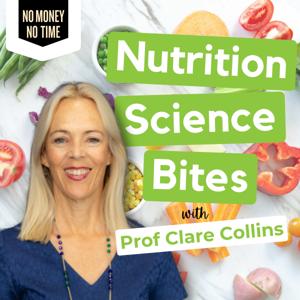
Nutrition Science Bites with Professor Clare Collins AO

Nutrition Science Bites with Professor Clare Collins AO

Download on the App Store

Nutrition Science Bites with Professor Clare Collins AO episodes

  • What health issues do we worry about? ... with Prof Deb Kerr

    In this episode, Prof Clare Collins talks with Prof Deb Kerr from Curtin University about results from her survey of what health issues adults worry about. They discuss how some issues, like osteoporosis, are not on people's health and wellbeing radar. They cover what adults were concerned about, plus the importance of bone health, common misconceptions, and practical strategies for maintaining strong bones through diet and exercise. They highlight the importance of being proactive about having health checks, especially as you age.


    Key topics

    1. Nutrition strategies for aging
    2. Importance of peak bone mass during growth years
    3. Low awareness of osteoporosis risk among adults
    4. Myth-busting about calcium and exercise for bone strength
    5. Proactive health checks and bone density testing


    Resources

    1. To access the Healthy Eating Quiz: Click on the top right hand 'green button' called 'How healthy is my diet' https://nomoneynotime.com.au/
    2. Want a more Personalised Food, Nutrient Assessment Report? Use our Australian Eating Survey - Purchase here New Digital Download - UON Nutrition Courses
    3. Here's the link to the No Money No Time closed Facebook group (be sure to take the Healthy Eating Quiz first) https://www.facebook.com/groups/386824626838448


    Our No Money No Time email: [email protected] and our Nutrition Science Bites email: [email protected]


    Are you in a position to make donation to support our No Money No Time website? Donate here


    Keywords: #BoneHhealth, #Osteoporosis, #Calcium, #Exercise, #AgingNutrition, #AntiAgingDiet, #HealthAwareness, #Nutrition, #FallsPrevention

    Hosted on Acast. See acast.com/privacy for more information.

    26 min
  • What to eat when you have high blood pressure - A Step by Step guide ...with Ilyse Jones

    Do you know your blood pressure numbers? I talk to Ilyse Jones about foods that influence #BloodPressure (BP) - plus practical tips for lowering #salt (sodium) intakes and boosting intake of foods rich in potassium. We discuss the importance of regular BP monitoring and how dietary changes can lower BP, because what you eat has a major impact on lowering BP related health risks, like heart disease, kidney disease and stroke.


    Key topics

    1. Blood pressure reading and what they mean
    2. How to interpret systolic and diastolic numbers
    3. The role of sodium and potassium in blood pressure regulation
    4. Dietary strategies for managing high blood pressure
    5. Impact of processed foods and hidden salt
    6. Practical tips for reducing sodium intake and increasing potassium
    7. Risks associated with hypertension and high blood pressure
    8. When to seek medical advice for blood pressure issues


    No Money No Time Resources

    1. Join our FREE 6-week guided online program to help Australians better understand blood pressure and support heart health. OPEN NOW - sign up here https://uoncourses.thinkific.com/courses/ai-placeholder
    2. To access the Healthy Eating Quiz: Click on the top right hand 'green button' called 'How healthy is my diet' https://nomoneynotime.com.au/
    3. For a Personalised Food and Nutrient Assessment Report that compares your intake to National recommendation use our Australian Eating Survey - Heart Version. Purchase here https://uoncourses.thinkific.com/products/digital_downloads/new-digital-download-1
    4. No Money No Time Food Label Decoder https://nomoneynotime.com.au/hacks-myths-faqs/how-to-decode-food-labels
    5. No Money No Time Watch You Salt https://nomoneynotime.com.au/hacks-myths-faqs/watch-the-salt-how-to-reduce-your-daily-salt-intake-without-compromising-on-flavour
    6. No Money No Time Getting enough potassium https://nomoneynotime.com.au/hacks-myths-faqs/how-can-i-get-the-right-amount-of-potassium
    7. Here's the link to the No Money No Time closed Facebook group (be sure to take the Healthy Eating Quiz first) https://www.facebook.com/groups/386824626838448
    8. Are you in a position to make donation to support our No Money No Time website? Donate here


    Our No Money No Time email: [email protected] and our Nutrition Science Bites email: [email protected]


    Keywords: #blood pressure #nutrition #sodium #potassium #salt #highbloodpressure #hypertension #diet #health #bloodpressuremonitoring #hearthealth #ChronicKidneyDisease

    Hosted on Acast. See acast.com/privacy for more information.

    33 min
  • What are pre, pro, post and synbiotics! Are they good for you? with A/Prof Heidi Staudacher

    In this episode, Professor Clare Collins interviews Associate Professor Heidi Staudacher about the complexities of 'biotics', including probiotics, prebiotics, postbiotics, synbiotics and eubiotics. They discuss what each of these substances are, how they work, their sources, impacts on gut health and practical advice for using foods and supplements to improve gut health.


    Key Topics

    1. Differences between probiotics, prebiotics, postbiotics, and synbiotics
    2. Sources of prebiotics in foods like onions, garlic, chicory, and legumes
    3. How prebiotics and probiotics may benefit gut health and specific conditions like IBS and antibiotic-associated diarrhea
    4. Emerging research on postbiotics and potential health benefits
    5. Role of short chain fatty acids in gut health and systemic effects
    6. Practical dietary advice for supporting a healthy microbiome
    7. Importance of consulting health professionals for personalized gut health strategies


    Resources

    1. Heidi's hamburger patty recipe https://nomoneynotime.com.au/healthy-easy-recipes/heidis-hamburger-patties
    2. Global guidelines for probiotics and prebiotics for gut health and disease https://isappscience.org/new-global-guidelines-for-probiotics-and-prebiotics-for-gut-health-and-disease/
    3. Find a Dietitian at GI DREAM (Gastrointestinal Dietitian's for Research, Education, Advocacy and Mentoring) https://www.gidream.org/findadietitian
    4. More about FODMAPS https://www.monashfodmap.com/about-fodmap-and-ibs/


    No Money No Time Resources

    1. To access the Healthy Eating Quiz: Click on the top right hand 'green button' called 'How healthy is my diet' https://nomoneynotime.com.au/
    2. Want a more Personalised Food, Nutrient Assessment Report? Use our Australian Eating Survey - Purchase here New Digital Download - UON Nutrition Courses
    3. Here's the link to the No Money No Time closed Facebook group (be sure to take the Healthy Eating Quiz first) https://www.facebook.com/groups/386824626838448
    4. Are you in a position to make donation to support our No Money No Time website? Donate here


    Our No Money No Time email: [email protected] and our Nutrition Science Bites email: [email protected]


    Keywords: #GutHealth #Probiotics #Prebiotics #Postbiotics #Synbiotics #Eubiotics, #Microbiome #Nutrition, #GutDisorders #DietaryFiber #FermentedFood

    Hosted on Acast. See acast.com/privacy for more information.

    33 min
  • Plastic in food? Results from the PERTH low plastic diet trial ...with Dr Amelia Harray

    In this Nutrition Science Bites episode I talk with Dr. Amelia Harray about results from the Perth low plastic diet trial. We cover how reducing plastic exposure means selecting particular foods, packaging and personal care products. We discuss the effect of plastics on health, and how reducing plastic exposure can impact heart health and fertility. This episode highlights practical steps to minimize plastic chemicals in daily life and the importance of future research in helping minimising exposure to plastics.


    Key topics


    1. Findings from the Perth Low Plastic Diet trial
    2. Everyday sources of plastic chemicals
    3. Impact of plastic chemicals on heart health
    4. Plastic chemicals and reproductive health
    5. Strategies to reduce plastic exposure from food and personal care products
    6. Role of food packaging and kitchenware in plastic exposure
    7. How body fat stored contribute to storing plastic chemicals
    8. Future research directions on plastics and health


    Resources

    • Nutrition Science Bites plastics episode #1 - Are there microplastics in my food and does it matter? with Dr Amelia Harray https://shorturl.at/Jg5l8
    • No Money No Time: Microwaving foods… is it safe and healthy? https://shorturl.at/lZJz3
    • The PERTH trial: Read the full paper here: https://www.nature.com/articles/s41591-026-04324-7 Harray, et al. Low-plastic diet and urinary levels of plastic-associated phthalates and bisphenols: the randomized controlled PERTH Trial. Nat Med 32, 1871–1883 (2026).


    No Money No Time Resources

    1. To access the Healthy Eating Quiz: Click on the top right hand 'green button' called 'How healthy is my diet' https://nomoneynotime.com.au/
    2. Want a more Personalised Food, Nutrient Assessment Report? Use our Australian Eating Survey - Purchase here New Digital Download - UON Nutrition Courses
    3. Here's the link to the No Money No Time closed Facebook group (be sure to take the Healthy Eating Quiz first) https://www.facebook.com/groups/386824626838448
    4. Are you in a position to make donation to support our No Money No Time website? Donate here


    Our No Money No Time email: [email protected] and our Nutrition Science Bites email: [email protected]


    Are you in a position to make donation to support our No Money No Time website? Donate here


    Keywords: #plastics, #health, #PerthTrial, #SustainableDiets, #EndocrineDisruptors, #BisphenolA, #PlasticChemicals, #Nutrition, #EnvironmentalHealth, #Fertility, #LowPlasticDiet, #NutritionScienceBites

    Hosted on Acast. See acast.com/privacy for more information.

    37 min
  • Fuel like a grand finalist! Food matters for sports performance... with Dr Rebecca Haslam

    It's Grand Final week, and whether you're taking the field, hitting the gym, or cheering from the sidelines, nutrition can play a big role in helping you perform at your best.


    In this episode, we dive into the world of sports nutrition with Dr Rebecca Haslam, an Accredited Practising Dietitian, Accredited Sports Dietitian and leading expert in athlete nutrition. We unpack what athletes should eat before, during and after exercise, common sports nutrition myths, and practical tips to help fuel performance and recovery at any level of sport. Whether you're chasing a premiership, a personal best or simply looking to get more from your training, this episode is packed with evidence-based advice to help you fuel with confidence.


    No Money No Time Resources

    1. No Money No Time Game Day Pizza Scrolls: https://nomoneynotime.com.au/healthy-easy-recipes/knights-pizza-scrolls
    2. No Money No Time Supplements for Better Sports Performance https://nomoneynotime.com.au/hacks-myths-faqs/supplements-for-better-sports-performance
    3. No Money No Time How Can The Foods you Eat Affect Sports Performance https://nomoneynotime.com.au/hacks-myths-faqs/how-can-the-foods-you-eat-effect-your-sports-performance
    4. Nutrition Science Bites Podcast Should you Take Sports Supplements https://nomoneynotime.com.au/podcasts/should-you-take-sports-supplements-like-creatine-pickle-juice-beta-alanine-coq10-or-vitamins


    To access the Healthy Eating Quiz: Click on the top right hand 'green button' called 'How healthy is my diet' https://nomoneynotime.com.au/

    Want a more Personalised Food, Nutrient Assessment Report? Use our Australian Eating Survey - Purchase here New Digital Download - UON Nutrition Courses


    Here's the link to the No Money No Time closed Facebook group (be sure to take the Healthy Eating Quiz first) https://www.facebook.com/groups/386824626838448

    Our No Money No Time email: [email protected] and our Nutrition Science Bites email: [email protected]


    Visit Dr Rebecca Haslam's Nutrient Nation website here and Instagram here.


    #NutritionScienceBites

    Hosted on Acast. See acast.com/privacy for more information.

    36 min
  • What are peptides? Does injecting them make you stronger, youthful, slim? ... with Dr Timothy Piatkowski

    Prof Clare Collins talks to Dr Tim Piatkowski from the University of Queensland about the rise of illicit peptide injections. They discuss what peptides are, the claims about them making you stronger, being anti-aging and helping with weight loss and the importance of medical supervision. They also cover the risks of purchasing products online and how online marketing and easy access are fueling a growing demand, especially among young people, and what can be done to improve safety and awareness.


    Key topics

    1. Rise of illicit peptide injections and their health risks
    2. Online marketing and social media influence on peptide use
    3. Legal pathways and medical supervision for peptide use
    4. Prevalence of peptide use among different demographics
    5. Risks of unregulated peptide products and potential health harms
    6. The lack of rigorous clinical trials for many peptides
    7. Impact of peptides on cancer risk and other health conditions
    8. Strategies for harm reduction and education for young people


    Resources:

    1. Journal Article Piatkowski, T., Ganson, K., & Nagata, J. (2026). Illicit Injectable Peptides and Regulatory Gaps. Journal of the American Medical Association - JAMA. 336;(3):189-190. https://doi.org/10.1001/jama.2026.10690
    2. Free and confidential helpline - Peer Qnect provides support to people who use substances, including those using anabolic steroids & other performance enhancing drugs, people on the opioid treatment program or seeking opioid treatment across QLD. Phone: 1800 175 889 Opening hours: Mon – Fri 9am-4pm Peer Qnect also provides training for prescribers, clinics and relevant community services Email: [email protected] Email for Peptides/Steroids: [email protected]


    No Money No Time Resources

    1. Nutrition Science Bites Podcast Should You Take Sports Supplements? with Sports Dietitians Australia President Sally Walker.
    2. To access the Healthy Eating Quiz: Click on the top right hand 'green button' called 'How healthy is my diet' https://nomoneynotime.com.au/
    3. Want a more Personalised Food, Nutrient Assessment Report? Use our Australian Eating Survey - Purchase here New Digital Download - UON Nutrition Courses
    4. Here's the link to the No Money No Time closed Facebook group (be sure to take the Healthy Eating Quiz first) https://www.facebook.com/groups/386824626838448
    5. Are you in a position to make donation to support our No Money No Time website? Donate here


    Our No Money No Time email: [email protected] and our Nutrition Science Bites email: [email protected]


    Keywords: #peptides, #illicitdrugs, #healthrisks, #onlinemarket, #medicalsupervision, #youngpeople, #drugregulation, #peptideefficacy, #harmreduction, #retatrutide, #GLP1, #NutritionScienceBites

    Hosted on Acast. See acast.com/privacy for more information.

    36 min
  • How do you spot 'fake' nutrition news? ...with Alex Ruani

    In this episode, Prof Clare Collins talks with Alex Ruani from University College London in the UK about the complexities of misinformation, especially in nutrition. They discuss how online platforms could better regulate inaccurate content through risk assessments and expert involvement.


    Key topics covered include:-


    1. Definition of misinformation beyond falsehoods
    2. Misleadingness and its effects on health decisions
    3. Prevalence of nutrition misinformation online
    4. Impact of social media algorithms on misinformation spread
    5. The importance of expert-led risk assessments
    6. Regulatory approaches to online misinformation
    7. The role of platforms in promoting accurate information
    8. Tools for detecting and mitigating harmful content


    Resources


    1. Research paper on development of the Diet-Misinformation Tool. Ruani, et al. Development and validation of a tool for detecting misinformation risk in diet, nutrition, and health content (Diet-MisRAT). Sci Rep. 2026 Mar 27;16(1):9207.
    2. No Money No Time: How to Spot Misleading Nutrition Advice Online. https://nomoneynotime.com.au/hacks-myths-faqs/how-to-spot-misleading-nutrition-advice-online
    3. To access the Healthy Eating Quiz: Click on the top right hand 'green button' called 'How healthy is my diet' https://nomoneynotime.com.au/
    4. Want a more Personalised Food, Nutrient Assessment Report? Use our Australian Eating Survey - New Digital Download - UON Nutrition Courses
    5. Are you in a position to make donation to support our No Money No Time website? Donate here


    Here's the link to the No Money No Time closed Facebook group (be sure to take the Healthy Eating Quiz first) https://www.facebook.com/groups/386824626838448


    Our No Money No Time email: [email protected] and our Nutrition Science Bites email: [email protected]


    Keywords: #misinformation, #nutrition, #onlinesafety, #riskassessment, #socialmedia, #healthmisinformation, #regulation, #AI, #platformresponsibility

    Hosted on Acast. See acast.com/privacy for more information.

    34 min
  • Does what you eat affect fatigue levels and vice versa? with Dr Trent Watson

    In this episode Prof Clare Collins talks with Dr Trent Watson, Managing Director of Ethos Health about how nutrition impacts fatigue, especially in high-risk workplaces like mining. They cover how fatigue extends beyond feeling sleepy or drowsy, how sleep disruption affects hunger hormones and the impact of alcohol on REM sleep and sleep aponea risk. The discussion includes practical strategies to manage fatigue through diet, sleep, and workplace technology and emphasizes the importance of tailored solutions. Dr Trent's 5 top nutrition tips to beat fatigue include, eat light overnight, use breakfast to get a head start, pack a lunch box, have a caffeine strategy and be alcohol wise!


    Key topics

    1. The impact of shift work and environment on fatigue
    2. Definition and characteristics of fatigue
    3. How sleep and nutrition interact to influence fatigue
    4. Technologies used to monitor and manage fatigue
    5. Practical dietary strategies for fatigue management


    Resources


    1. Ethos Health Fatigue Tech https://tech.ethoshealth.com.au/fatiguetech/
    2. No Money No Time 'Tired all the time? Your diet could be part of the picture' https://nomoneynotime.com.au/hacks-myths-faqs/tired-all-the-time-your-diet-could-be-part-of-the-picture
    3. To access the Healthy Eating Quiz: Click on the top right hand 'green button' called 'How healthy is my diet' https://nomoneynotime.com.au/
    4. Want a more Personalised Food, Nutrient Assessment Report? Use our Australian Eating Survey - Purchase here New Digital Download - UON Nutrition Courses


    Are you in a position to make donation to support our No Money No Time website? Donate here


    Here's the link to the No Money No Time closed Facebook group (be sure to take the Healthy Eating Quiz first) https://www.facebook.com/groups/386824626838448


    Our No Money No Time email: [email protected] and our Nutrition Science Bites email: [email protected]


    Keywords: #fatigue, #nutrition, #sleep, #workplacehealth, #shiftwork, #safety, #diet, #fatiguemanagement, #EthosHealth, #healthstrategies, #NutritionScienceBites

    Hosted on Acast. See acast.com/privacy for more information.

    36 min
  • What is the NiMe Diet and is it good for your microbiome and health? ...with Prof Jens Walter

    In this episode, Prof Clare Collins chats with Prof Jens Walter about the development of the NiMe (non-industrial microbiome restore) diet and key research findings from a study where people were fed this diet for 3 weeks. They exploring how the NiMe diet influences the microbiome and how it affects metabolic pathways related to gut health, inflammation, cancer, heart disease and brain health. Discover how traditional diets from Papua New Guinea inspired a modern approach to nutrition support for gut health and disease prevention.


    Key topics

    1. Development of the NEMI diet and its inspiration from traditional non-industrialized population dietary patterns
    2. Differences in microbiome species between industrialized and non-industrialized societies
    3. Role of dietary fiber and microbiome diversity in health
    4. Challenges and findings from the NEMI diet intervention study
    5. Implications of microbiome research for chronic disease prevention


    No Money No Time article on the NiMe Diet https://nomoneynotime.com.au/hacks-myths-faqs/what-is-the-nime-diet-and-should-you-be-following-it

    No Money No Time NiMe-style pork stir fry recipe: https://nomoneynotime.com.au/healthy-easy-recipes/nime-style-pork-stir-fry

    Link to the full NiMe research paper here https://pubmed.ncbi.nlm.nih.gov/39855197/


    To access the Healthy Eating Quiz: Click on the top right hand 'green button' called 'How healthy is my diet' https://nomoneynotime.com.au/


    Want a more Personalised Food, Nutrient Assessment Report? Use our Australian Eating Survey - Purchase here New Digital Download - UON Nutrition Courses


    Are you in a position to make donation to support our No Money No Time website? Donate here


    Here's the link to the No Money No Time closed Facebook group (be sure to take the Healthy Eating Quiz first) https://www.facebook.com/groups/386824626838448

    Our No Money No Time email: [email protected] and our Nutrition Science Bites email: [email protected]


    Keywords: #microbiome, #diet, #health, #NEMI, #PapuaNewGuinea, #gutbacteria, #fiber, #chronicdisease, #microbiomerestoration, #industrialization, #guthealth, #bowelcancer

    Hosted on Acast. See acast.com/privacy for more information.

    35 min
  • Should you take a multivitamin or mineral supplement? ...with Dr Rebecca Haslam

    In this episode Prof Clare Collins talks with Dr Rebecca Haslam a dietitian and lecturer at the University of Newcastle about vitamin and mineral supplements. They discuss the ins and outs of multivitamins and other nutrient supplements, including when they are necessary, how to choose the right one, avoiding overdose and the importance of a food-first approach to nutrition.


    Key topics


    1. What are multivitamins and their purpose
    2. Difference between vitamins and minerals
    3. Understanding nutrient reference values and RDIs
    4. When supplements are necessary based on life stage and health conditions
    5. Risks of over-supplementation and hypervitaminosis
    6. How to assess your dietary intake and need for supplements
    7. Importance of a food-first approach to nutrition
    8. Common misconceptions about multivitamins and health


    Resources

    1. Check out out No Money No Time Hacks and Myths on vitamins, minerals and nutrients https://nomoneynotime.com.au/hacks-myths-faqs?search=vitamins
    2. To access the Healthy Eating Quiz: Click on the top right hand 'green button' called 'How healthy is my diet' https://nomoneynotime.com.au/
    3. Want a more Personalised Food, Nutrient Assessment Report? Use our Australian Eating Survey - Purchase here New Digital Download - UON Nutrition Courses
    4. Here's the link to the No Money No Time closed Facebook group (be sure to take the Healthy Eating Quiz first) https://www.facebook.com/groups/386824626838448


    Are you in a position to make donation to support our No Money No Time website? Donate here


    Our No Money No Time email: [email protected] and our Nutrition Science Bites email: [email protected]


    Keywords: #multivitamins #nutrition #dietarysupplements #dietarysupplement, #vitamin #minerals #nutrients #health #nutrientreferencevalues #healthyfood

    Hosted on Acast. See acast.com/privacy for more information.

    32 min

About Nutrition Science Bites with Professor Clare Collins AO

From the publisher's feed

Welcome to Nutrition Science Bites with your host, Professor Clare Collins, AO. Clare's expertise in nutrition research and science communication makes her the perfect dietitian to translate…

Best of Nutrition Science Bites with Professor Clare Collins AO

Ranked by our users in the last 21 days