Overdrive

Overdrive

By David BrownTechnology
Download on the App Store

Overdrive episodes

  • Driverless cars: not necessarily a force for good - Yale Wong ITLS
    Driverless cars: not necessarily a force for good
    David Brown
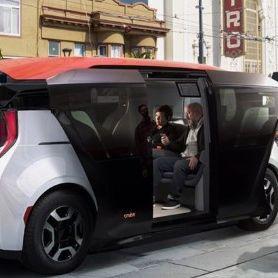
    When driverless cars were first discussed they were portrayed as leading to a motoring utopia. With a robotic chauffeur we could more usefully employed reading a book, watching a video or doing some work. Increasingly we are seeing alternative views.
    A recent report from the researchers at the University of Sydney's business school’s Institute of Transport and Logistics Studies “Moving People in the Future: Land passenger transport and “new” mobility technology” adds to the belief that autonomous vehicles may not be a force for good.
    We interviewed Yale Wong who is a research analyst at the ITLS and co-author of the research.
    Capacity
    Cities are places where space is a very scarce commodity. There's only a limited capacity in terms of road space and what a lot of these autonomous vehicles could mean in the future is it can actually replace a lot of the travel that's currently taking place on more spatially efficient modes like public transport, bus and rail in particular, and especially if you think about that dense kind of CBD in a subway kind of environments.
    If people are moving from these high capacity modes into this kind of unlimited counterpoint transportation, an autonomous taxi service, then that's going to be a big recipe in terms of a disaster, causing gridlock on the road network and with negative impacts on all sorts of externalities such as emissions, urban form, social inclusion and the like.
    Dead Running
    This is one of the key issues and one where I think government and governance has a key role to play in actually putting some regulation or institutional overlay to circumvent some of those issues.
    Ownership model - Mobility as a service
    A lot of what we’re talking about is actually predicated on the ownership model of these autonomous cars.
    One of the things we've been pushing for, but we don't know if this reality will emerge, is where these vehicles are shared. So people access them as a treat.
    So this links back to mobility as a service kind of concepts. We think if we can move towards greater sharing both of these vehicle assets but also of space, so people sharing within vehicles then there will be a much better outcome. But this sort of future is by no means guaranteed on its current trajectory.
    Corridors
    I think autonomy may well come within very defined corridors.
    Autonomous technologies have the potential to be to really transforming in terms of how we provide public transport by actually cutting the link between quantity of service and its labour costs. We know most of the costs in providing bus services is in labour.
    That is one potential, but I think the more realistic kind of potential is: because they've become so cheap it actually destroys a lot of public transport because people won't be taking large vehicles. They'll be taking smaller autonomous shuttles or pods and the like and we already talked in the session about how this is linked to congestion and use of road space.
    The role of bus operators
    One of the current major roles of bus operators is in managing labour. But with autonomous vehicles this is significantly reduced. Furthermore because of the technical complexity, buses may have to go back to the manufacturer for all of their servicing.
    If you want to have a competitive system this could push us towards government ownership of the vehicles as is the case in Singapore.
    If this eventuates then there may not need to be bus operators anymore as we know them now. An entire layer might be removed from the business ecosystem.
    So I think these Bus Operators have to sit up and think about what is their value. What sort of risks they are willing to take up?

    23 min
  • Monash University Student Race Car Program
    At the driverless vehicle summit held in Sydney there was a demonstration from Students from Monash University that might be a cute exercise for those who are interested in motor racing. It turns out, however, that it is a comprehensive exercise that prepares students for working in teams, with other disciplines and with business. And it has students making a commitment in their effort that many other faculties could only dream about.
    The basic elements are
    • Monash has a wide range of teams participating in major projects
    • Teams can have 120 or more students involved from many different disciplines
    • The Racing teams participate in a longstanding worldwide competition between universities.
    • It is a full racing team that races on circuits around the world
    • Up to 40 students may go overseas with the team to compete
    • Initially it was petrol cars and then it became electric vehicles and now it is autonomous vehicles.
    • Monash was ranked number one with their petrol car against many older and larger universities.
    Marc Pizzi is the Industry portfolio manager at Monash University.
    9 min
  • Overdrive: Streetlight redesign; AEB; Tesla Model 3; Audi SQ8; Monorail; Jaguar i-Pace
    Hello this is Overdrive a program that tries to spread the word about trains, planes, and automobiles.
    1. Public given opportunity to experience autonomous emergency braking. (1:21)
    2. The Future of the Streetlight Might Be in the Past (2:27)
    3. Europe’s first full-sized autonomous bus demonstrated at CAV Scotland event (3:14)
    4. Car-Mounted Ads Take a New Direction: Data Collection (4:09)
    5. Tesla Model Three (5:14)
    6. Motoring minute – Audi SQ8 (6:07)
    7. We chat to Rob Fraser about some electric cars especially the Jaguar iPace and how they are developing (7:17)
    8. Motoring minute – Kia Sportage (15:57)
    9. Motoring minute – Car Sales (17:04)
    10. Quirky news – and a good session with Brian smith with some quirky news stories on one suggestion to install a monorail in Auckland. (18:12)
    11. Motoring minute – Rally Australia Cancels Rally (24:15)
    12. Motoring minute – Subaru Liberty (25:45)
    You can find more information at Driven Media or previous programs are available as podcasts on iTunes or Spotify. OR our Facebook site OverdriveCity
    28 min
  • This is your project should you accept it: Ride beside Molly Taylor in a works Subaru Rally car
    Emily Middleton is doing a communications degree at Macquarie University and is also doing some work here for the Overdrive radio program. So we sent her on a mission. She went down to Canberra to sit beside Molly Taylor in her Subaru works rally car just to see what it's like.
    This was a bit of an adventure as Emily usually drives her parent’s Camry and there has been no family association with motor sport or driving fast in any way.
    How did she feel?
    “I honestly felt quite safe. It because I was so strapped in so tightly, I felt like nothing could happen to me. Clearly, I wasn't driving, but I felt like Molly was in control. It felt like a roller coaster; but in a safe way.
    And how did she react to the speed. Had she ever done 200km/hr anywhere?
    “No, not at all. Nowhere close to it. I was trying to look at the dials while she was driving, but I was more focussed on where we were going. But I did see that she was clocking over 200. And I was very, very surprised that a car could go that fast. I didn't know people could ever get there, especially on a dirt road!”
    How was Molly?
    “She was lovely; really, really lovely. Very reassuring. Very fun to talk to which was nice. I got to be her co-driver (navigator) for a little bit. She explained to us her notes that the driver needs and it's almost like a different language. And just for a bit of fun she got us to read them out to her. And when we were reading them, clearly, we have no idea where each note was meant to be read, but we read them out and she laughed at us while she was driving the car saying things like ‘That was 200 metres ago’.
    Did Emily did you get the bug? Does she think that she might ever dabble a little in going faster in a controlled environment?
    “I do get a rise. It was a lot of fun, but I don't know if I can trust myself driving that fast. I would definitely go again with somebody else driving, but maybe not myself. I don't think my mother would like it”.
    Did she describe the experience to her parents and what was their reaction?
    “I did describe it to them, I said I was going fast but I felt in control. They just laughed at me. And they said ‘How is it possibly in control’ and I said “You don't understand because you haven't been in it. But it is very controlled and also very fast at the same time. And they just they couldn't comprehend that.
    The entire radio interview with Emily at
    Emily’s video of the experience
    Previous radio interviews with Molly Taylor – Subaru team driver
    Molly Taylor: Determination and focus on the hard path to rallying success
    http://drivenmedia.com.au/wp/molly-taylor-determination-and-focus-on-the-hard-path-to-rallying-success/
    10 min
  • Paul Hamer MP: How an engineer can be an essential member of parliament
    Last year, I attended a student leadership summit organised by students from Monash University and led by a postgraduate candidate, Laura Aston, under the auspices of the Institute of Transportation Engineers, it was held at Box Hill.
    I spoke to a local representative there who regretted, to some degree, that the seat of Boxall in the state government was considered a safe seat.
    But in the 2018 state election, the Andrews government increased its majority, including winning the seat of Box Hill for the first time in 26 years. Their candidate was Paul Hamer, and in his maiden speech to parliament, he noted that his background was as a professional engineer, which was somewhat unusual for a politician. Can an engineer add something different to the political and government functions?
    I interviewed Paul and he discussed the following topics:
    • Engineers are underrepresented in Parliament
    • His working experience
    • Engineers look at the long term – Governments generally not
    • Being in Government means that your words are analysed in detail
    • Being a local member means that you meet a wider range of people.
    • Public servants go some great work that is not always reflected in the public debate
    • The value and strength of his family and their values: His father was a child in the Holocaust
    • The value of professional Institutes and the input they can give.
    The interview began as follows:
    DB: Paul, thank you very much for your time. I know you have an extremely busy schedule.
    PH: No problem at all. Thanks, David.
    DB: Are engineers are underrepresented?
    PH: Absolutely. For my inaugural speech, I did a little bit of research. And in the Victorian parliament since the first year of responsible government, which was 1856, they'd only been 31 engineers who had any form of engineering qualifications. So that would that included a diploma or undergraduate or postgraduate level. So I am number 32. And there's been almost 2000 members of parliament in that time.
    PH: So that is a poor representation amongst the engineering community in parliament. And I daresay that our state parliament and the federal parliament over its time has similarly been underrepresented.
    20 min
  • Overdrive: Recharge in 10 minutes; Mustang SUV; An engineer in Parliament; Hyundai Ioniq
    Hello and welcome to Overdrive, a program that pushes the parameters of discussing motoring and transport.
    1. Engineers have figured out how to charge electric car batteries in 10 minutes (1:24)
    2. Hyundai Ioniq (3:02)
    3. Warnings for mobile speed cameras (4:02)
    4. World premiere for the new Golf digitalised connected and intelligent (5:05)
    5. Ford makes a Mustang like SUV supposedly (5:59)
    6. Urban and Suburban Lifestyles Are More Similar Than You’d Think (7:01)
    7. Motoring minute – Honda Civic (8:31)
    8. We chat to Paul Hamer MP, only the 32 person since 1856 to have engineering qualifications and be an MP in the Victorian Parliament (9:44)
    9. Motoring minute – Solar Edge Inverters (16:47)
    10. Rob Fraser and I talk about the joys of driving in Tasmania (17:53)
    11. Quirky news – Ring emergency line to complain about an ice-cream truck parked outside their house (23:11)
    You can find more information at Driven Media or previous programs are available as podcasts on iTunes or Spotify. OR our Facebook site OverdriveCity
    So, let’s start with the news
    Originally broadcast 9 November 2019
    28 min
  • Overdrive: Hyundai Kona EV crash (test); Fiat/Peugeot Merger; Brabham BT62; Cars "helping" badly
    Welcome to Overdrive, a program that ponders the particulars of motoring and transport.
    1. Hyundai Kona Electric earns ANCAP 5-star safety rating in first-ever EV crash tested in Australia and the results are good. (1:33)
    2. Fiat Chrysler and Peugeot working out a merger (2:16)
    3. Brabham automotive announces BT62 competition specification (3:06)
    4. Lightyear One: the car built to perform on energy efficiency (4:05)
    5. Estonian police offer ‘road breaks’ for first-time speeders (5:00)
    6. Motoring minute – Road Safety Curtesy (5:50)
    7. Rob Fraser and discuss the new Audi A1 (7:05)
    8. Motoring minute – Autonomous vehicles – no nirvana yet, if ever (12:26)
    9. Marc Pizzi from Monash University talks about the student racing team that is now into autonomous cars (13:40)
    10. Motoring minute – Quality SUVs (19:49)
    11. Quirky news – Cars doing things for you, you don’t want (20:55)
    You can find more information at Driven Media or previous programs are available as podcasts on iTunes or Spotify. OR our Facebook site OverdriveCity
    So, let’s start with the news
    Originally broadcast 2 November 2019
    28 min
  • Overdrive: Volkswagen turns Turkey; Smart Cruise Control; Passenger in Subaru rally car
    Hello this is Overdrive a program that looks at the purpose of and the passion for trains, planes and automobiles.
    1. Congestion charge for Sydney & Melbourne (1:48)
    2. “Worried” Volkswagen pulls back on new Turkish factory as sanctions bite (2:56)
    3. Dyson Cancels electric car project (3:58)
    4. EU states support Denmark’s diesel ban proposal (4:51)
    5. Hyundai Smart Cruise Control Technology (5:32)
    6. Bathurst-winning team cops massive fine (6:30)
    7. Motoring minute – RAM 2500 (7:40)
    8. We sent our work experience person, Emily Middleton to Canberra to sit in the passenger seat beside Molly Taylor in her works Subaru rally car. Emily, who drives a Camry, gives us her report. (9:10)
    9. Motoring minute – Kia Seltos (14:14)
    10. Alan Zuvas has been driving the new Toyota Supra. He tells us what it is like (15:12)
    11. Motoring minute – Volkswagen Crafter (21:18)
    12. Quirky news – Child drives his toy tractor to the fair (22:21)
    13. Quirky news – tuning cars the modern way (24:30)
    You can find more information at Driven Media or previous programs are available as podcasts on iTunes or Spotify. OR our Facebook site OverdriveCity
    So, let’s start with the news
    Originally broadcast 26 October 2019
    29 min
  • Overdrive: Dyson quits; Kia Seltos; Nissan Warrior; Veloster Grappler; China Motor Museum
    Hello and welcome to Overdrive a program that puts a magnifying glass to the role of cars and transport in our society and tries to burn a hole in it.
    1. Dyson cancels electric car project (1:27)
    2. Active Transportation Transforms America (2:32)
    3. Kia Seltos (3:50)
    4. Tyre wear is out of sight and out of mind (4:58)
    5. Veloster Grappler (5:53)
    6. Motoring minute – Peugeot 308 GT (6:54)
    7. We hear from Our motoring correspondent in Melbourne about the details from the launch of the Nissan N Trek Warrior (8:12)
    8. Motoring minute – Pedestrian detection with AEB (13:09)
    9. Rob Fraser and I talk about driving the new Kia Seltos in the great outdoors (14:20)
    10. Motoring minute – Skoda Kodiaq (20:37)
    11. A quirky news story with Brian Smith
    You can find more information at Driven Media or previous programs are available as podcasts on iTunes or Spotify. OR our Facebook site OverdriveCity
    So, let’s start with the news
    Originally broadcast 19 October 2019
    29 min
  • Ford Driving Skills for Life: Liz Ampt Behavioral Scientist went along for a look
    Without major marketing fanfare, Ford Australia, in conjunction with the Amy Gillet Foundation, is provided free driver training in techniques that are not the normal part of getting your L plates.
    Designed for new and young drivers, DSFL offers hands-on training delivered by professional instructors to help participants become safer drivers. The course focuses on techniques not taught during L-plate driver instruction and aims to increase the use of safe and calm driving techniques as well as teach new drivers how to share the road with other vehicles and cyclists.
    Liz Ampt a behavioural scientist and transport data expert went along to the launch. Some of the things she noted included:
    With the advent of airbags, the best way to hold the steering wheel is with your hands in the 9:15 position rather than the traditional “ten-to-two”.
    Young people are given the chance to experience heavy braking situations.
    One approach to help drivers avoid dooring cyclists is called the Dutch reach, in which a driver uses their far hand (left hand for right-hand drive vehicles) to open the car door which forces drivers to turn their heads and look behind then hopefully to check for cyclists.
    We have all heard lectures about the dangers of drunk driving but the reality is that when we have been drinking, we do not appreciate how much our reactions and skills have diminished. At the Ford day people can test their skills in a sobriety test then put on an impairment suit. This has been specially designed with weights attached to your arms, thighs, legs and ankles and you also where earmuffs and goggles that distort your vision. You then have to repeat the sobriety test. The results often bring hilarity to the on-lookers.
    The program is backed up with work from the respected researcher Dr Marilyn Johnson. One of the exercises Dr Johnson did was to get truck drivers to ride the bicycle on a certain course in the city. Initially the experience drivers would sit back and say “What do we have to do this exercise for?”. But after they have done it, they could soon point out other truck driver errors when dealing with bikes.
    Their research also showed that almost one third (32 per cent) of people surveyed said they are not aware of common techniques such as the “one metre rule”, where drivers are advised to leave one metre distance between their vehicle and cyclists (driving 60 km/h or less), and only half (53 percent) observe it. The research also found that 68 percent of cyclists are concerned every time a vehicle passes them while on the road.
    The Driving Skills for Life is a free course funded by Ford and carried out at six locations around Australia.
    13 min

About Overdrive

From the publisher's feed

Overdrive: Cars, Transport and Culture.