Oxford Physics Public Lectures

Oxford Physics Public Lectures

By Oxford UniversityEducation
Download on the App Store

Oxford Physics Public Lectures episodes

  • Turning in the Widening Gyre: Accretion Processes in the Universe
    Inaugural Lecture by Professor Steven Balbus looking at the history of the universe A one sentence summary of much of the history of our Universe might be that it is the formation of ever more complex and compact structure from a diffuse background. The build-up of a compact core of material from more tenuous surroundings is known as accretion, and it is a process common to much of astrophysics, from the early creation of giant clusters of galaxies to current star, planet, and black hole formation. In this Lecture, I will give a general and personal overview of accretion physics. I will discuss some of the theoretical successes the community has enjoyed in its struggle to understand accretion, together with ongoing challenges. Above all, I will try to convey a sense of the richness of accretion as a physical process, and the role it has played in enhancing a deeper understanding of many astrophysical phenomena.
    57 min
  • Lorenz Gödel and Penrose: new perspectives on determinism and unpredictability, from fundamental physics to the science of climate change
    The 9th Dennis Sciama Memorial Lecture, looking at chaos theory and climate change Lorenz is one of the pioneers of chaos theory. However, over 50 years before Lorenz, Poincaré discovered the sensitive dependence on initial conditions that characterises chaos. So what makes Lorenz’s contribution so important? I argue it is the discovery of the fractal invariant set in state space: the Lorenz attractor. Quite amazingly, properties of the Lorenz attractor can be shown to link the calculus of dynamical systems theory to deep and diverse areas of mathematics such as Wiles’ proof of Fermat’s Last Theorem and Gödel’s incompleteness theorem. But more than this, I argue that the fractal invariant set has implications for physics – not only for practical problems such as climate prediction, but also for the deepest problems of fundamental physics. In particular, I will put some meat on the bones of Penrose’s suggestion that “the correct theory of quantum gravity might be a deterministic but non-computable theory” by treating the universe as a dynamical system with fractal invariant set. The result is a novel perspective, not only on the quantum gravity programme, but also on quantum physics in general.
    1 hr 7 min
  • Building stars, planets and the ingredients for life between the stars
    Halley Lecture 2013 by Professor Dr Ewine van Dishoeck on new developments in astronomy One of the most exciting developments in astronomy is the discovery of planets around stars other than our Sun. Nearly 1000 exo-planets have now been detected. But how do these planets form, and why
    are they so different from our own solar system? Which ingredients are available to build them? How are their parent stars formed? Thanks to powerful new telescopes, astronomers are starting to address these
    age-old questions scientifically. In this talk, an overview will be given of how stars and planets are born in the extremely cold and tenuous clouds between the stars in the Milky Way. These clouds also contain
    water and a surprisingly rich variety of organic material. How and where was the water formed that is now in our oceans on Earth? Can these organic molecules end up on new planets and form the basis for pre-biotic material and eventually life? The Atacama Large Millimeter/submillimeter Array (ALMA), under construction in Chile and planned to be fully operational by late 2013, will be able to zoom into the planet-forming zones of disks around young stars and revolutionize this field in the near future. First exciting and surprising ALMA results will be presented.

    57 min
  • The Fast Track to Finding an Inhabited Exoplanet
    The 8th Hintze Lecture by Professor David Charbonneau looking at investigating habitable exoplanets. The investigation of planets orbiting other stars has moved from the study of gas giants to the hunt for smaller planets that are predominantly rock and ice in composition. When such Planets are discovered in edge-on orbits, such that the planet and star undergo mutual eclipses, scientists granted the opportunity to determine directly the planetary masses and sizes. Most interestingly, we can study starlight filtered through the planetary atmosphere to deduce its chemical composition, and perhaps even search for biosignatures. The speaker will summarize the most recent results from the NASA Kepler Mission and describe two surveys intended to find the closest
    habitable exoplanet.
    1 hr 4 min
  • From Argument to Experiment
    Dr Christopher Palmer on the historical ties between physics and philosophy - from ancient philosophical thought through to the scientific revolution and the pioneers of modern physics.
    11 min
  • Space and Time
    Prof. Frank Arntzenius on whether space and time are absolute entities or simply relational properties derived from the idea of motion - an old debate between Newton and Leibniz, carried on today.
    16 min
  • Quantum Paradoxes
    Prof. Vlatko Vedral on the mind-boggling and paradoxical nature of quantum mechanics and its consequences on modern technology - the possibilities of superfast computing and teleportation. This interview was recorded via Skype, so is of a lower audio quality than the other podcasts in this series.
    14 min

About Oxford Physics Public Lectures

From the publisher's feed

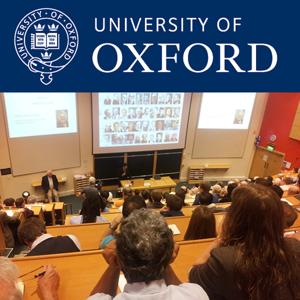
The Department of Physics public lecture series. An exciting series of lectures about the research at Oxford Physics take place throughout the academic year. Looking at topics diverse as the creation of the universe to the science of climate change.

More shows like Oxford Physics Public Lectures

Psychiatry by Oxford University

Psychiatry

57 Listeners

Philosophy for Beginners by Oxford University

Philosophy for Beginners

330 Listeners

Approaching Shakespeare by Oxford University

Approaching Shakespeare

332 Listeners

General Philosophy by Oxford University

General Philosophy

70 Listeners

Anthropology by Oxford University

Anthropology

72 Listeners

Theoretical Physics - From Outer Space to Plasma by Oxford University

Theoretical Physics - From Outer Space to Plasma

57 Listeners

Critical Reasoning: A Romp Through the Foothills of Logic by Oxford University

Critical Reasoning: A Romp Through the Foothills of Logic

37 Listeners

The Secrets of Mathematics by Oxford University

The Secrets of Mathematics

42 Listeners

Critical Reasoning for Beginners by Oxford University

Critical Reasoning for Beginners

30 Listeners

Kant's Critique of Pure Reason by Oxford University

Kant's Critique of Pure Reason

77 Listeners