
Sign up to save your podcasts
Or

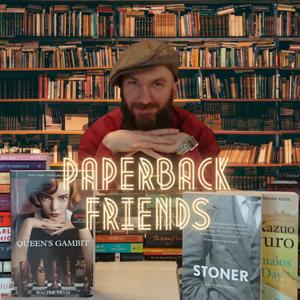


In this episode we forgo the usual review template, and dig into some complex but interesting literary terminology. Wolfgang Iser’s "culinary fiction” is a term that seems to try to distinguish shallow from deep literature, at least according to Iser… but, surprise, I think there is a bit more to it than that.
We look at what it means for a book to challenge its reader, whether unpredictability is really the same thing as depth, and whether even a seemingly simple book can offer more when the reader actively collaborates with the text. If it seems like a classic setup for: “in the eye of the beholder,” it’s because it probably is, but aren’t curious how we get there this time? Then welcome to another episode of Paperback Friends!
Type: Writing 101 | Book: The Act of Reading | Writer: Wolfgang Iser
Josephine Tey's The Daughter of Time is a historical mystery built around one fascinating question: was Richard III really responsible for the murder of the Princes in the Tower? When Scotland Yard inspector Alan Grant finds himself confined to a hospital bed, he turns to history to solve a mystery that has remained unanswered for centuries. What follows is an investigation into historical evidence, political propaganda, and the uncomfortable possibility that much of what we accept as fact is simply the story told by the winners.
This was not exactly a reading experience I enjoyed. Tey's writing felt slow and bare-bones to me, and despite some charming moments, I struggled to get invested in the characters or the mystery.
But there's more to this novel than my personal reading experience. We explore what makes the book so unusual, how fiction can challenge our understanding of real history, and why even a book that leaves me thoroughly bored can still offer something worth thinking about. Sometimes, the strangest reads make for the most interesting conversations.
Type: Review | Book: The Daughter of Time | Writer: Josephine Tey
This week on Paperback Friends, we have a very "Paperback Friends" episode where I think I mange to hit on some really interesting stuff in Muriel Barbery’s The Elegance of the Hedgehog. This is a novel about identity, class, what we choose to share, and what makes life worth living.
We follow Renée, a concierge hiding a rich intellectual life behind an unassuming exterior, and Paloma, a twelve-year-old girl convinced that the world around lacks so much beauty that life may not be worth living.
I found a lot to admire here: strong ideas, interesting characters, and some genuinely beautiful moments. But, behind all its intelligence and culture it’s missing some refinement.
Type: Review | Book: The Elegance of the Hedgehog | Writer: Muriel Barbery
Today, I had the pleasure of interviewing Jakob Örneberg, the BookToker known as Bokerian. We had a delightful discussion about what motivates Jakob to do what he does, some of his favorite books, and his thoughts on reviewing books.
It was really fun to hear his thoughts on reviewing since I've had many similar experiences with my own book podcast.
Jakob is great at TikTok and social media, and he makes it seem effortless. If you're one of my many Swedish listeners, you should definitely check him out.
Books mentioned (most of them)
Jakob’s links
TikTok https://www.tiktok.com/@bokerian
Instagram: https://www.instagram.com/bokerian_jakob
Discord: https://discord.gg/t2Ay5dntH2
Goodreads: https://www.goodreads.com/user/show/167114547-jakob-rneberg (avg. 3.5)
Linktree: https://linktr.ee/bokerian
Type: Interview | Book: N/A | Writer: N/A
This is a long promised episode that came about because of me often ranting at bad author bios that only seem to focus on “book awards” rather than the other themselves. I find these types of bios to be very tedious, but let’s leave actually dig deeper here, and do the “Paperback Friends’ thing” and analyse something thoroughly to see if there is something more to these awards
Are book awards a prestigious recognition of literary excellence, or just another marketing tool? That’s what we aim to find out in this episode. We take a look at why book awards exist, who decides the winners, and whether they actually matter? Specifically focusing on the Hugo and Nebula Awards.
I award you, thanks, for listening to this episode =)
Type: General | Book: N/A | Writer: N/A
Martha Wells brings the first major arc of The Murderbot Diaries to a close with Exit Strategy. Ending it with another fast-paced rescue mission, and a story that brings its growing relationship with freedom, identity, and the people around it into sharper focus.
We look at why this series continues to work so well for me despite some increasingly noticeable flaws, from the repetitive hacking to the thin supporting characters. Four books in, Murderbot remains a fantastic protagonist, and Wells has built a world I genuinely want to spend more time in.
But why this series over many others that I reject completely? One of many questions we answer in this week’s episode of Paperback Friends.
Type: Review | Book: Exit Strategy | Writer: Martha Wells
In this episode, I had the absolute pleasure of interviewing Andreas Hedberg from the National Library of Sweden. Andreas is a researcher at the National Library.
We managed to cover quite a lot in this episode. How much of a book comes from the writer, and how much from the interpretation? Why are some books worth researching, and what tools can we use to better understand novels? We also get to know Andreas a bit better.
I had a blast doing this, and would love to welcome Andreas back at some point as I think we have a lot more to talk about!
Books and authors mentioned
Authors and researchers mentioned
For more goings-on at the Kungliga biblioteket (National Library of Sweden), you can visit their website here: https://www.kb.se/eng.html
Type: Interview | Book: N/A | Writer: N/A
Why did George Orwell write?
In this episode of Paperback Friends, I take a look at Orwell's essay Why I Write, where he explores the four motivations he believed drive writers: ego, aesthetic enthusiasm, historical impulse, and of course the aspect that made his own writing so famous.
But this episode is about more than Orwell's reasons for writing. We also talk about how his early ambitions shaped Burmese Days, why reading this essay felt like Orwell had reached across time to respond to one of my own reviews, and why this old kook continues to mean so much to me.
Type: General | Book: Why I Write | Writer: George Orwell
In this episode, we take a look at Fredrik Backman’s A Man Called Ove, a hugely popular Swedish novel about grief, loneliness, friendship, and finding a reason to keep going.
The emotional beats are not bad, and the novel manages a tender moment or two, but Backman comes to represent a type of writing that is fundamentally disagreeable to me. He favors the plot over the narrative, and that lights a fire in me.
This is one of the worst novels we have ever read on this podcast, not because my opinion is right, but because this is how this novel made me feel. Regardless how you feel about it, it’s all good we are just adding to the greater conversation about this book!
Type: Review | Book: A Man Called Ove | Writer: Fredrik Backman
In this episode of Paperback Friends, we dive into one of the most beloved science-fiction novels ever written: Dune by Frank Herbert. I have to tread lightly on this one, to avoid the drum sand and the fans…
While Dune has inspired generations of readers, I found myself struggling to connect with some of its biggest ideas. Why did the political intrigue and character work captivate me, while the themes of prophecy, destiny, and messianic power left me feeling disconnected?
Sometimes the question isn't whether a book is great, or not, it’s what it can offer us as individuals.
Type: Review | Book: Dune | Writer: Frank Herbert