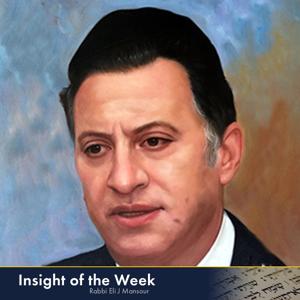
Parasha Insight

Parasha Insight

By Rabbi Eli MansourReligion & SpiritualityJudaism
Download on the App Store

Parasha Insight episodes

  • Parashat VaYishlah- Two Kinds of Dangers
    When Yaakob heard that his brother, Esav, was approaching with a militia of 400 men, he offered an impassioned prayer to G-d, begging for help. He cried, "Hasileni Na Mi'yad Ahi Mi'yad Esav" – "Save me, please, from my brother, from Esav" (32:12). A famous insight into this verse was offered by the Bet Ha'levi (Rav Yosef Dov Soloveitchik of Brisk, 1820-1892), one which is worth our while to review and ponder. The Bet Ha'levi noted that Yaakob asked G-d to protect him from both "Esav" and from "my brother." Of course, these seem to be one and the same. But the Bet Ha'levi explains that this refers to two different threats that Yaakob feared. The first and more obvious threat was that posed by "Esav" – the violent, evil man who hated Yaakob for having taken his blessing, and sought to kill him. Esav's hostility and violent character posed a clear and present danger. But Yaakob also feared the opposite prospect – that Esav would come as "my brother," with love and affection. This, too, presented a danger, albeit a much different form of danger – a spiritual danger. When the gentile nations treat us as "brothers," inviting us to closely interact with them, we risk becoming like them, of exchanging our traditional beliefs, values and practices for their culture. Whereas "Esav" threatens our physical existence, "my brother" threatens our spiritual existence. The Gemara tells that King Ahashverosh despised the Jews no less than Haman. When Haman presented to the king his idea to annihilate the Jews, and offered to pay for it, Ahashverosh responded that to the contrary, he would pay Haman to do this, because he wanted the Jews killed. The Gemara draws an analogy to a person with a large mound of dirt on his property which he wanted to get rid of, and he is approached by another person who has a large hole on his property which he wished to fill. The person with the hole in the ground offers to pay the other person for his mound of dirt – but the one with the mound of dirt is prepared to pay him to remove it. Likewise, Haman was willing to pay Ahashverosh to annihilate the Jews, but Ahashverosh was prepared to pay Haman to get rid of them. But when we read the Megilla, we do not get the impression that Ahashverosh disliked the Jews. To the contrary, he invited them to his feast, and they happily participated. In truth, however, this was no less sinister a plot than Haman's plan to murder the Jews. Haman approached the Jewish People as "Esav," whereas Ahashverosh approached them as "my brother," inviting them to assimilate and embrace the Persian culture, values and lifestyle. Returning to the story of Yaakob and Esav, the Torah tells that when they finally reunited, Esav embraced Yaakob and kissed him. However, one view in the Midrash, as Rashi (33:4) cites, explains that Esav first tried to bite Yaakob's neck. Hashem performed a miracle, making Yaakob's neck hard as marble, such that Esav's teeth could not penetrate it. Esav then kissed him. He at first tried to hurt Yaakov with hostility and violence, and when this failed, he resorted to the tactic of "my brother," by showing love and affection, hoping to lure Yaakob away from his beliefs and values. We must stand guard against both dangers. In a time of growing antisemitism, we must of course remain vigilant and take appropriate measures to protect ourselves. No less importantly, however, we must protect ourselves from the lure of assimilation. The United States offers us freedom and equality, treating us no differently than any other group in this country. This is, undoubtedly, a wonderful blessing for which we must be grateful, as it has allowed us to build communities such as ours and practice our religion without fear. At the same time, however, the freedoms have wrought a spiritual catastrophe, pulling a frighteningly high percentage of Jews away from their heritage. The American Jew's freedom to fully participate in American culture and society entices him to abandon his traditions in favor of the values and lifestyle of the people around us, and too many have fallen prey to this temptation. We need to ensure that our enjoyment of the wonderful freedoms granted us by this country does not result in our rejection of our traditions. And we do this through our community institutions, through our schools, synagogues, yeshivot and programs, which help solidify our identity as Torah Jews, an identity that we continue to wear with pride and conviction even as we participate in and interact with the general society.
    0 min
  • Parashat Veyseh- We Have the Strength!
    When Yaakov arrived at the outskirts of Haran, he saw local shepherds with their herds near the well outside the city. He asked them why they weren't giving their sheep water. The shepherds explained that they could not remove the large, heavy stone from the top of the well. They needed to wait for all the shepherds to assemble at the well so they could together roll the stone off the well. Yaakob then proceeded to the well and, by himself, pushed the stone off so the shepherds could draw water for their flocks. Rashi comments that this episode shows us that Yaakob possessed unique physical strength. We must ask, for what purpose did the Torah tells us about Yaakob Abinu's exceptional strength? What lesson are we to learn from this story? Every person, without any exceptions, has spiritual struggles. And no two people's struggles are the same. Misvot which come easily for one person is a difficult challenge for somebody else. Some people struggle to observe Kashrut, others have a hard time with Shabbat. There are those who have difficulty praying properly, and there are those who find it challenging to observe the Torah's standards of Seniut (modesty). But everyone is struggling with something. This is true even of the great Sadikim. King Shlomo teaches us in Mishleh (24:16), "Ki Sheba Yipol Sadik Ve'kam" – "For a righteous person falls seven times and gets up." Even the righteous fall – and they fall repeatedly. The difference between a righteous person and others is "Ve'kam" – that a Sadik "gets up" each and every time he falls. The wicked person, at a certain point, gives up. He decides not to bother struggling, figuring that it's just too hard for him. An example of this kind of person is Esav, about whom the Torah says, "Ve'hu Ayef" – "and he was tired" (25:29). Esav had the potential for greatness. He was no less capable of being a Sadik than Yaakob was. But he grew "tired" – he decided not to try. The Sadik doesn't get tired. He falls, often, but he keeps getting back up. How does the Sadik do this? What motivates him to keep trying, even after falling multiple times? The answer is found in one of the Birchot Ha'shahar (morning blessings), in which we thank Hashem "Ha'noten La'ya'ef Ko'ah" – "who gives strength to the weary." The Sadik keeps getting back up because he believes that Hashem is helping him and giving him strength. As long as we keep trying, Hashem gives us the abilities we need to eventually succeed. This is the difference between the wicked and the righteous: the wicked person feels powerless, and thus concludes that there is no purpose to continue trying, whereas the righteous person confidently believes that Hashem is giving him the strength he needs to improve. This is the message of the story of Yaakob Abinu's experiences at the well outside Haran. The large stone on the well symbolizes the Yeser Ha'ra, our evil inclination, the difficult – often overwhelming – spiritual challenges that we each face. Like the stone, they seem too big to move, too difficult to handle, too much for us to overcome. The shepherds, like many people, don't bother trying, because they assume they don't have the strength to succeed. Yaakob showed that when one believes in the "Noten La'ya'ef Ko'ah," he is much stronger than he thinks, and he can "remove the stone," and overcome his challenges. We are not expected to be perfect, because we are human beings, and human beings aren't perfect. We are, however, expected to try, and to try again when we don't succeed. We are expected not to grow tired, not to give up, and to instead trust that Hashem is helping us and giving us the strength we need to achieve.
    0 min
  • Parashat Haye Sarah- Hesed With the Hands & Face
    Parashat Hayeh-Sara tells the famous story of Eliezer, Abraham's trusted servant, whom Abraham sent to find a suitable match for Abraham's son, Yishak. Upon arriving at the well outside Abraham's hometown, Aram Naharayim, from where Abraham instructed him to find the match, Eliezer prayed to G-d, begging for His assistance. He said that he would ask a girl at the well for some water, and he asked Hashem to arrange that the girl who not only agreed to give him water, but also offered to give water to his camels, should be the girl destined to marry Yishak. Sure enough, Eliezer saw Ribka – the daughter of Yishak's cousin, Betuel – at the well, and, not knowing who she was, he approached her and asked for water. She agreed, gave him water from her pitcher, and then said that she would draw water from the well for his camels. Ribka then proceeded to repeatedly draw water and pour it into the trough for all ten of Eliezer's camels. Surprisingly, the Torah tells that as Ribka was doing all this, Eliezer watched carefully, wondering "if G-d had made his mission successful or not" (24:21). It seems that even at this point, after Ribka offered to draw water for his camels, he was still not convinced. He needed to observe her throughout this process to determine whether or not she was indeed the right girl to marry Abraham's son. We must ask, what else did Ribka need to prove? Eliezer explicitly said that the suitable girl would be the one who responded to his request for water by offering to draw water for his camels. Why did he still need to wait while Ribka proceeded to draw the water before concluding that she was the one chosen by G-d to marry Yishak? Rav Leib Mintzberg (Jerusalem, 1943-2018), in his Ben Melech, explains that the quality of one's Hesed is not assessed merely by the practical results, by the tangible benefits that he provides. It is measured also by the way it is performed, by whether one helps his fellow graciously, warmly, with a smile, in a manner that makes the recipient feel comfortable and respected. We've all had different kinds of experiences when asking for a favor. Sometimes the person grants our request, but does so coldly, almost begrudgingly, giving us the feeling that he or she would have preferred not to have been bothered. And then there are times when the person does the favor happily, with a warm smile, asking if there's anything else we need, making us feel comfortable and at ease. This is a critically important component of Hesed. Indeed, the Gemara teaches in Masechet Baba Batra (9b) that one who gives money to somebody in need is rewarded with six blessings, whereas one who speaks words of comfort to that individual, lifting his spirits and giving him encouragement, receives eleven blessings – because making a person feel comfortable and at ease is a crucial aspect of kindness. This, Rav Mintzberg writes, is what Eliezer was watching for. Ribka already said that she would draw water for the camels – but Eliezer wanted to see if she would do it warmly and happily, which she of course did. Rav Mintzberg explains on this basis why, afterward, Eliezer gave Ribka as a gift two bracelets and a nose ring, adorning her hands and her face. This symbolizes the fact that she excelled in both aspects of Hesed – the action, and the demeanor. She exerted physical effort to draw a large amount of water for Eliezer's camels, but she also helped him with her face, by wearing a warm smile, by showing her eagerness to help. And these two elements – the act of Hesed, coupled with her warmth and graciousness – are what made Ribka worthy of marrying Yishak and becoming a matriarch of Hashem's treasured nation.
    0 min
  • Parashat Vayera- Yes, It’s Worth It!
    Toward the end of Parashat Vayera, we read the famous story of Akedat Yishak – where Abraham Abinu was commanded to offer his beloved son, Yishak, as a sacrifice upon the altar. At the last moment, as Abraham held the knife over Yishak, prepared to slaughter him in fulfillment of G-d's command, an angel called out to Abraham and told him to desist, explaining that the command was merely a test of Abraham's devotion to Hashem. The Zohar, in a fascinating passage, adds a remarkable component to this story – one which sheds light on one of the critical lessons that it teaches us. When Yishak saw the knife about to descend upon his neck, the Zohar tells, he, in a sense, died. His soul departed. He was then given a new soul, and came back to life. Yishak was the first to recite the Beracha of "Mehayeh Ha'metim" – praising Hashem who restores life to the dead, and for this reason the second blessing of the Amida prayer, which corresponds to Yishak – the second of patriarchs – concludes with this Beracha. This replacement of Yishak's soul laid the foundations of the emergence of the Jewish Nation. Yishak's original soul was incapable of begetting children, but this new soul was. It turns out, then, that it was only because of Akedat Yishak that Yishak was able to produce offspring. This gives us an entirely new perspective on the story of the Akeda, and its relevance to our lives. When Avraham received the command to slaughter to Yishak, he did not understand how G-d could instruct him to do such a thing. After all, G-d had earlier told him, "Ki Be'Yishak Yikareh Lecha Zara" – that his line would continue through Yishak, and not through his first son, Yishmael (21:12). How, Abraham wondered, could G-d assure him that Yishak would be heir to his covenant with G-d, and the father of the nation destined to emerge from him, and then command offering him as a sacrifice before he had a child? Abraham did not understand. It seemed that offering Yishak on the altar marked the end of G-d's promise, as it would prevent the birth of Am Yisrael. In truth, however, fulfilling this command is precisely what enabled Yishak to have children. Had Abraham refused to obey, in the interest of assuring that Yishak would father the great nation that Hashem had promised – it would not have happened. It was specifically by fulfilling G-d's command, which entailed doing something that appeared to sabotage the process of Am Yisrael's emergence, that Am Yisrael in fact emerged. The Midrash teaches that G-d implores us, "Obey Me, because nobody obeys Me and loses." We never lose by following Hashem's will, by observing the Misvot. We often find ourselves tested the way Abraham was, as a Misva appears detrimental to us. Many times, we face a situation where doing the right thing seems to work against us and our best interests. Staying in bed instead of getting up for Minyan is more comfortable and convenient. Avoiding places where we know we should not be might cost us social points. Dressing, speaking and acting the way we know we should might invite ridicule. Adhering to the Torah's strict ethical standards could cost us profitable opportunities. So often, the right thing to do seems to hurt us. But even when this is true in the short-term, it is never true in the long-term. Whatever sacrifice we need to make here in the present to remain faithful to our Torah values is more than worth it, because Hashem guarantees us that in the long run, we only benefit from obeying His commands. Rav Nachman of Breslav (1772-1810) taught that when a person feels himself becoming angry, he should imagine that Hashem is about to give him an enormous fortune – but he must earn it by restraining his anger. The person thinks that shouting and insulting is the right response to the situation – but by doing so, he will forfeit the inestimable future rewards that are promised to those who control their anger. This can be applied to all the many religious challenges that we face on a day-to-day basis. When we feel tempted to compromise our principles, we should remember the lesson of Akedat Yishak – that the short-term benefits we sacrifice to obey Hashem are far surpassed by the long-term benefits of obedience.
    0 min
  • Parashat Lech Lecha- The Eternal Lesson of Abraham’s Victory
    The Midrash (Bereshit Rabba 42) tells the story of how Rabbi Eliezer ben Hyrcanus first began learning Torah. He had worked with his brothers in the farmlands owned by their father, Hyrcanus, until Eliezer ran away in order to learn Torah under the great Rabbinic leader of that generation, Rabbi Yohanan Ben Zakai. Sometime later, his father came to inform Eliezer that he was disowning him, and removing him from his will. But when his father arrived, he saw that Rabbi Yohanan was hosting a major feast for the Rabbis, with the wealthiest men of the generation in attendance. Of all the people assembled, Rabbi Yohanan selected Eliezer – now Rabbi Eliezer – to deliver a speech. Rabbi Eliezer's words dazzled everyone in the room – including his father, Hyrcanus, who approached him afterward. "I had come here to disown you and exclude you from my fortune," he said, "but I am instead giving you everything I own." What was this speech that so impressed Hyrcanus? The Midrash says that Rabbi Eliezer spoke about an event told by the Torah in Parashat Lech-Lecha – the war waged by the four kings against the five kings. During this war, the four kings captured the city of Sedom, and took its entire population as captives, including Lot, the nephew of Abraham Abinu. When Abraham heard that his nephew was taken, he immediately mobilized a small army and boldly launched an attack against the four kings. Miraculously, Abraham's little army triumphed, and rescued all the captives, including Lot. Rabbi Eliezer, in this first speech that he ever delivered, said that this war is alluded to in a verse in Tehillim (37:14): " The wicked have drawn the sword and bent their bow, to bring down the poor and needy, to slay those who walk uprightly. " These "wicked" people, Rabbi Eliezer explained, were the four kings, who were led by Amrafel, whom Rashi (Bereshit 14:1) identifies as Nimrod, the evil king who had thrown Abraham into a furnace to kill him for denying paganism. These kings came with their armies to wage war against "the poor and the needy" – referring to Lot, and to "slay those who walk uprightly" – referring to Abraham. However, their plan backfired, as the next verse says, " Their sword shall enter their heart" – they were defeated and killed by Abraham. What was so profound about this lecture? What great insight did Rabbi Eliezer here reveal, thus earning him his father's newfound admiration and praise? Rabbi Eliezer here taught that when other nations wage wars, they are invariably, in some way, targeting us, the Jewish People. When we read the Torah's account of this war, we get the impression that Abraham's involvement was purely incidental, the result of Lot happening to be living in Sedom, which fell to the four kings. In truth, however, as Rabbi Eliezer taught, the four kings were actually coming after Abraham and Lot. They targeted Abraham because of the monotheistic belief that he disseminated, and they targeted Lot because he was the ancestor of Rut – the great-grandmother of David – and Na'ama – the wife of King Shlomo, from whom the Davidic dynasty descended, culminating in Mashiah. This conflict outwardly seemed like a struggle between different kingdoms who had strategic alliances, but in truth, it was aimed at Abraham and Lot, seeking to destroy Am Yisrael even before its emergence, and to prevent the possibility of Mashiah's arrival to redeem the Jewish People. In the next passage, the Midrash comments that these four kings represent the four empires that would later persecute the Jewish Nation – Babylonia, Persia, Greece, and Edom (associated with Rome and the Christian world). The Midrash here teaches us that just as the war waged by the four kings was driven by hostility toward Abraham Abinu and toward the nation he was creating, the subsequent wars will similarly be motivated by this ancient hatred. We are thus assured that just as G-d miraculously assisted Abraham Abinu in overcoming his enemies, we, too, will prevail over our hostile adversaries. We need to confidently place our trust in the Almighty, in the "Magen Abraham" ("Shield of Abraham"), and ask Him to protect us and deliver us from our enemies just as He helped our ancestors throughout history.
    0 min
  • Parashat Noah- Compliance With Precision
    The Torah tells that after G-d commanded Noah to construct the ark, "Noah did in accordance with everything G-d had commanded him – so he did" (6:22). The final clause – "Ken Asa" ("so he did") – seems to have been added to emphasize that Noah built the ark precisely as G-d had commanded, without deviating even one iota from the specific instructions that he had received. We all know that even the most skilled and reputable contractors usually fail to complete their projects to the customer's complete satisfaction. There is always some detail, minor or major, that is not done the way the customer wanted. Noah, however, completed his project – the ark – in precise compliance with G-d's instructions, without overlooking or disregarding even a single detail. Intriguingly, a similar verse appears later in the Parasha, following G-d's command to Noah that he enter the ark with his family. The Torah writes, "Noah did in accordance with all that G-d had commanded him" (7:5). Rashi explains that this refers to his entering the ark. It is striking that in this context, the Torah does not add, "Ken Asa." In this instance, there is no emphasis on the fact that Noah complied precisely with G-d's instructions. The reason is found in Rashi's startling comments two verses later (7:7). The Torah tells that Noah and his family entered the ark "because of the waters of the flood," and Rashi explains that he did not go into the ark until he was forced to by the floodwaters. Noah, Rashi writes, was ambivalent. He did not fully believe that Hashem would bring the flood, and so he did not go into the ark immediately after he was told to. He waited until the heavy rains compelled him to seek refuge in the ark. This easily explains why the phrase "Ken Asa" is omitted in the context of Noah's entry into the ark. In this case, he did not, in fact, comply precisely with Hashem's command. Although he was, of course, a righteous man who faithfully obeyed G-d, his obedience in this instance was imperfect. The question then becomes, why was Noah ambivalent? He spent 120 years building the ark in preparation for the flood that G-d told him would come. Did he really not believe that G-d would flood the earth? Rav Yosef Salant (Jerusalem, 1885-1981), in his Be'er Yosef, explained that Noah of course did not question G-d's ability to bring the flood, or if He would tell the truth, but he thought that in His infinite mercy, G-d might rescind the decree. After all, G-d waited 120 years after issuing the decree, and then, as Rashi (7:4) brings from the Gemara, he waited an additional seven days so that the people could mourn the passing of Metushelah, a righteous man. Noah waited to see if G-d would further delay the flood in the hope that the people would repent. Nevertheless, Noah acted wrongly because he was explicitly commanded to go into the ark. We are to comply with Hashem's instructions without making our own calculations. Compelling as our own reasoning might seem to us, they can never get in the way of our strict compliance with the Torah's commands. We must strive to reach the level of "Ken Asa" – where our obedience is complete, unwavering, unhesitating and uncompromised, driven by a fierce desire to faithfully serve our Creator.
    0 min
  • Parashat Bereshit- Hashem Knows Better
    What was Adam thinking? Of course, eating the fruit from the forbidden tree was wrong, and he – along with all humankind – was punished as a result. But we would certainly expect that he had some rationale, some thgouht process that justified this action in his mind. What might have led him to eat fruit which G-d had explicitly commanded him not to eat? The Arizal explains the spiritual effects of Adam's sin, how it fundamentally transformed the human being. Before his sin, the Yeser Ha'ra (evil inclination) was external to the person, not part and parcel of his being. Adam was pure and pristine, with a natural inclination to act the right way and do the right thing. Although temptation existed, it could be avoided. A person could keep a distance from sources of temptation, and serve G-d easily, without any inner resistance or inner struggle. After the sin, however, everything became a struggle. As we all know, virtually every good deed we do requires some degree of effort, a "tug-of-war" between our desire to do the right thing and the desire to do the wrong thing. This ongoing struggle was introduced once Adam and Havah partook of the forbidden fruit. This explains Adam's rationale when he decided to eat the fruit that Havah brought him. Imagine a baseball team that shows up ready to play a game, but after the pregame workouts and batting practice, just before the first pitch, the other team decides to forfeit the game. The first team will of course be happy to be credited with a win, but it won't feel very proud of this victory. But if the game is played, and it goes into extra innings, with both teams playing hard, and the game is won in dramatic fashion in the 14 th inning – the team will go home feeling very gratified over its hard-fought win. Adam reasoned that he could draw closer to G-d by inviting the Yeser Ha'ra into his being, by accepting the challenge of perpetual spiritual struggle. Serving G-d without this inner conflict would be like winning via a forfeit, without a fight, whereas serving G-d by constantly resisting lures and temptations would be a hard-fought triumph each and every day of his life. This is what Adam wanted. He strove for greatness, and he understood that greatness is achieved only through hard work and struggle. He thus decided to subject himself to the difficult challenges of the Yeser Ha'ra so he would have to wage a lifelong battle against them. Nevertheless, Adam was wrong. This decision was sinful – so sinful, in fact, that it brought to the world numerous curses, including death itself. The reason why Adam was wrong is very simple – because Hashem told him not to eat the fruit. No human being can ever try to "outsmart" G-d, or think that he has a better idea than G-d had. And no human being can ever think that he can draw close to G-d by disobeying G-d's command. No matter how certain a person is that a certain action will propel him to great spiritual heights and enhance his relationship with Hashem – he must not commit that act if Hashem Himself proscribed it. It is impossible to serve G-d by disobeying G-d. The Gemara teaches that the "Zuhama" ("filth") of Adam's sin remained until the time of Matan Torah, when Beneh Yisrael stood at Mount Sinai and accepted the Torah. They proclaimed, "Na'aseh Ve'nishma" ("We will do and we will hear" – Shemot 24:7), committing themselves unconditionally to G-d's will. They declared their unbridled obedience, that they would observe every command without any hesitation and without rationalization. This corrected the ill that plagued mankind since the time of Adam's sin, the tendency to arrogantly subject G-d's commands to human logic and reasoning. Tragically, however, Beneh Yisrael fell once again just 40 days later, when they worshipped the golden calf. The Ramban and others explain that Beneh Yisrael did not worship they golden calf as a deity. They made a graven image not to replace the Almighty, but rather to replace Moshe, their leader and prophet through whom they served G-d – and whom they had assumed was never returning. Their intentions may have been noble – but they erred by directly disobeying the explicit command not to build an idol for religious worship. Religious observance cannot be diluted or altered to suit our own ideas, our own preferences, or our own perceptions of right and wrong. No matter how convinced we might be that a certain course action is "spiritual" or religiously beneficial, and serves to advance our relationship with G-d, it must not be followed if it violates Hashem's word, if it transgresses the Torah that He gave us. Adam's mistake reminds us that even the noblest intentions cannot justify disobedience. Real Abodat Hashem (service of Gd) begins when we humbly trust His wisdom more than our own.
    0 min
  • Yom Kippur- Learning From the Butcher’s Mistake
    The Gemara (Yoma 87a) tells that the great sage Rav was once insulted by the local butcher. Over the next several months, Rav waited for the butcher to apologize, but he never did. Finally, on Erev Yom Kippur, Rav decided to go and stand right outside the butcher shop so the butcher would see him. He hoped that if he would stand there, and make it very easy and convenient for the butcher to request forgiveness, he would. The butcher saw Rav standing outside his shop, and he shouted angrily, "I have nothing to say to you!" Not only did he refuse to ask forgiveness, he doubled down, insisting that he had nothing to apologize for. At that moment, a bone from the animal the butcherwas carving darted from the counter into his neck, killing him. The Rabbis of Mussar explain that although the butcher had offended Rav many months earlier, he was punished only now because he squandered the opportunity to apologize and make amends. All people make mistakes, and it is not easy to admit we were wrong and initiate a process of reconciliation. But what's inexcusable is avoiding reconciliation when the opportunity comes right to our doorstep. The butcher was wrong to offend Rav, and he was wrong for not going to request forgiveness – but what sealed his fate was failing to approach Rav when Rav made himself available. This story sheds light on a pronouncement by the prophet Yeshayahu about the Aseret Yemeh Teshuba – the ten-day period from Rosh Hashanah through Yom Kippur. Yeshayahu (55:6) turns to the people and exclaims, "Dirshu Hashem Be'himase'o, Kera'uhu Bi'hyoto Karob" – "Seek out G-d when He is accessible, call upon Him when He is near." Of course, G-d is always "accessible," and He is always "near." In all seasons, at all times of year, and at any time of day, in any circumstance, we can turn to Hashem for help, we can ask Him for forgiveness, and we can ask for whatever it is we need. However, the Gemara (Rosh Hashanah 18a) explains, during the Aseret Yemeh Teshuba, Hashem is especially close, and is especially receptive to our sincere prayers. During this period, the prayers recited by an individual have the same power as prayers recited together with a Minyan during the rest of the year. We can only imagine how powerful congregational prayer is during the Aseret Yemeh Teshuba! Indeed, Rav Chaim Brim of Jerusalem (1922-2002) would say that spiritual achievements which normally take weeks to attain can be reached in just a few moments during the Aseret Yemeh Teshuba. This is a special time, when our prayers and our efforts to repent and improve are particularly effective, many times more than at other times of the year. At first glance, it seems that Yeshayahu is encouraging us and advising us by calling upon us to turn to Hashem during this period of Aseret Yemeh Teshuba. As Hashem is close, it is recommended that we seize this opportunity for prayer and repentance. But in light of the Gemara's story about Rav and the butcher, we might conclude that Yeshayahu isn't just giving advice – he's issuing a stern warning. If Hashem is close, then we must initiate a process of "reconciliation," a process of Teshuba. It's not just a good idea – it's an obligation. We are flawed human beings, and so it is understandable that we will make mistakes. We are not expected to be perfect. And, it is understandable that we will find it difficult to acknowledge our mistakes, to admit wrongdoing, to confess that we've acted improperly and have made bad choices. This is embarrassing and uncomfortable. And, change is always challenging. But even if we could be excused the rest of the year for not making an effort to improve and ask Hashem for forgiveness, we have no excuse during this week, when Hashem specifically comes to us and invites us back. During the Aseret Yemeh Teshuba, Hashem is right here next to us with His arms open. He is ready to forgive us as long as we take the first step by admitting we were wrong and committing to try harder. If we don't seize this opportunity, this period when Teshuba is especially accessible, then we have no more excuses. Let's ensure not to make the butcher's mistake. Let's take full advantage of this special opportunity, and sincerely turn to Hashem in heartfelt prayer and with a firm resolve to improve, to correct our mistakes, and to enhance our relationship with our Father in heaven.
    45 min
  • Parashat Neesavim- Crowning the King with a Smile
    The Gemara (Rosh Hashanah 11a) lists several events that occurred on the date of Rosh Hashanah, the first of Tishreh. These include Sara conceiving with a child at the age of 90, after decades of infertility and desperate longing for a child. For this reason, we read on the first day of Rosh Hashanah the story of the birth of Sara's son, Yishak Abinu. The Gemara also mentions that Rosh Hashanah was the day when Yosef was released from prison in Egypt. He had been imprisoned when Potifar's wife falsely charged that he assaulted her, and Yosef spent 12 years in the dungeon, until he was brought before Pharaoh to interpret the king's mysterious dreams. This led to his being named Pharaoh's vizier. It was on Rosh Hashanah, the Gemara teaches, that Yosef was brought out of prison and taken before Pharaoh. This event is alluded to in the 81 st chapter of Tehillim, which – for good reason – is the chapter we read as the "Shir Shel Yom" (daily Psalm) on Rosh Hashanah. We find in this chapter references to both the sounding of the Shofar on Rosh Hashanah ("Tik'u Ba'hodesh Shofar" – verse 4), and Yosef's emergence as the leader of Egypt ("Edut Bi'Yehosef Samo Be'seto Al Eretz Misrayim" – verse 6) – clearly indicating that Yosef left prison on Rosh Hashanah. The Maharsha (Rav Shmuel Eidels, 1555-1631), in his commentary to Masechet Rosh Hashanah, draws a curious connection between these two events – Sara's conception, and Yosef's rise to power in Egypt. In the aforementioned chapter in Tehillim, Yosef's name appears with an extra letter Heh, such that it is written "Yehosef" instead of "Yosef." The Maharsha writes that this extra letter came from Sara, whose name ended with a Heh. Additionally, the Maharsha adds, according to the wisdom of Kabbalah, the letter Heh at the end of G-d's Name (the Name of "Havaya") signifies the concept of Malchut, kingship, and it was thus added to Yosef's name when he ascended to a position of royalty in Egypt. The commentators explain further that Sara's name, as we know, was originally "Sarai," which ended with the letter Yod, and it was later changed to "Sara," which ends with Heh. The letter Yod in Gematria equals 10, and it was divided into two Hehs, as the letter Heh in Gematria equals 5. One was given to Sara, and the other was given to Yosef. The question then becomes, why did specifically these two figures receive the letter Heh? What is their particular connection to this letter, which expresses the theme of Malchut? The answer lies in the fact that both Sara and Yosef faced numerous hardships over the course of many years, and nevertheless maintained pristine faith in Hashem. Sara was childless for many years, was twice abducted by ruthless kings, and wandered from place to place for much of her life. Yosef was cruelly banished from his home, brought as a slave to Egypt, where he was tempted by his master's wife – and when he refused, she had him imprisoned. As mentioned, he remained in prison for 12 years. Neither Sara nor Yosef ever questioned or challenged G-d's judgment. They fully and wholeheartedly accepted His rule over the world without complaint. And this is the greatest expression of Malchut – unconditional and unreserved submission to, and acceptance of, Hashem's will as the ultimate good. This is why Sara and Yosef are associated with the letter Heh – which signifies Hashem's kingship – and why they are associated with Rosh Hashanah, the day we celebrate Hashem's kingship. This teaches us a crucial lesson about how we must approach Rosh Hashanah. Many people approach this day focused solely on what went wrong during the previous year, and on their hopes and aspirations for the coming year, everything they want to be better during the new year. But they forget about all that went right during the past year, all the wonderful blessings that Hashem had granted them. The Tiferet Shlomo (Rav Shlomo of Radomsk, Poland, 1801-1866) taught that if we want our prayers to be answered, we must first thank Hashem for all the good in our lives before proceeding to ask for what we want. We cannot enter Rosh Hashanah ungratefully, complaining about all that is wrong with our lives, without first acknowledging, appreciating and being thankful for all that is currently right with our lives. After all, Rosh Hashanah is the day when Hashem is crowned anew as king over the universe, an event to which only "VIP members" are invited – and we, Am Yisrael, are the "VIP members." Imagine someone receiving an invitation to attend the Presidential inauguration, and he shows up with a frown, angry and agitated. When he gets a turn to greet the President, he doesn't smile, because he's so upset about whatever it is that's bothering him. He would likely be thrown out of the party, and he certainly would not be invited the next time around... On Rosh Hashanah, we are the special guests at Hashem's "inauguration." And thus Ezra Ha'sofer told the people on Rosh Hashanah, "Hedvat Hashem Hi Ma'uzchem" – that their source of strength and success was their joy and festivity on this day (Nehemia 8:10). We must show up on Rosh Hashanah smiling, celebrating Hashem's kingship, grateful for all He had done for us. Each and every year throughout her years of infertility, Sara joyously celebrated Hashem's kingship on Rosh Hashanah – just as Yosef did each and every year he spent in the dungeon. Of course, they also prayed for what they needed – but not before they felt genuine gratitude for all that they had. Let us enter Rosh Hashanah not only with a "laundry list" of everything we want Hashem to give us, but also with sincere gratitude for all that He has already given us, and we will then be worthy of His continued grace, kindness and blessing, Amen.

    0 min
  • Parashat Ki Tabo- Gratitude Starts at Home
    Parashat Ki-Tabo begins with the Misva of Bikkkurim – the obligation upon a farmer to bring the first fruits that ripen to the Bet Ha'mikdash and present them to a Kohen. The farmer then makes a special declaration praising and expressing gratitude to Hashem for bringing our nation out of Egypt into the Land of Israel, where he was able to till the land and produce delicious, nourishing fruit. The unique significance and importance of this Misva is expressed in the special fanfare that characterized the process of bringing Bikkurim. The farmers would assemble and march with song and festivity through the roads, and the shopkeepers in Jerusalem would close their stores and come out to welcome and celebrate the visitors who were bringing their fruits to the Bet Ha'mikdash. The importance of Bikkurim is also articulated by the Midrash, which teaches that this Misva is mentioned in the very first word of the Torah: "Bereshit." The Midrash interprets this word to mean that the world was created for the sake of Bikkurim, which is called "Reshit" ("Reshit Bikkureh Admatecha" – "the first of the fruits of your land that ripen" – Shemot 23:19). Remarkably, the Midrash is telling us that the entire world was created so we can fulfill the Misva of Bikkurim! The reason is that G-d created the world so that He could shower us with goodness which we would then appreciate and be grateful for. The most elementary of all Torah values is gratitude, acknowledging and appreciating what was done for us. Hence, the Misva of Bikkurim, which revolves around the concept of gratitude, thanking Hashem for providing us with food, can be seen as the purpose of all creation. Our Sages teach that gratitude toward Hashem begins with feeling and showing appreciation for other people. The Midrash states: "Whoever denies his fellow's goodness will ultimately deny the Almighty's goodness." The classic example demonstrating this principle is Pharaoh, who is said to have "not known Yosef" (Shemot 1:8). It is inconceivable, the Rabbis explain, that a king who ascended the throne soon after Yosef's lifetime had not heard of Yosef. He was the one who saved Egypt from the devastating famine that struck the rest of the region, and thereby enriched the kingdom, as all the surrounding peoples came to purchase grain which Yosef had stored in anticipation of the looming drought. Rather, this means that the new Pharaoh did not acknowledge Yosef's role in saving the kingdom and bringing it to great heights of wealth and prestige. Because Pharaoh denied all the good that Yosef brought to the kingdom, he ultimately denied G-d Himself, brazenly and outrageously telling Moshe many years later, "Lo Yadati Et Hashem" – "I do not know G-d!" (Shemot 5:2). Translating this message into practical terms – one cannot be considered "religious" if he recites Birkat Ha'mazon after every meal with intense concentration, thanking Hashem for his food, and says "Modim" in the Amida prayer three times a day with great emotion, expressing gratitude to Hashem for all He does – but he does not show gratitude to the people in his life. Gratitude begins at home, with the people who do the most for us – first and foremost our parents, who gave us life and exerted so much hard work and made so many sacrifices for us, and then our spouse, the one closest to us, with whom we build and run our families. If we are not grateful to them and to everyone who helps us and does things for us, we will ultimately feel ungrateful also toward G-d. And, yes, this applies also to those who are paid to do things for us. Many years ago, I was hired as a private tutor for a teenage boy in the community. While we were learning, he called the family's housekeeper on the intercom system, and told her to bring him soda and some snacks. I was startled by the way he spoke, not even using the word "please." She came a minute later with the soda and snacks, and he said, "Close the door on your way out." I turned to the boy and asked, "You don't say 'thank you'??" "Rabbi," the boy replied, "she works for us. We're paying her to do this." "Now you're making me very nervous," I said. "Why?" "Because I also work for you. Your parents pay me, too. Are you going to treat me that way because I'm getting paid?" Whether it's the secretary, the cashier, the uber driver, the coworker, the delivery guy – feeling and expressing gratitude is not just required, but it is the ABC's of the Torah, our most basic obligation as Jews and as human beings. The more we appreciate all the people in our lives and all that they do for us, the more we will appreciate all that Hashem does for us – and this will, in turn, make us worthy of even more of His unlimited blessings and goodness.
    20 min

About Parasha Insight

From the publisher's feed

Relevant weekly insights by Rabbi Eli Mansour - delivered directly to your computer and/or mobile device

More shows like Parasha Insight

The Rabbi Sacks Legacy by Rabbi Lord Jonathan Sacks

The Rabbi Sacks Legacy

557 Listeners

A Torah State Of Mind by Rabbi Shlomo Farhi

A Torah State Of Mind

82 Listeners

Daily Morning Class by Rabbi Meyer Yedid

Daily Morning Class

28 Listeners