
Sign up to save your podcasts
Or



Emily is an occupational therapist who had two babies in the NICU. Her first baby was born at 33 weeks and her second baby was born at 23 weeks.
Her biggest advice for families in the NICU:
Do your research. You know your child best, and you can work with the physicians to make better decisions for your baby. As a neonatologist, I strongly believe that parents know their children best, and should feel comfortable asking questions and advocating for their child.
Do not isolate yourself. Especially for Mamas of micro-preemies. Seek out online support groups or Mamas who have similar experiences so you are not isolated.
Do not compare your journey and your baby to someone else’s. Comparison is the thief of joy.
Take it 1 hour at a time and get out of the hospital. Get a bite to eat or take a walk.
Ebony had every symptom of Pre-Eclampsia and HELLP, yet there was a delay in recognizing it. During this podcast, we talk about Ebony’s work with the March of Dimes and the #It’sNotFine Campain. Despite it being the year 2020 Black, American Indian, and Alaska Native women are two to three times more likely to die from pregnancy-related causes than white women (CDC, 2019).
I’ll be honest. This is a hard conversation. It is an uncomfortable conversation. But it is a conversation that we have got to have. It is simply Not Ok. We need to do better. We MUST do better. And here are a few ways to get moving in the right direction:
Slow down and listen. Ignore pre-conceived notions. Do not make clinical assumptions before you have really listened to the patient. When health care providers really listen to patients, they find the information they need to provide good care.
Patients need to educate themselves prior to showing up to a hospital or clinic. Know your symptoms, do a little research when you can, and come armed with information to advocate for yourselves.
It is unfortunate that black women almost have to become the stereotype of the aggressive woman they are unfairly portrayed as in order to get the health care system to listen to them.
You can follow Reign’s story on Instagram @andsheshallreign.
A few of the many quotes I love from this podcast:
The day I went home, I wasn’t prepared for how empty I would feel not pregnant and not with my baby. That night was the hardest night that I had.
Just because you are grieving what you wanted, doesn’t mean you aren’t grateful for what you have.
There is no right way to react to having a baby in the NICU.
The NICU is an experience in the juxtaposition of emotions.
As time has passed, instead of thinking things went wrong and my body failed, MAYBE, I’m living the best-case scenario of an alternative outcome that would have been devastating - and that would have been losing our baby at 20 weeks. In that world, the NICU would have been my dream scenario.
I didn’t feel strong when I was going through the NICU. But I was strong. And if I could tell preemie moms anything, it would be that they are strong. And their baby is strong.
You are not alone.
Taryn is the creator and voice of the Messy Mama Podcast. She interviews and talks to moms who want to feel both connected and supported in their mama journey. She also had two premature infants in the NICU.
Listen: www.anchor.fm/the-messy-mama-podcast
Instagram: @themessymamapodcast
Katie found out at her 20-week anatomy scan that her son had a giant omphalocele. She candidly and honestly talks about the initial bumbling conversation where she first heard about his diagnosis and the relief she felt when she got hooked into a high-risk OB practice and a NICU with experience with babies with Giant Oomphaloceles.
Because she found out at 20 weeks about her son’s omphalocele, she had the remainder of her pregnancy to really process what that meant. Letting go of “the perfect pregnancy” and “the perfect delivery” and “the perfect child” and even their chosen name (Colin is too close to Colon) to accept the journey that was ahead. For parents in the NICU, it is not simply important, but essential, to acknowledge what was wanted and expected. Acknowledge it, feel it, and move forward to your new normal, where you can fight for, advocate for, and love your baby.
Throughout this podcast, Katie weaves suggestions for NICU parents into her story. Here are a few of my favorites:
Take it an hour a day, a day at a time. You can not think more than an hour or a day ahead, so stay in the moment.
Develop a communication plan. Friends and family are going to want updates. You should plan how you want to communicate with people (text, call, social media, website), who you want to update, how much you want to share, and when you are going to share (daily, weekly, never, etc).
Do not compare yourself to someone else. You are on your own journey. Your child is on their own journey.
The first time you hold your baby, soak it all in. The connection, the love, the peace. But also fear grief and sadness. It is ok to feel both at the same time.
When working on oral feedings, remember to take a deep breath. Your baby will pick up on your vibes and your energy. Try to stay calm while you are feeding your baby, so they can pick up on those calm vibes.
For parents of babies with GI issues at birth (gastroschisis to omphalocele to Hirschsprung’s) and micro-preemies, working on feedings at the end of the hospital stay can be one of the most challenging and frustrating parts of the NICU stay. Working on helping your baby learn something that is supposed to be instinctual can be emotional. Spending weeks to months in the NICU, and knowing you are so so close to going home and WAITING for your baby to take all of their feedings can be painful. Here is a great video of Tim working on feeding.
Katie is now working on publishing a book about her NICU experience. The book is called “Infinite Miracles: The Memoir of a NICU Mom”. The book details a unique entre into parenthood and ultimately having a son who thrives into toddlerhood. In her book, Katie brilliantly talks through how they developed a communication plan, and how they dealt with the conversations around them.
I love the conversation Katie and I have towards the end of the podcast about how people communicate differently when hearing bad news. Optimism bullies… Over Empathisers… Cliche Sayers… We need to avoid these. The best thing to do is to just sit quietly in the hard — and listen.
Tim turns FIVE!
Tim holding a picture of himself in the NICU during the first week of life.
In case you missed the Instagram Live, I have attached the Video Recording of it as well as released the audio as a Bonus Podcast for Mighty Littles.
Key Updates:
Continue delayed cord clamping per hospital routine policy.
Encourages infant and mother to room in. This ends the suggestion to temporarily separate mothers and babies after birth.
Breastfeeding (or pumped breastmilk) is strongly encouraged.
Infants should be bathed shortly after birth, and have COVID testing done at 24 and 48hrs. Any infant with a positive test should have frequent outpatient follow up (in person or via telehealth) for the first 2 weeks of life.
NICU visitation for positive parents discussed. Parents may return to the unit when they have been fever-free for 24hrs, have improvement of symptoms, and are a minimum of 10 days from initial symptoms or positive test.
Here is the link to the AAP’s updated guidelines: Management of Infants Born to Mothers with Suspected or Confirmed COVID-19.
From infertility to social media to shame and guilt over having a baby in the NICU, we discuss motherhood and all the messages we get about how we are doing it wrong.
As NICU physicians, we know that babies born at 23 weeks can face a multitude of issues, many life-threatening, and Liam and Wyatt experienced many of those complications. Fighting pulmonary hemorrhage, intestinal perforation, infection/sepsis, complications from central lines, and unfortunately the loss of Wyatt. Moving forward with the remainder of the NICU stay with Liam, they encountered more complications with retinopathy of prematurity, aspiration pneumonia, and ultimately a G-tube.
Ashley and Time courageously talk about their NICU experience and balancing love and loss in the NICU. Feeling split loyalty between grieving for Wyatt and celebrating Liam turned out to be one of the most difficult aspects of their NICU stay.
Since this was recorded just before Father’s Day, we talk a little bit about Dad’s role in the NICU as well.
Savannah from @thesmallestfight joins Mighty Littles to talk about protecting our kids from COVID while still participating in live.
From the publisher's feed
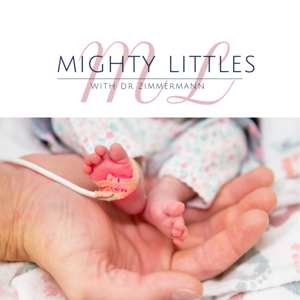
Dr. Anna Zimmermann, a neonatal intensive care unit (NICU) doctor, talks about life in the NICU with parents, authors, and others. If you or someone you know is heading to a NICU, you are not…