
Sign up to save your podcasts
Or

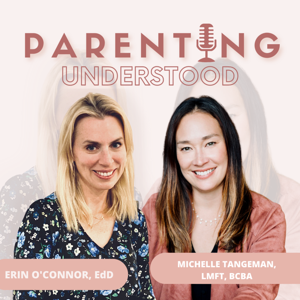


In this episode of Parenting Understood we are joined by Chelsey Goodan, author of Underestimated: The Wisdom and Power of Teenage Girls. In this episode we talk about girls' experiences feeling unheard while also experiencing societal pressures to be perfect and likable. We delve into the role of social media in girls' views of themselves and others. We further discuss the role of gender in girls and boys identity development. Chelsey also offers advice on how to support girls and to provide strong relationships for them.
To learn more about Chelsey and her work please visit:
Chelsey Goodan | Author & Speaker
This week we discuss how AI language models, specifically ChatGPT and Gemini, can support us in parenting. We delve into how ChatGPT and Gemini may help with things from crafting meals to creating personalized bedtime stories, generating craft ideas and developing educational games. We note, however, that AI models are best used as a starting point for evidence-based information and should not replace the input of a qualified professional.
In this episode of Parenting Understood we speak with Dr. Harriet Tenenbaum about the importance of parent-child talk for a child's development. As we discuss, parents who speak more about emotions with their children help their children understand emotions better. Interestingly, there does not appear to be a large difference between explaining emotions to children and asking them questions about emotions in supporting their learning about emotions. We also address the role of parent talk in both children's understanding of scientific principles, and in gender stereotyping.
For more information on Dr. Tenenbaum and her work please visit: Prof Harriet Tenenbaum | University of Surrey
In this episode, we discuss how a reward chart can support young children when traveling. More specifically, we walk through the key steps to using a reward chart, and the role of supporting positive behaviors. Traveling is a time of transition and often stress for children (and parents) but there are evidence based strategies to support children in the experience.
For more information on Spot It and to get a copy please e-mail Michelle at [email protected]
We are thrilled to be re-releasing our episode with Dr. Clancy Blair as part of our four week back to school series before our reflection on the past 100 plus episodes in two weeks. Dr. Blair is a developmental psychologist and Professor at New York University, who studies self-regulation in young children. His primary interest concerns the development of cognitive abilities, referred to as executive functions, and the ways in which these aspects of cognition are important for school readiness and early school achievement. He is also interested in the development and evaluation of preschool and elementary school curricula designed to promote executive functions as a means of preventing school failure. Prior to coming to NYU, Blair spent ten years as an Assistant and then Associate Professor in the department of Human Development and Family Studies at Penn State.
Dr. Blair spoke with us regarding self-regulation, and the different stages that can be expected in children as they age from infants to adolescents. We also explored the ways in which the environment can impact self-regulation, and how parents can utilize different strategies for trying to best promote positive self-regulation.
If you would like to learn more about the work of Dr. Blair, you can visit his Google Scholar page at https://scholar.google.com/citations?user=duCRaqgAAAAJ&hl=en
In this episode, we sit down with Dr. Holly Gover, a board-certified behavior analyst with extensive experience working with children with developmental disabilities. Dr. Gover, currently a faculty member in pediatrics at Vanderbilt University Medical Center, joins us to tackle a common concern for parents: picky eaters.
Dr. Gover shares valuable insights on how to encourage children to try new foods in a relaxed and enjoyable manner, empowering them to feel in control of their eating choices. We also explore the warning signs that may indicate the presence of an eating disorder and discuss the pressures faced by parents when preparing meals for their children and families.
Delving deeper, we uncover three essential techniques: creating a culture of trying, increasing exposure to diverse foods, and avoiding mealtime battles. These strategies serve as powerful tools for parents seeking to overcome the challenges of picky eating and to foster healthier eating habits in their children.
Join us for this discussion that empowers parents with practical advice and effective approaches to navigate the world of picky eaters, ultimately creating a positive mealtime experience for the entire family.
To learn more about Michelle's Pocket Parent membership, please visit https://www.thrivingtoddler.com/pocketparent
You can reach out to Dr. Gover by contacting her at [email protected] or by visiting her webpage at https://pediatrics.vumc.org/person/holly-c-gover-phd-bcba-d
In this episode, we are joined by Lauren Smith-Brody, founder of the Fifth Trimester movement and the author of The Fifth Trimester: The Working Mom's Guide to Style, Sanity, and Big Success After Baby. We discuss with Lauren how her work addresses the research and policy around early parenthood, as well as the practical. Lauren speaks about how her work dissects the systems that drive the inequities that make new motherhood, and especially new employed motherhood, so challenging, and her mission to recruit others to speak up about caregivers in their workplace and their needs. Lauren addresses the parallels between infants' fourth trimester and mothers' fifth trimester. She further talks about child care, especially in regards to thinking about how one gets comfortable with one's decision about care, and how decisions are made. We further talk about the roles of ambivalence and agency in parenting. Lauren also speaks about her current work around rights and caregivers in the workforce.
For more information on Lauren please visit:
http://www.thefifthtrimester.com/founder
For more information on Chambers of Mothers please visit:
https://www.chamberofmothers.com/
In this episode, we discuss 9 key principles to consider when having conversations with children around difficult topics, such as illness. We discuss ways to be developmentally appropriate with one's approach, especially for younger children. In addition, we talk about supports to consider when having these conversations, and the importance of gearing one's approach towards one's own child's needs.
Resources:
Talking to Children about Cancer
Talking to Children about Mental Illness
Talking to Children about Death
In this episode we are joined by Harvard Professor, Dr. Paul Harris, to delve into the intricate world of children's imagination and its developmental significance. Drawing on his research, Dr. Harris challenges historical views, notably those of Freud and Piaget, highlighting the pragmatic value of children's imaginative play. He shares experiments involving young children's responses to pretend scenarios, revealing their sophisticated understanding and application of imagination in everyday situations. Moreover, Dr. Harris explores children's willingness to believe in unseen phenomena, shedding light on the role of trust, consensus, and attachment in shaping their perceptions. Throughout the discussion, Dr. Harris provides practical insights and thought-provoking reflections, offering a deeper understanding of child development and the dynamics of parent-child interactions.
To learn more about Dr. Harris and his research please visit his website Dr. Paul Harris.
In this episode, we are joined by Dr. Felienne Hermans to delve into the world of programming and its significance in children's development. We explore why programming is vital for children, emphasizing their shift from being digital consumers to creators. Felienne underscores the importance of fostering creativity in the digital realm, highlighting how programming empowers children to craft their own digital creations.
Felienne also offers insights into age-appropriate programming activities. Moreover, she addresses common misconceptions about programming and offers practical advice for parents looking to engage their children in coding. She stresses the value of choosing activities aligned with children's interests, whether it's art, storytelling, or gaming.
Felienne also encourages parents to embrace learning alongside their children, emphasizing the importance of modeling curiosity and resilience.
To learn more about Dr. Hermans and her coding program, please visit her website https://www.felienne.com/ and https://www.hedycode.com/
From the publisher's feed

3,636 Listeners

111,873 Listeners

56,396 Listeners