
Sign up to save your podcasts
Or



As a kid, Richard Burrell lived in the motels along Parkway Drive in Fresno, California. As an adult he founded and runs an organization that supports the wellbeing of the kids who live there now.
Richard Burrell is the founder and executive director of Live Again Fresno, a nonprofit after-school and community support organization that “co-powers” children and families in Fresno’s most vulnerable communities by providing mentorship, education, and holistic support to break cycles of poverty and build brighter futures.
In this conversation, Richard reflects on his own childhood growing up on “Motel Drive” and the day he informally started what has now formally grown into Live Again Fresno. Richard’s work exemplifies the healing powers of trauma-informed frameworks and the importance of organizational leadership living in deep relationship with the community it serves.
Learn more about Live Again Fresno
Read more about the documentary Richard was part of called Motel Drive
Dr. Mona Hanna, affectionately known as “Dr. Mona”, is best known as the pediatrician who exposed the Flint water crisis. She is also the associate dean for Public Health at Michigan State University and now the founder of RxKids – a cash prescriptions program for expectant mothers in Michigan and currently the largest cash-transfer program in the country.
In this episode, Dr. Mona reflects on how her experience in medical school and her experience navigating the Flint water crisis inform her approach to public health. She also discusses the impact and financial efficiency of RxKids, and how a program like RxKids – which centers love and trust by design – significantly improves health outcomes for babies and new mothers.
Find Dr. Hanna’s book, What the Eyes Don’t See, and learn more about RxKids:
https://rxkids.org/
What the Eyes Don't See
Marcia Black is a Detroit-based archivist, curator, and cultural preservationist whose work focuses on preserving the histories of Black women, Black Detroit, and the Black radical tradition. Guided by her education at Marygrove College and inspired by her entrepreneurial grandmother who was a beauty salon owner, computer worker, and reverend, Marcia has dedicated herself to archival work with a purpose.
In this episode, Marcia reflects on her approach to collecting oral histories with Detroit’s Black elders, and ways those elders and their stories can inform a reimagining of Detroit’s future.
This discussion also explores ideas around archiving, pushing back against cultural erasure, and the opportunities for community-led reparations efforts through projects like the I-375 Reparative Roundtable – a group of 20 stakeholders addressing the historical injustice of Detroit’s interstate construction in the 1960s.
Learn more about Marcia, the Black Bottom Archives, and the Detroit Reparative Roundtable
https://www.blackbottomarchives.com/
https://detroitisdifferent.com/keeping-the-flame-marcia-black-on-black-women-archives-and-the-legacy-of-black-detroit/
https://www.michigan.gov/mdot/projects-studies/special-construction/i-375-reconnecting-communities-project
Damien Wilson is the Senior Director of the HBCU Brilliance Initiative at Reinvestment Fund, where he leads efforts to provide technical and financial support to Historically Black Colleges and Universities.
In this episode, Damien discusses how his career on Wall Street, his love for his hometown, and his own HBCU experience all inform his approach as a financial advisor working to ensure these institutions become strong community anchors.
This discussion explores the financial challenges and opportunities facing HBCUs in this moment and highlights the importance of debt as leverage in securing the futures of these schools. This conversation also explores the need for innovative and business-minded leadership and the ways HBCUs can holistically serve their communities.
Learn more about Damien and the HBCU Brilliance Initiative
https://www.reinvestment.com/grants/hbcu-brilliance-initiative/
https://www.reinvestment.com/people/damien-wilson/
https://pathbreakers.kresge.org/story/damien-wilson/
Favianna Rodriguez is an interdisciplinary artist, cultural strategist, and entrepreneur based in Oakland, California. She is the co-founder of The Center for Cultural Power.
In this conversation, Favianna shares her journey as an artist and activist, discussing the influence of her immigrant parents, the challenges she faced in pursuing art, and the importance of cultural narratives in shaping political policies.
Favianna reflects on her journey with the Center for Cultural Power and her transition into new artistic endeavors, focusing on storytelling in film and television. The discussion also highlights the role of philanthropy in supporting cultural narratives and the necessity of investing in artists to create meaningful change.
LEARN MORE about Favianna, her work and the Center for Cultural Power
https://favianna.com/
https://www.culturalpower.org/
https://pathbreakers.flywheelsites.com/story/favianna-rodriguez/
Elizabeth Birr Moje is dean, George Herbert Mead Collegiate Professor of Education, and an Arthur F. Thurnau Professor of Literacy, Language, and Culture in the Marsal Family School of Education at the University of Michigan.
On this episode she describes the transformative arc of the Marygrove Learning Community in Northwest Detroit.
The dialogue emphasizes the significance of purpose-driven learning and the commitment to nurturing both students and educators in a supportive environment. Moje highlights the critical intersection of innovation and justice in education, advocating for equitable access to resources and opportunities for all students.
First, hosts Jamie Bennet and Tracey Pearson check in with Kresge Foundcation President and CEO, Rip Rapson
---
LEARN MORE about Dean Moje and the Marygrove Learning Community
https://mlcdetroit.org/
https://kresge.org/our-work/detroit/transformative-project-marygrove-cradle-to-career-campus/
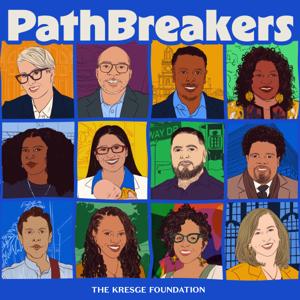
Welcome to PathBreakers, a show from The Kresge Foundation all about the people who break through the noise, red tape, and all of the other obstacles to progress.
In each episode, you’ll meet a different Pathbreaker, people working in cities to forge new ways forward and discover the possibilities, sometimes hidden in plain sight.
From the publisher's feed