
Sign up to save your podcasts
Or



Based on Podcast App listening data
For decades, career advice has been simple: specialize, build deep expertise, and become indispensable. But what happens when AI makes that expertise accessible to almost anyone? The value of knowing how to do something is shifting toward knowing what should be done, why it matters, and whether the result is actually any good.
In this episode of People Managing People, host David Rice speaks with Tony Castellanos, Head of People at Nextdoor, about why judgment, curiosity, and taste are becoming critical leadership capabilities. They explore how AI could invert the traditional hierarchy of specialists and generalists, why organizing teams around business problems makes more sense than defending functional boundaries, and what happens when the org chart stops dictating who gets to solve what.
Related Links:
Support the show
Most enterprise AI strategies start with the same question: What can we automate? It's a reasonable question if your ambition is to make the existing workplace run faster. It's a much less useful one if you're trying to build something better.
In this episode, David Rice speaks with Paula Goldman, Chief Ethical and Humane Use Officer at Salesforce, about why human-AI collaboration demands a different approach to organizational design. They explore the hidden value of workplace friction, why employees need a seat at the table when redesigning work, and the danger of measuring AI success exclusively through efficiency. Because saving time is one thing. Preserving the judgment, relationships, and expertise that make an organization effective is another.
Related Links:
Support the show
Most companies are still figuring out what an AI agent should actually do. JLL has moved well past that question. With agents operating across facilities management, brand communications, and corporate functions, the company is learning that the hardest problems aren’t necessarily technical—they’re about proving value, building trust, and making sure AI solves an actual business problem instead of becoming another expensive corporate science project.
Recorded at the AI4 conference in Las Vegas—with some of the inevitable conference-floor background noise—this conversation between host David Rice and Carlin Power, Global VP of AI and Platform Technology Enablement at JLL, explores what it actually takes to deploy AI at scale. They discuss why ROI needs to live inside the P&L, how decentralized AI development can accelerate useful innovation, and why eliminating entry-level roles in the name of efficiency may be exactly the wrong lesson to take from AI.
Related Links:
Support the show
Recorded live at the AI4 conference in Las Vegas, this conversation puts David Rice and Dr. Lilian Ajayi Ore—AI lead faculty and lecturer in strategic communication at Columbia University and co-author of The Power of the Learning Mindset—in the middle of one of the biggest questions surrounding workplace AI: Are companies gaining efficiency while quietly weakening their people’s ability to think? With the energy of a live conference comes some background noise, but the discussion cuts through it.
David and Dr. Ore explore cognitive debt, skill decay, and why the usual AI metrics—seats, logins, prompts, adoption rates—say very little about whether workforce capability is actually improving. They discuss the risks of outsourcing judgment and critical thinking, the loss of institutional knowledge when organizations replace people rather than reskill them, and why AI transformation needs to be treated as a talent priority alongside a technology priority. Because faster work isn’t much of a win if the people doing it are slowly losing the skills that made them valuable in the first place.
Related Links:
Support the show
AI may be changing the work, but the bigger risk is what happens when organizations optimize so aggressively for today’s efficiency that they stop building tomorrow’s capability.
Recorded live at the AI4 conference in Las Vegas, host David Rice sits down with Dr. Jana Brown, Chief Human Resources Officer at eHealth, to unpack the long-term consequences of shrinking entry-level pipelines, why HR needs “transformation fluency” rather than technical expertise alone, and what separates useful AI initiatives from expensive corporate hobbies. They also explore the human and operating systems that have to move together if transformation is going to stick—and why the technology itself is rarely the thing that sinks an AI project. Listeners may hear a little more conference-floor noise than usual, but that’s the price of capturing these conversations where they’re actually happening.
Related Links:
Support the show
AI in HR has a credibility problem: the technology is getting better at spotting patterns, summarizing data, and automating work, but none of that guarantees a better employee experience. In this conversation, Motivosity Chief Product Officer Jesse Dowdle and VP of Engineering Dano Gillette make the case for “appreciation intelligence”—using AI to remove administrative friction without automating the human moments that actually make recognition meaningful.
The bigger opportunity isn’t an AI-generated thank-you note. It’s giving HR and frontline managers a richer picture of employees, surfacing signals before problems become crises, and turning data into useful action. But there’s an important line running through the conversation: AI can recommend, filter, moderate, and nudge. Humans still need to own the judgment.
Related Links:
Support the show
When people stay quiet at work, organizations lose more than participation. They lose ideas, warnings, customer insight, process improvements, and market intelligence that never make it into the room. Seema Bhansali calls this the silence tax—the hidden cost companies pay when their environments make self-censorship the safer option.
In this episode, Seema joins David Rice to unpack why “speak up” advice misses the real problem. Employee voice isn’t simply a confidence issue; it’s shaped by systems, social risk, management behavior, and the environments leaders create. They also explore why this matters even more as companies adopt AI, and why communication needs to be treated less like a soft skill and more like an operational capability tied to performance.
Related Links:
Support the show
AI transformation has a funny way of becoming an organizational X-ray. The companies getting real value from it aren’t necessarily the ones buying the most tools or burning the most tokens. They’re the ones that understand what they’re trying to accomplish, what excellence looks like, and which problems are actually worth solving.
In this episode of People Managing People, David Rice speaks with Zapier’s Chief People and AI Transformation Officer, Brandon Sammut, about why AI ROI starts with organizational clarity, how to build experimentation that survives contact with actual workloads, and why adoption eventually needs to give way to impact. They also explore AI coaching, the growing value of judgment and wisdom, and why the best employers may increasingly be defined by how much more capable people become while working there.
Related Links:
Support the show
HR has been told for years to “speak the language of the business,” usually as code for proving it deserves to be in the room. But Dr. Shindale Seale makes a stronger case: this isn’t about self-defense. It’s about leadership. If disengagement, poor management, weak culture, and badly handled transformation all carry measurable financial costs, HR needs to connect the human consequences to the numbers executives use to make decisions.
In this episode, host David Rice and Dr. Seale unpack the “disengagement tax,” why engagement metrics without business impact can become little more than dashboard theater, and what it actually means for HR to become bilingual. They also explore the impossible job organizations have created for managers, why AI tends to amplify the culture it lands in, and whether the CHRO role is big enough for the human side of the transformation ahead.
Related Links:
Support the show
There are two ways the AI transformation of work can go. We can hand the keys to the efficiency obsessives and spend the next decade trying to engineer the humanity out of organizations. Or HR can recognize that understanding motivation, organizational design, and how people actually experience work is suddenly a strategic advantage—and start acting like it.
Jessica Zwaan, VP of People Strategy and Operations at Leapsome and author of Built For People and Purpose In Work, joins David Rice to talk about why HR has the raw materials to lead this moment, but also some baggage to lose. They get into purpose washing, why not everyone needs a calling disguised as a job, what AI means for early-career development, and why designing better work requires considerably more than putting a mission statement on the wall and hoping everyone believes it.
Related Links:
Support the show
From the publisher's feed
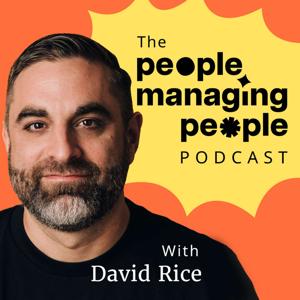
The People Managing People podcast equips forward-thinking leaders to thrive in the AI era—reshaping teams, systems, and strategy without losing what makes work human. Hosted by David Rice, each…

43,356 Listeners
1,338 Listeners

147 Listeners

10,651 Listeners

8,307 Listeners

9,065 Listeners
124 Listeners

46,902 Listeners

2,236 Listeners

1,126 Listeners

41,371 Listeners

3,455 Listeners

19,071 Listeners

154 Listeners
377 Listeners