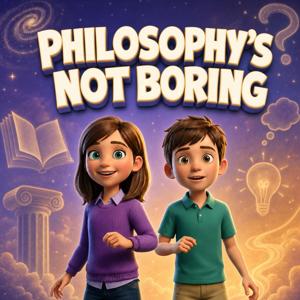
Philosophy for Kids / Philosophy's Not Boring: The Kids Philosophy Podcast

Philosophy for Kids / Philosophy's Not Boring: The Kids Philosophy Podcast

Download on the App Store

Philosophy for Kids / Philosophy's Not Boring: The Kids Philosophy Podcast episodes

  • What is a tickle robot?
    Have you ever wondered why you can’t tickle yourself? It’s a mystery that even the ancient Greek philosopher Aristotle tried to solve over two thousand years ago! Join Mira and Finn as they uncover the massive, mind-bending secret hidden inside your own head. You’ll meet Sarah-Jayne Blakemore, a brilliant British neuroscientist who finally cracked the case by building something totally wild: a real-life tickle robot! Discover how a tiny, fraction-of-a-second delay tricked volunteers' brains and proved that we basically live our lives slightly in the future. You'll learn all about the cerebellum—a special part at the back of your brain that acts like a master detective. It constantly predicts your own movements and hits the "mute button" on your senses so you aren't overwhelmed by every blink or squish of your toes. Get ready to find out why your brain runs a secret simulation to keep you ready for surprises, and why you literally cannot jump-scare yourself! It's a hilarious, science-packed adventure that will change how you feel the world forever!
    13 min
  • What is the voice in your head?
    Have you ever noticed that you have a tiny narrator inside your brain? When you read a book silently or think about your favorite animal, do you hear a voice talking? It turns out, that invisible voice is full of wild scientific secrets! In this mind-bending episode, Mira and Finn explore what exactly the voice in your head really is. You'll discover a secret human superpower called subvocalisation, where your brain sends microscopic signals to your vocal cords to practice talking without making a single sound! We will also travel back to the 1920s to learn how psychologist Lev Vygotsky figured out that our inner voice actually comes from talking out loud when we were little toddlers. But here is the biggest plot twist of all: not everyone has a voice in their head! Learn about psychologist Russell Hurlburt's wacky beeper experiment and find out what it means to have a completely silent mind, known as anendophasia. Do you think in words, pictures, or feelings? Tune in to explore the invisible, unique universe inside your own amazing mind!
    13 min
  • Who was Ludwig Wittgenstein?
    Have you ever had a massive argument with your friends over whether a hot dog is actually a sandwich? Or what exactly makes a game a "game"? Welcome to the wildest, messiest problem in human history: language! In this brain-bending episode of Philosophy is Not Boring, Mira and Finn dive into the amazing ideas of Ludwig Wittgenstein, one of the 20th century's most intense thinkers. Wittgenstein realized that words aren't perfect little boxes with strict rules. Instead, they share something called "family resemblance"—just like how you might have your mom's eyes or your cousin's loud laugh! Discover why there's no invisible "essence" connecting every single sandwich, how humans just draw the lines ourselves, and why Wittgenstein once got so heated during a debate that he waved a metal fireplace poker at another famous philosopher! It’s a hilarious and fascinating look at why the words we use every single day are beautifully messy. Tune in to find out if a taco is really a sandwich, and get ready to look at your lunch menu in a completely different way!
    12 min
  • What is luck?
    Have you ever rolled a double six in a board game and felt like you had magical powers? It feels like the universe is totally on your side! But is luck real, or is it just a feeling? In this mind-bending episode of Philosophy is Not Boring, Mira and Finn dive into the amazing science of probability and the ancient philosophy of luck! Discover why mathematicians say dice have absolutely zero memory, and learn about a super cool Roman philosopher named Seneca who believed luck is simply what happens when preparation meets opportunity! You will also hear about a hilarious 1993 science experiment by psychologist Richard Wiseman. He tricked hundreds of people with a giant hidden message in a newspaper to see who was actually "lucky"! Find out why people who feel unlucky completely missed the giant text, while lucky people spotted it in seconds! We might not be able to control the dice, but can we build our own luck like a superpower? Grab your treasure maps, keep your eyes wide open, and let's find out!
    12 min
  • What is the Butterfly Effect?
    Have you ever wondered if a tiny butterfly flapping its wings in Brazil could cause a giant tornado all the way in Texas? It sounds like superhero magic, but it is actually real science! Join Mira and Finn on Philosophy is Not Boring as we dive into a mind-boggling idea called the Butterfly Effect!
    In 1961, a scientist named Edward Lorenz was working at MIT, using a giant, clunky computer to predict the weather. To save a little time, he rounded off a super tiny decimal number—changing 0.506127 to just 0.506. He thought it wouldn't matter at all. But when he came back from his coffee break, the computer predicted a completely different, wild weather forecast!
    This amazing discovery led to Chaos Theory, which shows that in huge systems, one microscopic change can ripple into a massive event. But what does this mean for you? It means that every tiny choice you make matters! Whether it is choosing your shoes or being kind to a friend on the playground, you are creating ripples that can change the entire world. Tune in to learn how you can be a good butterfly!
    15 min
  • What is Hare Krishna?
    Have you ever walked down a busy city street and suddenly heard drums, tiny cymbals, and joyful singing? You might have just seen the Hare Krishna tradition in action! In this special episode inspired by a listener's amazing question, Mira and Finn dive into the fascinating history of Bhakti yoga, the path of love and devotion. Travel back 500 years to ancient India, where a teacher named Chaitanya Mahaprabhu decided spirituality shouldn't just be for quiet temples—it should be a public, musical celebration for absolutely everybody!
    Then, fast forward to 1965 and join a brave 69-year-old teacher named Swami Prabhupada as he sails across the ocean to New York City with nothing but a trunk of books and a few dollars in his pocket. Discover how a simple 16-word chant called the Maha Mantra grew from a solo performance under a tree in a park into a massive worldwide movement! Plus, learn all about their beautiful tradition of sharing delicious vegetarian meals with anyone who wants to join. Get ready to explore how music, dancing, and food can bring the whole world together!
    12 min
  • Who was Marcus Aurelius?
    Imagine being the most powerful person in the entire world! You could order everyone to eat ice cream for breakfast or build a giant rollercoaster in your bedroom! But what if, instead of bossing everyone else around, you spent all your time bossing yourself around? That is exactly what the Ancient Roman Emperor Marcus Aurelius did! Over two thousand years ago, Marcus ruled a massive empire, but he didn't want to be a cruel or spoiled leader. Instead, he became a brilliant "philosopher king" who practiced Stoicism!
    Marcus realized that even an emperor can't control everything, like thunderstorms or annoying people. So, he kept a top-secret diary—which we now call "Meditations"—just to tell himself how to be a better human! While out leading armies, he wrote down rules reminding himself not to get angry or throw tantrums. He learned to sort life into two boxes: things he couldn't control (like rainy days or someone taking the last cookie) and the one superpower he could control—his own mind! Join Mira and Finn as they uncover the wild secrets of this ancient diary and learn how you can become the emperor of your own brain!
    13 min
  • What is the Baha'i Faith?
    Have you ever wondered why there are so many different religions in the world? What if they weren't actually rivals fighting against each other, but just different chapters of one giant, epic storybook? In this mind-bending episode, Mira and Finn explore the Baha'i faith! Founded in Persia in the 1800s by a man named Baha'u'llah, it is one of the youngest major world religions. You'll discover the amazing idea of "progressive revelation"—the belief that humanity is like a student growing up, and different messengers were sent at different times when people were ready to learn new lessons! We'll dive into Baha'u'llah's core teaching: the absolute oneness of humanity and the end of all prejudice. Plus, you will learn why Baha'i Houses of Worship all around the world have exactly nine sides and nine doors, and why those doors are wide open to absolutely everyone, no matter what they believe! Get ready to be an independent investigator of truth as we explore how looking for what connects us might just change the world. Tune in for a beautiful story about unity, respect, and one human family!
    12 min
  • What is the Zeigarnik Effect?
    Have you ever wondered why a TV show cliffhanger drives you totally crazy, or why that big homework project you haven't started nags at you all weekend long? Your brain is actually trying to help you! In this fascinating episode of Philosophy is Not Boring, Mira and Finn travel back to a bustling 1920s café in Vienna to meet a brilliant psychologist named Bluma Zeigarnik. She noticed something wild: waiters could remember incredibly complicated food orders without writing a single thing down—but the exact instant the customer paid the bill, the memory completely vanished! Why? Because of a brain quirk now known as the Zeigarnik Effect! We will discover exactly why unfinished tasks leave a noisy mental itch in your mind, and how finished ones are quietly tossed in the mental trash. Best of all, Mira and Finn reveal a literal life hack! Learn the amazing two-minute trick to quiet your bossy brain, tackle scary chores, and save your Saturday. Grab some hot chocolate, get ready for mind-bending psychology, and test your memory in our fun quiz at the end!
    12 min
  • What is the Veil of Ignorance?
    Imagine there is only one piece of delicious chocolate cake left, and you have to share it with your sibling. How do you make sure it is split perfectly fair? Easy! One person cuts the cake, and the other person gets to pick their slice first! That means the cutter will make the pieces exactly perfectly equal, because they don't want to get stuck with a tiny crumb!
    Today on Philosophy is Not Boring, Mira and Finn explore how an amazing American philosopher named John Rawls used this exact same idea to design a perfectly fair society. Get ready to step behind a magical, mind-bending curtain called the Veil of Ignorance! What if you had to write the rules for a whole new world, but you had temporary amnesia and didn't know who you would be when you woke up? You wouldn't know if you were going to be rich or poor, the fastest runner or a kid using a wheelchair. What rules would you choose? Join us as we learn how this incredible thought experiment helps solve everyday playground arguments and makes sure no one gets left behind!
    13 min

About Philosophy for Kids / Philosophy's Not Boring: The Kids Philosophy Podcast

From the publisher's feed

A groundbreaking podcast for curious kids aged 4-12, and the grown-ups listening with them, that proves philosophy, psychology and religion are anything but dull.

Join our fictional AI hosts…