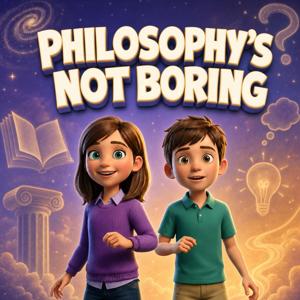
Philosophy for Kids / Philosophy's Not Boring: The Kids Philosophy Podcast

Philosophy for Kids / Philosophy's Not Boring: The Kids Philosophy Podcast

Download on the App Store

Philosophy for Kids / Philosophy's Not Boring: The Kids Philosophy Podcast episodes

  • What is the Paradox of the Heap?
    Imagine a giant mountain of sand at the beach. If you take away just one single tiny grain, is it still a heap? Of course! But what if you keep taking away one grain at a time, all afternoon, until there is only one microscopic grain left? When exactly did it stop being a heap? Which single grain broke the rule? Join Mira and Finn as they explore one of the oldest and most mind-bending puzzles in history: the Paradox of the Heap! Invented by the ancient Greek philosopher Eubulides of Miletus over two thousand years ago, this awesome puzzle shows us that many everyday words—like "tall," "old," or even "clean"—are actually totally blurry! We will dive into the funny Bald Man paradox, ask at what exact drop of water a puddle magically becomes a lake, and discover why having fuzzy words isn't a mistake, but actually a brilliant feature of our amazing, constantly changing world. Get ready to stretch your brain and look at puddles, messy rooms, and growing up in a whole new way!
    12 min
  • What is the Fundamental Attribution Error?
    Have you ever noticed that when someone bumps into you in the hallway, you instantly think they are rude? But when YOU bump into someone, you have a perfectly good excuse, like being in a massive hurry! Welcome to the Fundamental Attribution Error! Join Mira and Finn on Philosophy is Not Boring as they uncover why our brains can be so unfair on purpose! Psychologists have discovered that we sort actions into two buckets: Character (who someone is inside) and Situation (what's happening around them). When we make a mistake, we blame our situation, but when other people make mistakes, we blame their character! We learn all about Lee Ross's famous 1977 psychology experiment and why our brains take lazy shortcuts when we're tired or busy. What happens when your best friend doesn't text back? Did their tablet die, or are they ignoring you? Discover how learning to spot this mental error is actually a real-life superpower! Once you see the hidden situations around you, you can become a much kinder, more generous friend. Grab your headphones and let's unlock this awesome psychology secret!
    11 min
  • What is the problem of other minds?
    Have you ever stubbed your toe and felt a huge wave of pain? You know for certain that it hurts! But how do you know your friends feel pain exactly the same way? Welcome to one of the biggest brain-twisters in human history: The Problem of Other Minds! Join Mira and Finn as they explore a wild philosophical puzzle. We know what our own thoughts and feelings are like from the inside, but we can only guess what is happening inside everyone else's head from the outside! Is everyone around you actually a "philosophical zombie" just pretending to be human? Do we all have the exact same "beetle" hidden in our secret brain boxes? We will dive into amazing ideas from famous thinkers like René Descartes and Ludwig Wittgenstein to see how humans connect. Plus, find out why scientists originally thought dogs didn't have feelings, and how a famous computer test tried to prove machines could think! Don't worry, this puzzle has a beautiful ending. Discover why trusting each other is the absolute coolest choice we make every single day. Get ready to bend your brain!
    13 min
  • What is Zoroastrianism?
    Imagine you're in a giant cosmic game of tug-of-war, and you have to play! Join Mira and Finn as they travel over three thousand years back in time to Ancient Persia to explore Zoroastrianism! Founded by a prophet named Zarathustra, this is one of the absolute oldest religions in the world. Instead of just watching gods fight in the sky, Zoroastrians believe that every single person is an active warrior in a massive cosmic battle between Truth and the Lie. How do you fight? Not with swords or shields, but with a special ancient code: Good Thoughts, Good Words, and Good Deeds! We'll discover how your ordinary everyday choices tip the balance of the universe, learn about amazing sacred fire temples that have been kept burning for over a thousand years, and reveal how Zarathustra's ideas secretly helped shape other major world religions. Plus, find out a mind-blowing secret about the Three Wise Men from the Christmas story! Get ready for an epic historical adventure where your choices truly matter to the whole universe!
    14 min
  • What is cognitive dissonance?
    Have you ever wanted something really, really badly, but when you couldn't get it, you suddenly decided you never even wanted it in the first place? Welcome to the weird and wild world of the human brain! Join Mira and Finn as they uncover a sneaky mind trick called Cognitive Dissonance. In the 1950s, a famous psychologist named Leon Festinger discovered that our brains absolutely hate it when our beliefs and our actions crash into each other. It creates a terrible, buzzing, clashing feeling in our minds!
    To make that uncomfortable buzz go away, our brains will actually rewrite the story and change what we believe without even asking us. We'll explore why we make up silly excuses when we lose a game, why people in a famous science experiment convinced themselves a totally boring job was actually super fun, and how an ancient Greek fable about a fox gave us the famous phrase "sour grapes"! Spotting this sneaky brain trick as it happens is a genuine real-life superpower. Are you ready to catch your brain in the act? Tune in and let's go!
    13 min
  • Who was Epictetus?
    Have you ever built a massive, perfect LEGO tower only to have it completely smashed by a tumbling pet? It feels super unfair and makes you incredibly mad! But what if there was an ancient mental trick to help you almost never let a bad day ruin your mood again? In this episode, Mira and Finn travel back to the Roman Empire to meet Epictetus! He was born into slavery and had a really tough life, but he discovered a brilliant secret to happiness and became one of the most famous thinkers in history!
    You'll learn all about his clever "Dichotomy of Control" trick, which is a big fancy word for sorting the entire world into two simple piles. What goes in Pile One, and what belongs in Pile Two? Discover how focusing on your own choices can make you totally free! Plus, get ready to be completely grossed out as Finn and Mira uncover the disgusting truth about ancient Roman public bathrooms and their shared sea sponges. Eww! Tune in to learn how to control your effort, release the outcome, and find your inner peace!
    12 min
  • What is a religion?
    Have you ever wondered what actually makes a religion a religion? If you picture a church, a temple, or someone praying to a creator up in the sky, you aren't alone! But what happens if you take a god completely out of the picture? Is it still a religion, or just a club with strict rules?
    Join Mira and Finn as they answer an amazing listener question and travel back thousands of years to explore ancient traditions that don't focus on a supreme creator! Discover Jainism, where followers are so devoted to not harming living things that monks use naturally fallen peacock feathers to gently sweep tiny bugs out of their path! Learn about Buddhism, started by a real human prince named Siddhartha Gautama, who taught people to wake up to reality and find peace in their own minds. Finally, explore ancient Chinese Confucianism and the immense power of community rituals—like a special family tea ceremony!
    Get ready to bend your brain and discover that religion isn't just about what you believe in your head, but what you treat as sacred! Tune in now!
    13 min
  • Who was Elizabeth Loftus?
    Have you ever closed your eyes and remembered something so clearly it felt exactly like watching a video on your phone? What if we told you your brain doesn't actually have a video player in it? Join Mira and Finn on an exciting new episode of Philosophy is Not Boring as they dive into the mind-bending world of psychology! Today, they are exploring the amazing discoveries of scientist Elizabeth Loftus. She proved that our memories aren't perfect recordings. Instead, they are more like a giant, messy Lego set that you rebuild every single time you remember something! In a famous 1974 experiment, Loftus proved that just changing one tiny word in a question could completely change a person's memory, making them picture broken glass that never even existed! Discover why your brain acts more like a Wikipedia page that can be edited, rather than a perfect video camera. You will learn why you and your siblings might remember the exact same family trip completely differently, and why your messy, Lego-building memory is actually a superpower! Get ready for a mind-blowing adventure into the human brain!
    13 min
  • Who was Socrates?
    Have you ever been one-hundred-percent sure you were right about something, only to realize you were completely wrong? Welcome to the wild world of Socrates! Travel back to Ancient Athens to meet one of history's most famous thinkers—a man who figured out that the smartest thing you can possibly do is admit you know absolutely nothing at all! Instead of writing books or working a normal job, Socrates spent his days wandering the marketplace, asking powerful leaders simple but tricky questions. He wanted to see if they actually knew what words like "fairness" and "courage" meant. Spoiler alert: they usually didn't! This back-and-forth questioning became known as the Socratic Method. Discover why asking "why?" is a superpower, how saying "I don't know" can actually win an argument, and why the leaders of Athens were so afraid of this question-asking genius. Plus, learn some wild facts about Socrates, like how he used to walk barefoot in the freezing ice and stand completely still for an entire day just to think! Get ready to twist your brain into knots—in the best way possible!
    13 min
  • What is the Langar?
    Imagine the biggest, busiest restaurant in the entire world. It's open twenty-four hours a day, seven days a week, and the best part? The food is completely free! Join Mira and Finn on Philosophy is Not Boring as they explore the amazing 500-year-old Sikh tradition of the Langar! Started by Guru Nanak in northern India, the Langar is a massive community kitchen where absolutely anyone—from famous billionaires to regular kids—can sit on the floor together and share a delicious hot meal. Why do they sit on the floor? Because it proves that everyone is equal! We'll travel to the famous Golden Temple, where volunteers feed up to 100,000 people every single day using a giant flatbread-making machine! But how do they afford it, and who washes all those dirty plates? You'll learn all about "Sewa," the incredible superpower of selfless service, where helping a stranger is treated like a joyful form of worship rather than a boring chore. Discover how you can become a secret "service ninja" in your own home and spread kindness without ever asking for a thank-you!
    14 min

About Philosophy for Kids / Philosophy's Not Boring: The Kids Philosophy Podcast

From the publisher's feed

A groundbreaking podcast for curious kids aged 4-12, and the grown-ups listening with them, that proves philosophy, psychology and religion are anything but dull.

Join our fictional AI hosts…