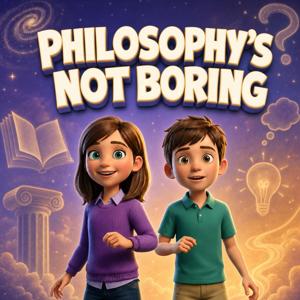
Philosophy for Kids / Philosophy's Not Boring: The Kids Philosophy Podcast

Philosophy for Kids / Philosophy's Not Boring: The Kids Philosophy Podcast

Download on the App Store

Philosophy for Kids / Philosophy's Not Boring: The Kids Philosophy Podcast episodes

  • How did time begin?
    Have you ever wondered what happened before the universe began? If you had a remote control for the cosmos and pressed rewind all the way back to the start, would the timer hit zero, or just keep going backward forever? In this mind-bending episode of Philosophy is Not Boring, Mira and Finn tackle a massive question sent in by two brothers: Did time have a first day? Join our hosts as they travel back 1,600 years to meet Augustine, a thinker from a city called Hippo (yes, like the animal!). Augustine realized that time isn't just an empty room waiting for things to happen—it's a creation itself! Discover why asking what happened "before" time started is as silly as looking for North when you're already at the North Pole, a clever trick shared by the brilliant scientist Stephen Hawking. Along the way, you'll hear a hilarious true story about stolen pears, find out why the Big Bang exploded time into existence, and learn why not having all the answers makes our world even more magical. Get ready to twist your brain into a pretzel and explore the biggest mystery in the cosmos!
    12 min
  • Who was Hermann Ebbinghaus?
    Have you ever crammed for a spelling test, got a perfect score, and then completely forgot every single word by Saturday? Join Mira and Finn on Kidopoly's Philosophy is Not Boring as they travel back to the 1880s to meet a German psychologist named Hermann Ebbinghaus. He wanted to understand how human memory works, so he did something totally bonkers—he tested it entirely on himself! By memorizing thousands of funny nonsense words (like DAX and ZOL) to the steady tick of a metronome, Ebbinghaus discovered the Forgetting Curve. He proved that our brains naturally wipe out almost half of what we learn in just twenty minutes! But don't panic! Ebbinghaus also discovered the ultimate cheat code for your brain: the Spacing Effect! It turns out you don't have to study harder or longer. You just have to chop your study time up over a few days! Find out how this brilliant 140-year-old discovery can help you ace your math tests, learn to juggle, or master the piano without doing a single extra minute of hard work!
    13 min
  • What is Brahman?
    Have you ever wondered if you and the universe are actually the exact same thing? It sounds completely mind-blowing, but ancient thinkers in India explored this very idea thousands of years ago! In this episode, Mira and Finn dive deep into the Hindu religion to discover the amazing concepts of Atman (your true, deep self) and Brahman (the ultimate reality of the entire universe). Together, we will learn about ancient sacred texts called the Upanishads and explore a famous story about a boy named Svetaketu! When his dad gives him a weird homework assignment involving a lump of salt and a bowl of water, Svetaketu learns an incredible secret about how the world works. He discovers the meaning of the famous phrase "Tat tvam asi," which means "you are that"! Are we all just like temporary waves in one giant ocean? Could being kind to someone else actually mean you're being kind to yourself? Tune in to bend your brain, think huge thoughts, and see the universe in a completely new and connected way!
    13 min
  • Who was Immanuel Kant?
    Have you ever wanted to skip a line, break a tiny promise, or drop a piece of trash and thought, "It's just me, no big deal!"? When you get caught, grown-ups always say, "What if everybody did that?" Well, it turns out that annoying question is actually one of the most powerful ideas in human history! Join Mira and Finn as they explore the brilliant mind of Immanuel Kant, a famous philosopher who lived hundreds of years ago. Kant loved rules and order so much that he woke up at exactly 5:00 AM every single day, and his neighbors even set their clocks by his daily afternoon walks! He invented an amazing secret "everybody test" for right and wrong. If you imagine everyone in the whole world doing your sneaky action, and the world stops working—like how all trust vanishes if everyone breaks promises—then you shouldn't do it either! It is like a superpower for your brain to figure out fairness all by yourself. Discover why he never made special exceptions, why he only breathed through his nose, and why thinkers still argue about his rules today!
    13 min
  • Who was Diogenes?
    Have you ever looked at your messy room and wished you could just throw it all away? Meet Diogenes, an ancient Greek philosopher who did exactly that! While other people in ancient Athens were busy trying to buy the fanciest clothes and go to the best parties, Diogenes decided that having a lot of stuff was just a giant trap. Instead of living in a normal house, he chose to live in a massive clay jar right in the middle of the street!
    Join Mira and Finn on this hilarious episode as they explore the wild life of the thinker who owned almost nothing. Discover why Diogenes threw away his only wooden drinking cup, and why he famously walked through a crowded marketplace in broad daylight carrying a lit lantern! You'll even hear the legendary story of the time the most powerful king on earth, Alexander the Great, offered Diogenes anything he wanted—and Diogenes simply asked him to move out of his sunlight! Get ready to ask a massive question: do all our toys and things actually make us happy, or can we be freer with less? Let's find out!
    12 min
  • What is Shinto?
    Have you ever stood next to a giant, twisted tree or a rushing river and felt like it was alive? In Japan's ancient spiritual tradition called Shinto, that feeling is totally real! Nature isn't just scenery—it is filled with infinite, invisible spirits called kami. Join Mira and Finn as they explore a magical world where life forces live in towering waterfalls, massive rocks, and even the wind! You'll discover peaceful sacred forests and learn the beautiful secret behind those giant, bright red torii gates you see in pictures of Japan. Guess what? These massive gates don't even have doors! They are always open, waiting for you to pause, take a deep breath, and step into a sacred space. Plus, you'll find out why the Japanese say there are "eight million" kami, and learn about the special zigzagging white ropes tied around ancient trees to show they are their very own shrines. Get ready for a mind-bending episode that will completely change the way you look at the natural world. Tune in and discover how seeing nature as a sacred friend helps us treat the Earth with wonder and respect!
    13 min
  • What is the bystander effect?
    Imagine dropping all your heavy books and markers in a super crowded school hallway. You'd think having thirty kids around would mean you'd get help super fast, right? Well, science says the exact opposite! Join hosts Mira and Finn as they explore a mind-blowing psychology puzzle called the bystander effect. Why do huge crowds sometimes just stare when someone is in trouble? It turns out, it's not because people are mean—it is a weird brain glitch called the "diffusion of responsibility."
    In this episode, Mira and Finn unpack a wild 1968 experiment by psychologists John Darley and Bibb Latané, where people sat in a room filling with fake smoke just because no one else was panicking! Discover how our brains get confused by big groups, slicing up responsibility like a giant pie until nobody takes action. But don't worry, there's a superpower waiting for you! Learn the ultimate, brilliant trick to completely beat the bystander effect. Whether you're the one who needs a hand or the superhero ready to step up, this episode will change the way you look at crowds forever!
    13 min
  • What is Shabbat?
    Imagine a day where you are completely forbidden from doing chores, homework, or even looking at your screens! What would you do? Join Mira and Finn as they explore the ancient Jewish tradition of Shabbat! For thousands of years, Jewish families have celebrated this special day of rest every single week. Starting on Friday evening and ending on Saturday night, Shabbat is a massive pause button for the whole world. You'll discover why the ancient Torah says that rest is actually a superpower that proves you are a free human being, not just a working machine! Learn all about delicious braided Challah bread, the rules of unplugging from modern technology, and the beautiful ceremony of lighting candles and smelling sweet spices. Plus, find out the magical way people know exactly when the day of rest is officially over—by looking up at the night sky for three shining stars! Tune in to Philosophy is Not Boring for a relaxing adventure that will make you rethink the busy, rushing world!
    12 min
  • What is the Allegory of the Cave?
    Have you ever woken up in the middle of the night, terrified by a giant shadow monster in the corner of your room, only to realize it was just a pile of dirty laundry? Our brains can easily be tricked into believing a shadow is reality! In this mind-bending episode of Philosophy is Not Boring, Mira and Finn explore an amazing story from over two thousand years ago: Plato's Allegory of the Cave!
    Imagine a group of people who have spent their entire lives chained inside a dark underground cave. They can only stare at a blank wall, watching flickering shadows cast by a roaring fire behind them. To them, these flat, gray shapes are the whole entire world! But what happens when one person finally breaks free, climbs out of the cave, and steps into the dazzling sunlight for the very first time? Their mind is completely blown by real trees, real animals, and vibrant colors!
    Join the adventure to find out why this famous Greek philosopher (who was actually a competitive wrestler named Aristocles!) wanted us to ask one massive, world-changing question: What if everything we see is just a shadow?
    13 min
  • What is Islam?
    Imagine having a magical superpower to look down at Earth and seeing nearly two billion people all stop what they are doing at the exact same time, face the exact same city, and pray! In this mind-blowing episode, Mira and Finn explore the amazing traditions of Islam and the famous Five Pillars that hold up the faith for Muslims around the world. What does it mean to pray five times a day? Why do millions of people go a whole month without eating or drinking while the sun is up during Ramadan? And what is the incredible journey to Mecca called the Hajj? Discover how a teacher named the Prophet Muhammad shared these teachings in the 7th century, and learn how practices like giving to charity and wearing plain white clothes can teach us about kindness, equality, and empathy. Whether you're learning about Islam for the first time or celebrating your own traditions, this episode is packed with fascinating facts—like how astronauts fast in space when they see 16 sunrises a day! Grab your spacesuit and get ready to explore!
    14 min

About Philosophy for Kids / Philosophy's Not Boring: The Kids Philosophy Podcast

From the publisher's feed

A groundbreaking podcast for curious kids aged 4-12, and the grown-ups listening with them, that proves philosophy, psychology and religion are anything but dull.

Join our fictional AI hosts…