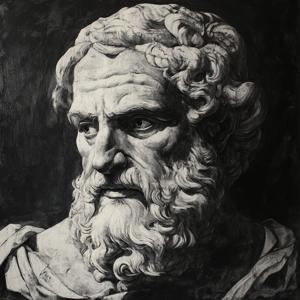
Plato Classics Podcast

Plato Classics Podcast

Download on the App Store

Plato Classics Podcast episodes

  • Meno-Plato (Πλάτων)
    Meno by Plato (Πλάτων).

    Meno (Ancient Greek: Μένων) is a Socratic dialogue written by Plato. Written in the Socratic dialectic style, it attempts to determine the definition of virtue, or arete, meaning in this case virtue in general, rather than particular virtues, such as justice or temperance. The goal is a common definition that applies equally to all particular virtues. Socrates moves the discussion past the philosophical confusion, or aporia, created by Meno's paradox (aka the learner's paradox) with the introduction of new Platonic ideas: the theory of knowledge as recollection, anamnesis, and in the final lines a movement towards Platonic idealism..

    Featured on Plato Classics Podcast.

    Public-domain recording courtesy of LibriVox (librivox.org).
    2 hr 23 min
  • Protagoras-Plato (Πλάτων)
    Protagoras by Plato (Πλάτων).

    Jowett, in his always informative introduction, sees this dialogue as transitional between the early and middle dialogues. Socrates meets with Protagoras and other sophists and pursues his inquiry into virtue. The dialectic brings the thinkers to a surprising ending.

    Featured on Plato Classics Podcast.

    Public-domain recording courtesy of LibriVox (librivox.org).
    3 hr 14 min
  • Gorgias-Benjamin Jowett, Plato (Πλάτων)
    Gorgias by Benjamin Jowett and Plato (Πλάτων).

    This dialogue brings Socrates face to face with the famous sophist Gorgias and his followers. It is a work likely completed around the time of "Republic" and illuminates many of the spiritual ideas of Plato. The spirituality, as Jowett points out in his wonderful introduction, has many ideas akin to Christianity, but is more generous as it reserves damnation only for the tyrants of the world. Some of the truths of Socrates, as presented by Plato, shine forth in this wonderful work on sophistry and other forms of persuasion or cookery.

    Featured on Plato Classics Podcast.

    Public-domain recording courtesy of LibriVox (librivox.org).
    7 hr 7 min
  • Ion-Plato (Πλάτων)
    Ion by Plato (Πλάτων).

    In Plato's ION, Socrates questions Ion, whether he should really claim laud and glory for his 'rhapsodic' recitals of Homer's poetry.

    Featured on Plato Classics Podcast.

    Public-domain recording courtesy of LibriVox (librivox.org).
    54 min
  • Philebus-Plato (Πλάτων)
    Philebus by Plato (Πλάτων).

    Philebus (ΦΙΛΗΒΟΣ) discusses pleasure, wisdom, soul and God.

    Featured on Plato Classics Podcast.

    Public-domain recording courtesy of LibriVox (librivox.org).
    2 hr 37 min
  • Timaeus-Plato (Πλάτων)
    Timaeus by Plato (Πλάτων).

    "Our intention is, that Timaeus, who is the most of an astronomer amongst us, and has made the nature of the universe his special study, should speak first, beginning with the generation of the world and going down to the creation of man..." 'Timaeus' is usually regarded as one of Plato's later dialogues, and provides an account of the creation of the universe, with physical, metaphysical and ethical dimensions, which had great influence over philosophers for centuries following. It attributes the order and beauty of the universe to a benevolent demiurge - a 'craftsman' or god - fashioning the physical world after the pattern of an ideal, eternal one. The dramatic setting of the dialogue is the day after a discussion in which Socrates has described his ideal state - as in the 'Republic'.

    Featured on Plato Classics Podcast.

    Public-domain recording courtesy of LibriVox (librivox.org).

    7 hr 52 min

About Plato Classics Podcast

From the publisher's feed

Delve into the profound philosophical inquiries that have shaped human thought with the Plato Classics Podcast, where the essence of wisdom and the quest for understanding take center stage. Each…