
Sign up to save your podcasts
Or



Ons veranderende lichaam is een gevoelig onderwerp. De samenleving waarin we leven heeft een hoge mate van maakbaarheid en met behulp van allerlei filters profileren we ons op social media als mooi, jong en vrolijk. Tijdens de corona pandemie ondervinden we allemaal dagelijks het gevolg van onze lichamelijke kwetsbaarheid. In het maatschappelijke debat hangt de zorg voor het veranderende lichaam samen met de steeds hogere kosten die gepaard gaan met veroudering of ziekte.
Social designer Joost van Wijmen onderzoekt hoe het lichaam verandert. Door het lichaam verzamelen we ervaring en kennis over deze veranderingen, het toont onze flexibiliteit en veerkracht evenals onze kwetsbaarheid of koppigheid. In zijn doorlopende project ENCOUNTER staat centraal hoe de mens deze veranderingen ervaart. Aanvullend werkt Joost met het zorgdomein om te kijken hoe deze ervaringen een plek krijgen.
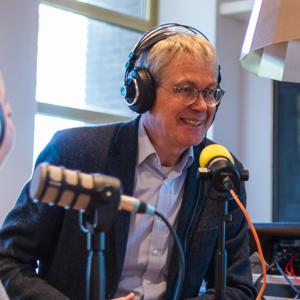
Jean-Paul Linnartz ging in gesprek met Joost van Wijmen, voor DDW 2020, in the Embassy of Health over Encounter 8.
Facebook increasingly influences how we view the world. We see the opinions of our friends responding to news that may or may not be fake. But which messages we see first and which messages remain hidden is all controlled by algorithms. Algorithms based on Artificial Intelligence. And these algorithms are the work of a large research team led by Professor Yann LeCun.
LeCun, thereby is one of the leading technologists behind one of the largest companies in the world. Facebook’s Mark Zuckerburg recognized that his ideas could really boost Facebook, when LeCun was building a formidable reputation in the academic world with his convolutional neural networks, and when already almost all handwritten checks are processed by his algorithms, but when the link between social media and AI was still unexplored. Meanwhile, social media controlled by AI are influencing our lives every day.
Philips, Signify and the TU/e awarded Yann LeCun the prestigious Holst Memorial Medial 2018. Radio4Brainport’s Jean-Paul Linnartz spoke to him on his visit to Eindhoven.
Artist, designer and researcher Danielle Roberts creates tools to enhance awareness. Tools to boost mental wellness supported by the latests Internet of Things IoT technology, also borrowing from traditional Japanse tea rituals. She participates in the World Design Embassies with her Magic Tea. An interview by Jean-Paul Linnartz.
Shahar Livne mines plastic waste to create sculptural objects. How will future generation look upon plastics waste after it mingles with other materials? A podcast interview for the World Design Embassies by Jean-Paul Linnartz of Radio 4 Brainport.
Triggered by the theme "Rethinking Plastics" of the World Design Embassies of the Dutch Design Week 2020, Iris Bekkers created a face mask that can be adapted to the infection risk, that can filter potentially contaminated air with active coal, and that can be recycled with new business model. A podcast by Jean-Paul Linnartz for Radio4Brainport.org
A skype interview with the new Treasurer of the COSMOS, the TU Eindhoven international student association.
Hosted by Limi Kalapurachal for Radio4Brainport.org.
With this landmark textbook book “Design for the Real World: Human Ecology and Social Design”, Victor J. Papanek changed our view on design. Can design make a difference? That is not a question up for debate, but necessity. We asked Prof. Alison J. Clarke why the book by Papanek is a must read for any design student.
Leon Balmaekers on Radio4Brainport.org, Eindhoven
Wireless access to the Internet is booming, but that also leads to severe congestion of the airwaves. In fact, most complaints about poor WiFI have little to do with poor coverage but rather are caused if too many people use WiFi at the same time. The EU Horizon 2020 ELIoT project is an Innovation Action to use light to communicate. These signals do not go through the wall and that turns out to be a major advantage: you are not affected by interference from others. It gives latency-free connections. Peter Simons of Radio4Brainport.org interviews the ELIoT project leader Prof. Jean-Paul Linnartz.
Finding your way immediately even if you visit a museum, a shopping mall, a hospital or an airport for the first time. Invisible codes embedded into the light can be picked up by any smartphone, and apps can provide a wealth of location based information.
Onno Janssen of Signify explains how this new technology can enhance logistics in warehouses or guide autonoumous robots.
Is social distancing of 1.5 meter adequate to avoid Corona infections? According to an alarming MIT paper, the corona virus may be carried by much smaller particles than the heavy droplet assumed thus far. The 1.5 meter norm appears to have been based om models for tuberculose, but COVID behaves differently. At Radio 4 Brainport we ask an expert in air flows, Professor Bert Blocken, about whether air flows pose an unprecedented risk in the spraed of the Virus.
Photo: 2019 archive photo of Jean-Paul Linnartz interviewing Bert Blocken. This interview on Radio 4 Brainport was recorded in March 2020, and one of the first to address the risk of aerosols.
From the publisher's feed

4 Listeners