
Sign up to save your podcasts
Or



Manage Performance
Even in crisis, especially in crisis, you have to manage performance if you want to maintain any continuity across your routine business operations. We are running lean and pulled in different directions, but:
If outcomes matter, you have to manage
If talent matters, you have to manage
If quality, safety and delivery of service or product matter, you have to manage performance.
If culture matters…
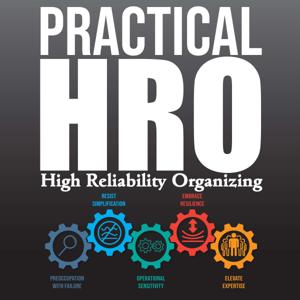
Preoccupation with Failure: Recognizes that big threats usually start as small problems.
There is nothing more important than aligning your employees, resources, and systems to meet the new reality.
Employees are likely to be the single biggest determinant in how fast and how well an organization recovers from a crisis. How you manage performance, goals, expectations and talent during the crisis will have a direct impact on your ability to move forward.
Putting people first now, protects the future.
Reluctance to Oversimplify: Look to simply the solutions do not oversimplify the threat.
Maintaining the normal functions feels normal. Which is a comfort for most people when everything is not normal.
Uniting your employees around the common goal of doing their best to run “business as usual” is a relief to people during a crisis.
Sensitivity to Operations: More can always be done to improve the function of an organization in real time.
More can always be done to improve the function of an organization in real time if you know what needs to be done. Managing performance provides leaders with a certain sense of what needs to be done.
Commitment to Resiliency: Organizations ability to adapt under stressful circumstances.
The way that you work undoubtedly changed.
It’s very likely that your traditional approach or understanding of performance management may need to be deconstructed and re-conceptualized.
You just need an abbreviated approach to managing that focuses on setting new goals and new measures …with a heavy emphasis on coaching and feedback that moves people forward.
People learn faster through feedback.
Deference to Expertise: In high reliability organizing, every individual in any and every role should be trained and encouraged to see themselves as an expert in that particular operation.
This is the time to encourage initiative and empower people at all levels of the organization.
Experts are born during crisis.
I’ll give you an example…You have teams and individual performers who are problem-solving their way out of challenges every day. You want to know who they are- you want to recognize their roles. Some of them will surprise you. You want to invest in those that are invaluable to the organization.
Another way to cultivate expertise is to invest in expertise. If you have the resources and the capacity, you should be invested in developing talent at every layer right now. You can’t know who needs what unless you are managing performance.
We were forced to adapt to change that we weren’t ready for and didn’t want.
And more change is coming, but we don’t know what it looks like or how it is going to affect us.
All of which is exhausting.
When the rate of change won’t change, we have to adjust our headspace… Otherwise …we’ll be reduced to reactive zombies.
Your organization is full of people uncertain about the future. They might be showing up every day, working from home, or furloughed. Doesn’t matter.
They might love you, hate you, trust you, distrust you…
Doesn’t matter. What matters is that you dig deep and refocus the contributors on all that we do know: who we are, why do we matter, what are we doing and are we prepared for what’s coming next. In times of uncertainty, we listen for the confidant for direction. Remind everyone that despite all that you don’t know, somethings, the most important things are certain.
Answer the questions that are going to carry you forward whether you have all the concrete answers or not.
What questions?
What do you do and what are we doing that actually matters?
Why are we doing it?
And what are we accomplishing?
The answers to these simple questions are bigger than the daily grind, of absorbing stress and fighting off all the threats.
Be vulnerable.
There is a higher order purpose to your work. Define it, communicate it and reinvigorate everyone’s headspace while we are in this weird lull.
We have a lot working against us right now.
Your 2, 3, 4 weeks into a radical transformation operations, complete re-organization of how and where. Your infrastructure's stable, but, completely consumed by disruptions.
So for that reason,
One thing, one seemingly small thing that exhausted leaders can do today is to focus on being clear and very definitively specific when communicating plans, expectations, and changes. Fatigue effects our performance especially our speech and listening capacity. It’s important to remind yourself that you are exhausted, remind yourself that you have to think differently about how you communicate right now
Preoccupation with Failure: Recognizes that big threats usually start as small problems.
Big threats are consequence of not enough words, so use clear speech, don’t start rapid firing directives, slow down, take a breath, organize your thoughts. Speak in full sentences. Outline the steps. Give context. Define the measure or clarify the boundaries.
Take the time to communicate precisely to the stressed and fatigued people around you. Look to simply the solutions do not oversimplify the threat.
Right now, it’s a mistake to believe that anything is obvious! Consider it your role right now to communicate the obvious. Do not assume that everyone knows what you know. Remember, we all have our own mental contexts and life experiences that complicate our ability to understand each other in low stress states.
Now in high stress states, we need to go to the next level when communicating. The only way to ensure that the meaning of your message is understood, is to clearly define the specifics. Organize information in simple steps and plain sentences.
More can always be done to improve the function of an organization in real time. Consider, essential employees report exposure. But, what does expose mean? My definitions of exposure, not yours? Does exposure mean that you spent 15 or more minutes within a 6’ range of someone that is waiting for a test, has tested positive or is hospitalized?
Use whatever definitions that you trust, but by defining the specifics you are accomplishing four goals:
One: Minimizing a threat to your workforce
Two: Protect scarce resources
Three: educating your working culture by offering one more clear safety standard for them to observe.
Four: By defining the ask and tasks in detail, you are more likely to realize the outcomes you have defined.
Now isn’t the time to be vague
One Small Thing - On the Same Page <-- Worksheet Link
One thing you can do today is tighten the format of your meetings.
Many of you are relying on remote conferencing to manage some of the most important conversations that you’ll ever have in your professional career. Not only that, you are relying on people to work together that quite literally may NOT be working together, for the first time.
The demands on communication, accountability, competence, risk-management and coordination are so much greater than they’ve ever been. And yet, the way we are working CAN feel out of sync with the imperatives and new reality.
In times of uncertainty, little controls that bring stability or a sense of normalcy into balance are very comforting to teams and reinforce the significance of what you are trying to collectively accomplish.
By simply asking a few questions you can ensure that the meeting participants are perfectly in-sync around a shared understanding and clear plan.
After each agenda item is discussed, take a moment to drill down on the specifics that were decided. Queue the note taker.
“What did we decide today?”
“Who owns this initiative?”
“Who is going to do what? By when?”
“Who else do we need to involve or inform?”
“Who is going to inform them?”
“What do we expect from them?” “By when?”
“What are the critical take-a-ways and the key messages to be shared?”
These simple questions close the loops, ensure that meetings are productive, that decisions are actionable, and that everyone is on the same page and armed with the details necessary to lead forward.
You have team members that you are trying to keep employed while they juggle childcare or whose roles are so radically altered by working from home that they have capacity to own process review work. Utilize these human resources to organize and update the backbone of your operations.
HRO TIP - Use Remote Work Staff to Improve/Write processes
One thing that every contributor can do while working remotely is review the processes and work instructions that define the tasks and the workflow within their department and across departments.
If you have never developed processes or work instructions, now is the time to start. All any employee has to do to begin the process is document the steps that they take to achieve any particular outcomes.
If you want your working culture to adopt an aptitude for continuous improvement, you have to cultivate it. Operational reforms are most effective and the least disruptive when they empower, recognize contributor’s expertise and make sense. Common pitfalls and obstacles companies put in front of their staff include:
Now is the time, seize the moment to attend to all of those big needs that never get the attention that they deserve. A simple set of bullet points will lay a solid foundation. Applying resources towards process reviews is an investment in achieving uncommon outcomes when everyone returns back to work.
Keep the ask simple.
Here are some tips to try if you are looking to bring HRO into your business.
HRO TIP - Wash Your Rings, Watches, Phones
Washing your hands is a must. And yet there's more to be done... jewelry, watches, fitbits, rings need cleaning. Your phone and other surfaces are other recommendations for sterilizing to lower the potential for transmission.
Background
Like millions of others around the world, we are being impacted by the Covid-19 Pandemic. If ever there was a time to be safety and quality conscious, it is right now. And although our team is not in a risk category, we're still following the rules and procedures that local and state government are providing. Despite many folks early dismissal of the novel corona virus, no one looks as though they are going to avoid disruption and impact to their lives, families and businesses.
During this crisis, we’ll be providing tips and practices that you can use to rise the level of safety and quality in your organization during and after the crisis. Practically speaking (and what may appear to be contradictory) the best time to start to implement HRO is now, crisis or not because this situation will expose the gaps and missing processes in your system.
Thanks for listening. Please practice your own version of HRO by following local government and medical leaders directives and programs, even if they don’t seem to affect you or you don’t think they apply. As in all HRO environments, working together reduces the impacts of errors and improves the potential for positive outcomes in a crisis. Wash your hands, avoid crowds and be mindful.... and safe.
Here are some tips to try if you are looking to bring HRO into your business.
HRO TIP -Staff Hotline
Set up a call in system to allow your temporary work from home staff to offer suggestions on improving processes, addressing safety and other challenges, and providing ideas and suggestions on how to better work in socially distancing situations.
Background
Like millions of others around the world, we are being impacted by the Covid-19 Pandemic. If ever there was a time to be safety and quality conscious, it is right now. And although our team is not in a risk category, we're still following the rules and procedures that local and state government are providing. Despite many folks early dismissal of the novel corona virus, no one looks as though they are going to avoid disruption and impact to their lives, families and businesses.
During this crisis, we’ll be providing tips and practices that you can use to rise the level of safety and quality in your organization during and after the crisis. Practically speaking (and what may appear to be contradictory) the best time to start to implement HRO is now, crisis or not because this situation will expose the gaps and missing processes in your system.
Thanks for listening. Please practice your own version of HRO by following local government and medical leaders directives and programs, even if they don’t seem to affect you or you don’t think they apply. As in all HRO environments, working together reduces the impacts of errors and improves the potential for positive outcomes in a crisis. Wash your hands, avoid crowds and be mindful.... and safe.
In our last major episode we interviewed Joe Bell Executive Director of the Niagara Aerospace Museum and retired aerospace industry executive. We covered a wide range of topics in our interview. We couldn’t share all of the stories and lessons in one podcast, so we’ve created a few standalone podcasts to share more of Joe’s stories.
In this mini episode, Joe shares a couple of stories from the front lines of reliability, quality and HRO. High Reliability can start long before the product is designed. By understanding how a product is used, what the users face, the environment its used in product designers and reliability engineers can not only make sure a product solves the problem its intended to deal with, but can ensure that it doesn’t create another potential crisis or failure point. Practically speaking “Unless you go out and live it, you can’t see it”.
Season 2 Episode 001
This High Reliability podcast is an interview with Mr. Joe Bell, Executive Director of the Niagara Aerospace Museum and retired Aerospace Executive. Joe has more than 4 decades of experience in quality, reliability, and culture in the Aerospace Industry. In this episode Joe offers practical insights into the 5 HRO habits, how to help teams use these habits and provides some intriguing stories from an industry insider.
Links:
Niagara Aerospace Museum: https://niagaraaerospacemuseum.org/
TReC Coworking Space: https://trecbyngti.com/
This is the season finale for this year. Many of you might be looking at some form of High Reliability implementation in the New Year and like many leaders are having a hard time identifying what’s your next (or first) step. In a slight tongue-in-check episode, we offer a collection of different HRO changes to consider, using Santa and his workshop to get you thinking outside of the toy box.
Practically speaking, HRO is hard. There is so much to consider and the challenge of knowing what effort makes the most sense first can seem as daunting as the mall the day before Christmas. Well, sit back, grab a hot cocoa and some cookies and listen to how Jolly Ole Santa Claus has built a High Reliability holiday juggernaut and give some thought to what to ask Santa for Christmas.
I hope you enjoy today's season finale and all of this years episodes. Thanks to all the listeners and followers for helping grow our podcast this year. Next year is already taking shape. We’ll be adding interviews on a routine basis. We’ll be talking with practitioners and business leaders who practice High Reliability Organizing and we’ll be continuing our focus on implementation by interviewing folks who operate in HRO industries.
HRO is a game changing differentiator for all types of businesses, but it is a challenge. Putting HRO into practice is a deeper effort than simply bringing third party training on board and then leaving the team to dig in. It takes investment, commitment and experience. If your wish list for next year includes HRO in some fashion, let’s connect. My expertise runs the gamut… I can help you chart a course forward, collaborate with the implementation team, mentor the leadership team, embed myself in an project to work side by side or I can come on board full time to lead an extensive program.
From the publisher's feed