
Sign up to save your podcasts
Or



In June 2026, the last of the top-eight Source-to-Pay suites on Gartner's Magic Quadrant quietly shipped its "AI Agent Studio".
Now, every serious procurement platform has one. But before you take any "Studio" label at face value, it's worth knowing what the term actually means...
In this minisode, Joël Collin-Demers cuts through the naming noise to the one distinction that decides your future flexibility:
A studio lets your team author its own AI agents and LLM-supported workflows, while embedded AI just lets you consume the vendor's.
You'll also get the single question to pressure-test a vendor "studio" in any demo, the four things that separate one studio from the next, and why the real work only starts after you've signed.
If you've got a platform decision or a vendor demo on the horizon, this one's for you.
Based on this week's Pure Procurement Newsletter: https://newsletter.pureprocurement.ca/p/what-is-an-ai-agent-studio
Other resources mentioned:
"What Is a Process Scope Diagram (IGOE)?": https://newsletter.pureprocurement.ca/p/what-is-a-process-scope-diagram-igoe
Agentic business process management: https://newsletter.pureprocurement.ca/p/procurement-business-process-management
Every agentic procurement platform you're evaluating runs on a large language model it rents from a provider you've never assessed... And most vendors won't tell you which one unless you ask.
This minisode makes the case that the model behind your platform is a strategic supplier (one you'd never let into your supply base unvetted).
Joël Collin-Demers breaks down the four forces pushing procurement toward "Bring-Your-Own-LLM" (cost, performance, data security and control), points to the enterprise vendors that already shipped it, and gives you three questions to put in your next software RFP while asking them still costs a conversation instead of your leverage.
For procurement and IT leaders with an agentic platform in evaluation, or a vendor already in the inbox promising AI agents.
Subscribe to The Pure Procurement Newsletter for more content like this: https://newsletter.pureprocurement.ca/subscribe
Reports referenced in this episode:
LayerX, Enterprise AI & SaaS Data Security Report 2025: https://go.layerxsecurity.com/hubfs/LayerX_Enterprise_AI_and_SaaS_Data_Security_Report.pdf
Cyberhaven, 2026 AI Adoption & Risk Report: https://info.cyberhaven.com/hubfs/Webflow_Resources/Cyberhaven-AI-Risk-Report-2026.pdf
Your sourcing platform doesn't save a dollar until suppliers bid. Your risk tool doesn't flag anything until suppliers submit their information. Your P2P doesn't touch a transaction until suppliers transact.
For most procurement technology, supplier enablement is the "long pole in the tent"... The thing everything else depends on.
And it's the one part of the project you have no authority over.
In this minisode, Joël Collin-Demers explains why internal change management is the easy half, why every supplier login screen is a leak in your business case, and walks through six questions to pressure-test any vendor selling you a "modern supplier onboarding" experience.
If you're mid-implementation and wondering why supplier data went stale the week after go-live, or you've got a supplier management demo on the calendar, this is your prep.
Based on the following edition of The Pure Procurement Newsletter: https://newsletter.pureprocurement.ca/p/supplier-portals-are-obsolete
If you're relying on a flat fee monthly AI subscription to keep costs predictable, you're one usage spike away from a renewal conversation you didn't see coming.
This week, Joël Collin-Demers breaks down the four-step pricing playbook every major LLM provider is running right now (the same one cloud vendors used a decade ago) using Uber's and Microsoft's own AI budget blowouts as the evidence.
You'll walk away with the exact questions to put in front of your next AI vendor before a flat monthly fee turns into a usage-based bill nobody predicted.
For procurement and finance leaders standardizing on a frontier AI provider, or about to face a ProcureTech vendor's new AI-powered features for the first time.
Based on this week's Pure Procurement Newsletter: https://newsletter.pureprocurement.ca/p/the-golden-age-of-cheap-ai-is-ending
Other sources referenced:
Uber AI spending cap (Simon Willison, citing Bloomberg): https://simonwillison.net/2026/Jun/3/uber-caps-usage/
Microsoft cancels Claude Code licenses (Forbes, ties Uber + Microsoft together): https://www.forbes.com/sites/jonmarkman/2026/06/01/microsoft-ends-claude-code-licenses-as-it-pushes-copilot-cli/
Hidden cloud storage cost survey, 403 IT decision-makers (Backblaze, citing Dimensional Research): https://www.backblaze.com/blog/the-hidden-cost-of-cloud-storage-what-400-it-leaders-wish-they-knew-sooner/
Everyone at every procurement conference this spring said the same thing: "AI agents are the answer to procurement's problems..."
Almost nobody could tell you the question.
This week Matt and Joël cut through the noise with a working definition of what an AI agent actually is built on five components: trigger, outcome, guides, enablers, and process.
From there, they lay out three heuristic questions to run before deploying an agent anywhere near your procurement process:
Is the path to the outcome actually ambiguous?
Is a directionally-correct output recoverable if it's wrong?
Are your guardrails defined well enough to constrain it?
Plus: what the Anthropic-Salesforce stack battle signals about who owns the workflow layer, and more evidence of the ongoing convergence in procurement tech (Vendr/Vertice, Tropic/Omnea, Coupa/Rossum/Tonkean).
This one's for procurement and IT leaders who keep hearing "AI agent" in every vendor pitch and want a real framework for deciding when that's actually the right tool... Not just the current buzzword.
That 6-month implementation timeline in your business case? It's not a forecast. It's a wish.
In this episode, Joël Collin-Demers breaks down why ProcureTech projects almost never hit their original timeline...
It's not because people are incompetent. It's because of how we build estimates in the first place.
You'll get a clear explanation of the planning fallacy, an introduction to Reference Class Forecasting, how to apply it before your next technology deployment, and a frank look at why the RFP process itself is designed to make the problem worse.
If you have a ProcureTech vendor evaluation coming up (or a business case that needs to go to the CFO), this one's for you.
Based on the Pure Procurement Newsletter, published March 22, 2026: https://newsletter.pureprocurement.ca/p/reference-class-forecasting
"AI will transform procurement." Sure. But which kind of AI? Doing what, exactly?
That question is at the heart of this episode. We cover three AI subdomains procurement professionals should actually understand — Natural Language Processing, Computer Vision, and Anomaly Detection — including what each one does well, where it breaks down, and where it shows up in procurement today.
We also cover something more important: how modern AI systems like Claude, ChatGPT, and Gemini work by layering multiple types of AI together depending on the problem they're solving. And why that makes "it's powered by AI" one of the least useful things a vendor can tell you.
If you work in procurement and you're being pitched AI solutions, this episode gives you the vocabulary to ask better questions.
Based on the following edition of The Pure Procurement Newsletter: https://newsletter.pureprocurement.ca/p/10-ai-subdomains
Most procurement platform decisions get made for the wrong reasons — and by the time you realize it, you're already in implementation.
In this episode, Joël Collin-Demers breaks down the only factor that actually matters for your ERP vs. S2P decision: your industry. Not your vendor relationships. Not your IT team's preferences. Your industry.
You'll get two diagnostic scores you can run to compare architecture scenarios, a breakdown of how the right architecture looks completely different for direct vs. indirect businesses, and the two principles that resolves most procurement platform architecture debates before they start.
If you're in a procurement or finance leadership role and you have a technology decision coming up — or a vendor in your inbox — this one is worth your time.
Based on this week's edition of The Pure Procurement Newsletter: https://newsletter.pureprocurement.ca/p/procurement-system-setup-by-industry
The procurement technology landscape is evolving faster than ever, and separating signal from noise has never been harder.
In our debut episode, hosts Joël Collin-Demers and Matthew Buckingham dig into what's actually shaping the ProcureTech market right now.
Market Signals:
SAP's pivot toward becoming an AI company and what that means for your contracts and your architecture decisions. Link: SAP's Latest API Policy
Breaking down Deloitte's State of AI in the Enterprise 2026 study (3,200+ respondents across 24 countries) and what it reveals about why most organizations are still stuck.
Deep Dive:
Joël makes the case that the old S2P Suite vs. Intake & Orchestration debate is officially dead, and what you should be evaluating instead.
Rapid Fire:
An Overrated/Underrated round covering everything from supplier portals to reverse auctions to procurement's obsession with being "strategic."
Other Links Discussed:
Kevin Kelly’s book - The Inevitable
Epoch AI
ArtificialAnalysis.ai
If you're a procurement leader trying to make smarter bets on technology, this is the show for you.
Subscribe to The Pure Procurement Newsletter for more weekly ProcureTech insights
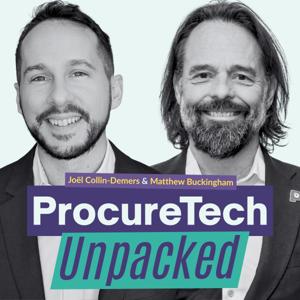
Meet Joël Collin-Demers and Matthew Buckingham.
One brings 15 years of procurement technology deployment. The other brings 20 years in the enterprise procurement space in global organizations.
Together, they're launching ProcureTech Unpacked—a podcast for procurement leaders drowning in vendor hype and conflicting advice.
Each month, deep dives into current technology trends. Weekly recaps of the Pure Procurement newsletter in between.
No vendor spin. Just balanced answers.
The first full episode launches June 12th: The 2026 State of Procurement Technology.
Subscribe now.
From the publisher's feed